CCL: https://rb.gy/jbjm1
We sincerely hope that each of you, our readers, will greatly enjoy and appreciate this article we present about these 5 Regal Mammals of Russia. It was certainly our great pleasure to compile the various information for you. May it provide you with both education and increased awareness.
Obviously, these few species listed herein represent only a small portion of the natural wonders found throughout the region, though. Yet, it’s our belief that they serve as excellent representations of the wonders found here. Check out some of our many other articles for similar marvels.
Moose
Moose Facts
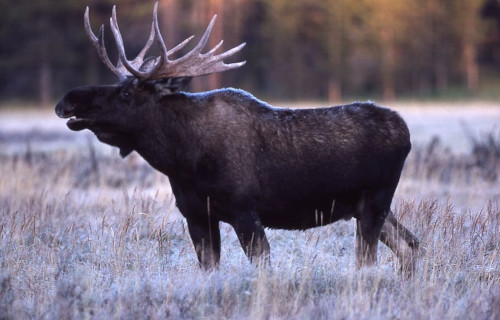
- Starting off this article about these 5 Regal Mammals of Russia we present you with the majestic creature best known simply as the Moose.
- This massive and magnificent mammal most frequently goes by the simple name used here within a certain portion of its range. Intriguingly, however, this wonder holds a very different common name in another part of its territory. That’s the equally short moniker of Elk.
- Inside of the scientific community, though, the animal remains generally much better known by its technical title. Thankfully for the layperson, that’s an extremely simple term to pronounce compared to most. That’s because it currently holds the formal title of Alces alces.
- The remarkable creature received that easy to pronounce name due to the efforts of Carl Linnaeus. The Swedish zoologist accomplished the first official recognition of it as a separate and distinct species. That scientifically noteworthy event occurred in the year 1758.
- Regardless of which of these monikers one chooses to use, it remains a highly impressive species. It also stands out from its kindred for several reasons. Perhaps most impressively, it’s the largest extant species within the deer family. It’s also the only known member of its genus.
- Luckily, the Moose seems to be maintaining a sizeable and comparatively stable population. That pleasant situation further appears to hold true throughout its entire habitat range. The IUCN, therefore, currently lists it as Least Concern on its Red List of Threatened Species.
- The majestic creation of evolution nevertheless faces the same multiple potential threats to its existence as most species. Most of these dangers stem from the actions of humans. These perils include such dangers as habitat loss due to human expansion and climate change.
Moose Physical Description
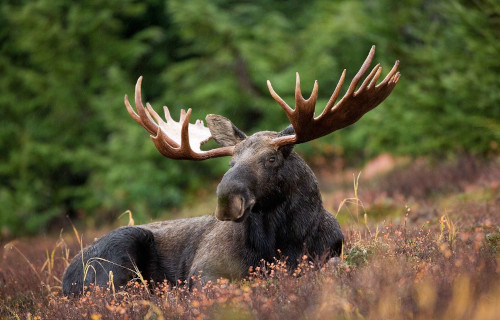
The undeniably incredible Moose clearly distinguishes itself from all other presently known varieties of deer. Obviously, its most attention-grabbing attribute is its size. Yet it certainly holds the appreciation of Nature lovers due to its appearance, as well. Nature truly blessed this marvel.
Though larger than its relatives, this marvel follows a similar pattern regarding its nature. That’s the fact that the animal displays a moderate degree of the physiological characteristic of sexual dimorphism. In its case, this natural trait manifests itself in not one, but two distinct manners.
In terms of pure size, males of the amazing species attain greater average measurements than do their female counterparts. Males reach a height at the shoulder ranging from roughly 4.5 – 7 ft (1.4 – 2.1 m). These behemoths also range in weight from an incredible 838 – 1,543 lb (380 – 700 kg)!
Females of the creature, however, reach noticeably smaller dimensions in both of these categories. This gender typically boasts masses ranging from 441 – 1,080 lb (200 – 490 kg). Their overall body height and length also remain accordingly smaller than the males of the remarkable Cervidae.
The nose of both sexes additionally stands out from others of its kind, too. It’s unique among living cervids due to its significantly greater length, relative to body size. The stunning creature also evolved an adaptation allowing it to seal its own nostrils when feeding on aquatic vegetation.
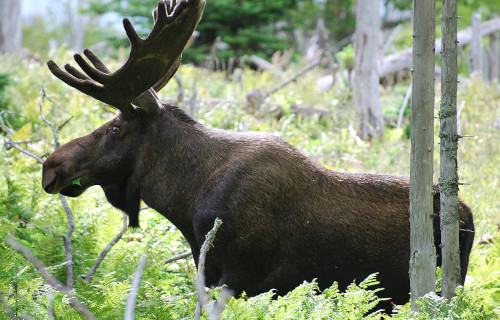
Its the antlers of the breathtaking Moose that most separate the genders, however. Females lack this distinctive feature entirely. Among males, though, these reach impressive dimensions. This varies with age and range, but averages an extraordinary 79 in (2 m) among healthy, mature adults!
- Kingdom: Animalia
- Phylum: Chordata
- Class: Mammalia
- Order: Artiodactyla
- Family: Cervidae
- Genus: Alces
- Species: A. alces
CCL: https://rb.gy/1xko9
Moose Distribution, Habitat, and Ecology
The extraordinary Moose evolved as native to an extremely wide expanse of the surface of the globe. The full extent of that territory surprises many people. That’s because the intriguing mammal developed as endemic to sections of North America, Europe, and even a small part of Asia.
In North America, that native territory covers virtually all of Canada. It also appears in Alaska, and the most northerly portions of the United States. In Europe, though, the awesome mammal lives in such countries as Sweden, Norway, and Finland. But in Asia, it’s mainly confined to Russia.
The fascinating creatue also evolved very precise preferences regarding its choice of habitat. As a general principle, individuals avoid regions with little or no snow. Its evolutionary cold-adaptations make this a basic necessity. Specimens typically try to avoid the hotter regions for that reason.
The creation of Nature also naturally requires the presence of sufficient vegetation of the right kind. The species most commonly prefers sub-alpine areas where possible, in early winter. During the latter part of that season, however, examples usually move to river valleys with deciduous forests.
The mighty Moose evolved as what’s known as a browsing herbivore. It feeds opportunistically on an extremely wide variety of flora. This includes such fare as aquatic plants, fruit, and tree shoots. The average adult individual actually consumes approximately 71 lb (32 kg) of food per day!
The massive mammal understandably typically has few natural predators, due to its great size. Only siberian tigers hunt mature individuals solo. Packs of wolves sometimes will do so as a group, though. In certain parts of its range, black bears and cougars sometimes prey on the calves.
Mountain Hare
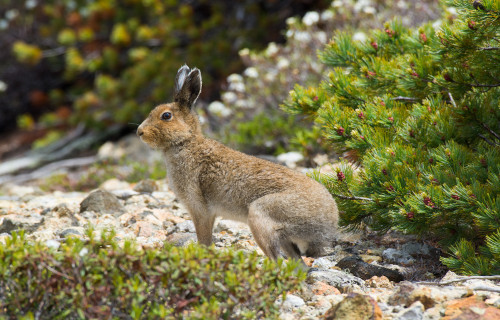
CCL: https://tinyurl.com/462rnnjn
Mountain Hare Facts
- Next up in this compilation of 5 Regal Mammals of Russia comes the precious work of Nature appropriately named the Mountain Hare.
- This beautiful small mammal most frequently goes by this informative common name throughout much of its native range. Yet, the wonder of Nature does have several other general titles. These options include tundra hare, blue hare, white hare, Irish hare, and alpine hare.
- Within the scientific community, however, the mammal’s possibly significantly better known by its purely technical designation. Fortunately for the layperson, that’s a comparatively simple one to pronounce. That’s because the marvel holds the official epithet of Lepus timidus.
- This beautiful creature received that designation due to the efforts of Carl Linnaeus himself. The highly esteemed Swedish researcher recorded the first acknowledgement of it as a separate and distinct species. He achieved that scientifically noteworthy deed in the year 1758.
- Thankfully, the remarkable Mountain Hare appears to be maintaining a population base that’s both stable and sufficient. This pleasant state also seems to hold true across its entire range. The IUCN thus currently shows it as Least Concern on its Red List of Threatened Species.
- The gorgeous animal nevertheless still faces the same potential threats to its continued existence as all species on earth today. Like the rest of us, most of those stem from the actions of man. They include the closely related perils of habitat loss and ongoing climate change.
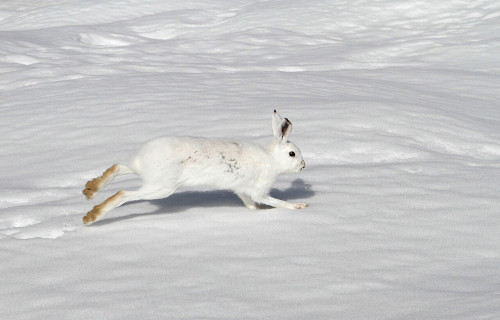
CCL: https://tinyurl.com/bdes27an
Mountain Hare Physical Description
The amazing Mountain Hare, like many of its numerous relatives across the globe, captures the attention of most people lucky enough to encounter it. This specific example of its kind, though, does so for several reasons. That’s true since it’s not just lovely, but also slightly larger than average.
In regards to purely physical measurements, this beautiful creature follows the same evolutionary path as its countless brethren. That’s demonstrated by the fact that it displays a certain degree of the phsyiological characteristic of sexual dimorphism. In its case, though, it’s a small amount.
Technically, males of the species tend to achieve slightly greater average sizes than females. The total difference, however, remains so slight as to not always easily discernible without close examination. In general, males and females of this mammal thus exhibit similar characteristics.
In terms of overall length, individuals of both genders reach approximately the same mean range of head-and-body measurement. This trait varies somewhat, though, from about 18 – 26 in (45-65 cm). The short, relatively bushy tail also adds an average of about 1.5 – 3 in (4 – 8 cm) to this.
Body masses sometimes vary more noticeably between the sexes, however. Taken together, this aspect of the animal generally ranges from 4.5 – 11.75 lb (2 – 5.3 kg). On this scale, females typically tend to be on the higher end, while their male counterparts most commonly appear on the lower.
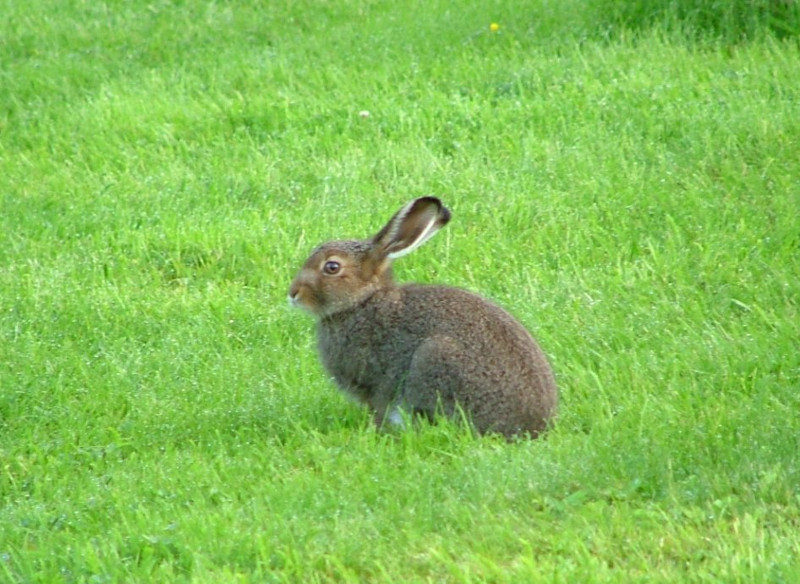
Yet, it’s doubtless the literally eye-catching coloring of the gorgeous Mountain Hare that usually garners the most interest among observers. During the summer months, this consists of various shades of brown. In winter, however, this changes to pure or mostly pure white for camouflage.
Otherwise, the stunning hare also possesses comparatively long, distinctive ears, often black-tipped. Its eyes develop as large and round, positioned on the sides of its head to provide a wide field of vision. Its feet also have a dense covering of fur, and the hind feet grow larger than the front.
- Kingdom: Animalia
- Phylum: Chordata
- Class: Mammalia
- Order: Lagomorpha
- Family: Leporidae
- Genus: Lepus
- Species: L. timidus
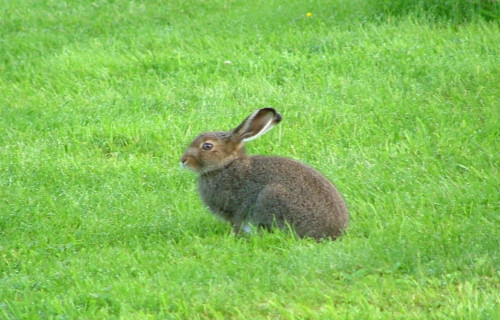
CCL: https://tinyurl.com/33psz7af
Mountain Hare Distribution, Habitat, and Ecology
Luckily, it’s still widespread across much of Eurasia. The mammal inhabits regions from Scandinavia to Eastern Siberia, including countries such as Norway, Sweden, Finland, Russia, and East Europe. It’s also found in Scotland and Ireland. In Asia, it’s also seen in China, and Mongolia.
Nature further blessed this natural wonder with a moderate degree of flexibility regarding its choice of habitat. It’s therefore found in a wide variety of habitats within its territorial range. These do, however, tend to share certain traits that the animal clearly prefers in its place of residence.
As its very name implies, this wonder of Nature and evolution obviously favors upland and mountainous areas. In these locations, the wonder seeks out habitats with a favorable mix of open spaces and cover. This includes such settings as heathland, moorland, alpine meadows, and tundra.
While it principally prefers open areas, the small mammal also requires at least some vegetation cover for shelter and protection from predators. It frequently appears in locations hosting sparse shrubs, grasses, heather, and various other low vegetation where it’s possible to both hide and nest.
Given its demonstrated preference for mountainous regions, altitude also plays an important factor in its selection of where to live. The amazing hare evolved as perfectly adapted to colder climates and often shows up at elevations ranging from sea level to over 9,800 ft (3,000 m) above that.
Given its very nature, the wondrous Mountain Hare also evolved as herbivorous in nature. The precise compostion of its diet varies, though, depending on the nature of the precise region of each individual. In some areas, this largely consists of grasses, while in others it’s mostly twigs and bark.
The hare’s also crepuscular, meaning it’s most active during the periods of dawn and dusk. It’s known for its amazing agility and speed, used to evade predators. During the day, it usually rests in forms, shallow depressions in the ground or under vegetation, where it remains well hidden.
Breeding season for this remarkble animal occurs from the month of January to August, with peak activity occurring in spring and early summer. Females generally give birth to litters of young known as leverets, which, intriguingly are born fully furred, and with their small eyes completely open.
Eurasian Brown Bear
CCL: https://rb.gy/jbjm1
Eurasian Brown Bear Facts
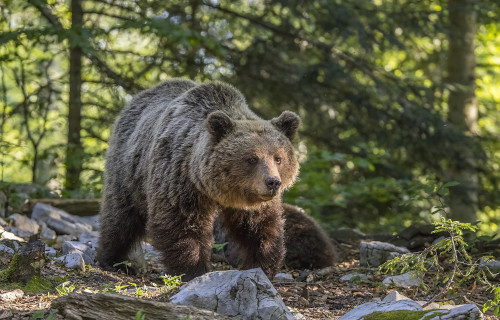
- Our next choice for inclusion in this listing of these 5 Regal Mammals of Russia bears the fully fitting title of Eurasian Brown Bear.
- This impressively large and majestic land mammal most frequently goes by the informative common name for the obvious reasons. The wonder does have alternate titles, though. These include the terms common bear, common brown bear, and European brown bear.
- In the scientific community, however, the animal is likely significantly better known by its scientific title. Fortunately, that’s a relatively easy name for the layperson to pronounce. That’s because this marvel of Nature holds the purely technical moniker Ursus arctos arctos.
- This amazing animal received that interesting name due to the efforts of the highly esteemed Carl Linnaeus. The eminent Swedish zoologist accomplished the first official recognition of the beautiful creature. He managed that scientifically noteworthy deed in the year 1758.
- Technically, this product of evolution represents a subspecies of the brown bear. In fact, it’s one of the most common of all known subspecies of the parent species. Visually, it’s quite similar to the other, making it difficult for anyone but experts to tell them apart with the eye.
- Thankfully, the Eurasian Brown Bear appears to be maintaining large and stable population base. That pleasant situation further seems to hold true throughout the entirey of its natural range. The IUCN thus now lists it as Least Concern on its Red List of Threatened Species.
- The carnivore nonetheless faces several potential threats to its continued existence as a species, at least. These dangers include such perils as habitat loss and illegal hunting. The greatest danger facing it, though, likely consists of the effects of ongoing climate change.
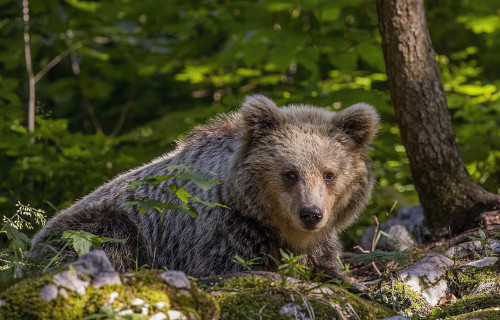
CCL: https://rb.gy/ihdl2
Eurasian Brown Bear Physical Description
The wondrous Eurasian Brown Bear immediately draws the attention of anyone fortunate enough to encounter it in the wild. Certainly, it’s a beautiful mammal, of course. Yet it principally garners attention due to the sheer size that the species remains capable of reaching in some cases.
It additionally follows a pattern that’s well established by its many kindred found around the world. That’s in the fact that it displays a certain degree of the physiological characteristic of sexual dimorphism. In its specific case, this natural trait manifests itself mainly in physical measurements.
More exactly, males of the species typically attain a larger size than their female counterparts. This extends to both weight and length of body. The males sometimes reach a total length equaling up to 8.2 ft (2.5 m). Female specimens, however, usually reach somewhat shorter lengths than this.
Weights also naturally differ markedly between the sexes, given these facts. Males typically range from around 550 – 660 lb (250 – 300 kg). A few mass as much as 1,060 lb (481 kg), though. Meanwhile, the females of the animal generally range in mass from 331 – 550 lb (150 – 250 kg).
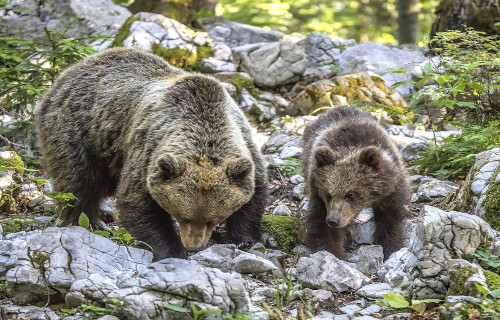
Both genders of the stunning Eurasian Brown Bear display the same general pattern of coloring. That consists of brown fur that covers the entirety of the body, save for the soles of the feet. The shades of this coat vary between specimens, ranging from yellow-brown to almost black.
The relatively largely head also develops as highly rounded in shape. The ears develop as comparatively small, and rounded as well. Its powerful jaw holds 42 extremely sharp, predatory teeth. The mighty animal also possesses strong, sharp claws that reach up to 3.9 in (10 cm) in length.
- Kingdom: Animalia
- Phylym: Chordata
- Class: Mammalia
- Order: Carnivora
- Family: Ursidae
- Genus: Ursus
- Species: U. arctos
- Subspecies: U. a. arctos
CCL: https://rb.gy/xgf1f
Eurasian Brown Bear Distribution, Habitat, and Ecology
The captivating Eurasian Brown Bear evolved as endemic to a large portion of the surface of the globe, relatively speaking. Given its name, the location of that zone of habitation comes as no surprise. As alluded to, the animal inhabits the majority of the continents of Europe and Asia.
Within that greater range, however, its current presence appears to be sporadic. The largest known concentration presently exists in Russia. Other groupings appear in such countries as Greece, Serbia, Poland, Turkey, Albania, and along the border between France and Spain, among others.
Nature and evolution did provide this mammalian marvel with an impressive adpatability regarding its choice of habitat. That’s so far served it well in its struggle to survive. Generally speaking, though, it often lives in regions composed of wetlands, sparsely vegetated areas, and grasslands.
Yet perhaps its most highly favored type of environment is even more specific. That’s due to the fact that the largest percentage of individuals choose to make their home within areas of mountain woodlands. It typically does tend to avoid the highest altitudes however, due to the scarcity of food.
Intriguingly, the dietary habits of the Eurasian Brown Bear today aren’t what they once were. In the past, studies showed that meat comprised about 80% of its diet. Today, though, that only forms about 10-15% of it. The notable change likely occurred due to reduced number of prey animals.
Being technically omnivorous, the large mammal mainly feeds on large quantities of roots, seeds, insects, fruit, and fish. When it does eat meat, the powerful predator seems to favor sheep. Yet it also feeds opportunistically, having no qualms about eating carrion when it comes across it.
Wisent
CCL: https://tinyurl.com/4883uvy3
Wisent Facts
- Now appearing in this compendium of 5 Regal Mammals of Russia we give you the powerful wonder known simply as the Wisent.
- This magnificent mammal is most frequently known by the quite short common name given herein across most of its native range. Yet, the marvel of Nature also has other general titles, too. These include such terms as European buffalo and European wood bison.
- Inside of most scientific circles, however, it’s possibly typically much better known by its entirely technical label. Thankfully, that’s a comparatively simple one for the average layperson to pronounce. That’s because it holds the offical epithet of Bison bonasus.
- The impressive animal received that short moniker due to the efforts of Carl Linnaeus. The highly esteemed Swedish researcher accomplished the first formal recognition of it as a separate and distinct species. He managed that scientifically noteworthy feat in 1758.
- It stands out for several reasons. It represents one of only two known surviving members of its Genus. The remarkable creature additionally constitutes the largest wild land animal on the continent it’s native to. These two facts alone merit respect and appreciation.
- Sadly, during the early 20th century, humans hunted his amazing product of Nature and evolution to extinction in the wild. Captive breeding programs did preserve the stunning species, albeit in captivity. Later, though, officials re-introduced some individuals to the wild.
- Today, the wild population of the Wisent still only numbers a few thousand. These also only appear in a tiny portion of its previous range. The IUCN thus presently lists this powerful work of Nature as Near Threatened on its published Red List of Threatened Species.
- Obviously, the awesome fauna still faces numerous threats to its continued existence as a species. Not surprisingly, however, most of these stem from the actions of mankind. Those dangers include such perils as habitat degradation and the effects of climate change.
Wisent Physical Description
The wondrous Wisent instantly captures the attention and appreciation of those individuals fortunate enough to view one of these wonders. Unlike some creatures, however, it doesn’t solely do so due to its visual appeal. That’s true since it’s also an extremely large species of bovine.
Following a pattern common to most mammals, thhis behemoth displays a certain degree of the physiological trait of sexual dimorphism. In its case, though, this characteristic manifests itself purely in terms of sheer size. When it comes to appearance, the genders appear the same.
Males of the species typically attain greater average measurements in both length and weight. They generally range in body length from 9.2 – 10.8 ft (2.8 – 3.3 m). In height it averages 5.9 – 6.9 ft (1.8 – 2.1 m) at the shoulder. A mean body mass ranges from 1,356 – 2,028 lb (615 – 920 kg).
Females, though, achieve markedly smaller measurements. For them, 7.9 – 9.5 ft (2.4 – 2.9 m) represents an average length of body. Meanwhile, their own shoulder height usually ranges from 5.5 – 6.5 ft (1.69 – 1.97 m). They reach a mean weight ranging from 935 – 1,396 lb (424 – 633 kg).
Exceptional specimens of this wonder nevertheless do sometimes occur, as well. Yet, when these do, even they rarely exceed these measurements by much. In the past, though, many grew far larger. In fact, records exist of scattered male individuals sometimes reaching 4,200 lb (1,900 kg)!
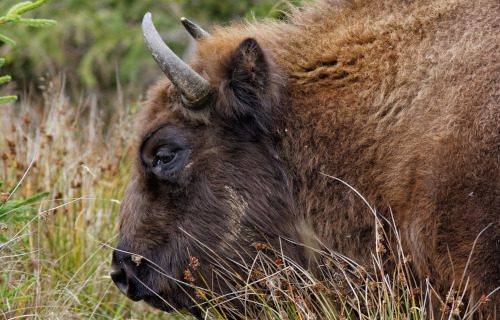
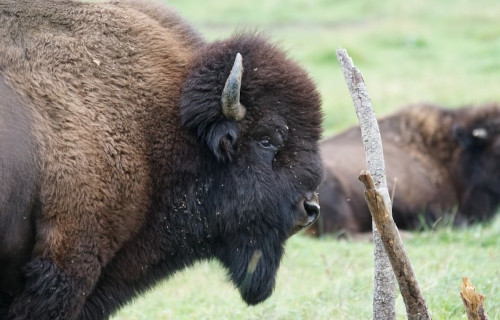
Otherwise, both sexes of the amazing Wisent present the same overall appearance to the observer, except for sexual organs, of course. Generally, the fur of the animal develops as quite thick. It also displays varying shades of dark brown. This also usually grows longer on the front of the body.
The astonishing mammal additionally develops comparatively thick horns. Unlike some related species around the world, though, male and females alike produce these intriguing features. Each attains a length of around 2 ft (0.6 m), and shows a curved shape and deep black color.
- Kingdom: Animalia
- Phylum: Chordata
- Class: Mammalia
- Order: Artiodactyla
- Family: Bovidae
- Genus: Bison
- Species: B. bonasus
CCL: https://tinyurl.com/4883uvy3
Wisent Distribution, Habitat, and Ecology
The understandably attention-grabbing Wisent evolved as native to a relatively large expanse of the surface of the earth. That zone of habitation originally extended as far west as France, in Europe, to as far east as the portion of Russia in Asia. Now, though, it only lives in a tiny part of that.
Following its being hunted to extintion in the wild, captive breeding programs released small numbers back into the wild in several countries. Those consisted of Lithuania, Poland, Russia, Belarus, Slovakia, and Ukraine. It’s unknown if the bovine moved beyond that on its own.
The magnificent mammal flourished until the intervention of man, partly due to its nature. That’s true since it developed a moderate degree of flexibility regarding its choice of habitat. It mainly inhabits areas formed of deciduous or mixed forests. Yet, it also often appears in meadows.
The largest single known grouping of the remarkable creature today currently resides within the confines of the beautiful Białowieża Forest. Straddling the borders of the nations of Poland and Belarus, it currently serves as home to an estimated 800 specimens of this true marvel of Nature.
The amazing Wisent also evolved to live as a herd animal, like many of its relatives. Herd size depends largely on local environmental factors, but averages 8 – 13 specimens. Despite the small numbers, most herds do not function as family units, but more like very loose associations.
This wondrous animal also feeds entirely as a herbivore, just like other bovines. The majority of its diet consists of various locally available grasses. Yet, leaves and shoots frequently augment this in smaller quantities. It also consumes these in vast amounts, up to as much as 71 lb (32 kg) per day.
Given its impressive size, this product of evolution possesses few natural predators itself today. As recently as the 19th century, however, a few animals managed the feat on occasion. These consisted of bears, tigers, lion, and wolves. These typically preyed on the old, sick, or young, though.
Eurasian Red Squirrel
CCL: https://tinyurl.com/22y23f9m
Eurasian Red Squirrel Facts
- Closing out this article about these 5 Regal Mammals of Russia is the beautiful small creature named the Eurasian Red Squirrel.
- This gorgeous creation of Nature and evolution most frequently goes by the descriptive and informative common name due to obvious reasons. Yet, in many parts of the animal’s territory, it’s also sometimes simply called by the shorter title of the Red Squirrel.
- Inside of many scientific circles, however, it’s perhaps significantly better known by its technical title. Thankfully, that’s a comparatively easy term for the average layperson to pronounce. That’s because the lovely animal holds the official moniker of the Sciurus vulgaris.
- The beautiful creature received that short appellation due to the efforts of Carl Linnnaeus himself. The eminent Swedish zoologist accomplished the first recognition of it as a separate and distinct species. He manged that scientifically noteworthy deed in the year 1758.
- Research indicates that the numbers of this marvel of Nature recently declined dramatically. Many experts attribute that to the introduction of a related species from another part of the world into its range. For the moment, its numbers do seem to be stabilizing, though.
- Fortunately, despite this situation, its overall population appears to still be sufficient. Even with the recent developments, that condition also seems to hold true in most sections of its range. The IUCN thus still lists the natural wonder as Least Concern on its published Red List.
- The small rodent nevertheless continues to face multiple, ever-increasing threats to its continued existence as a species. Most of these dangers stem from the actions of mankind. These perils include the closely related threats of habitat loss and ongoing climate change.

Photo: Blondinrikard Fröberg
CCL: https://tinyurl.com/22y23f9m
Eurasian Red Squirrel Physical Description
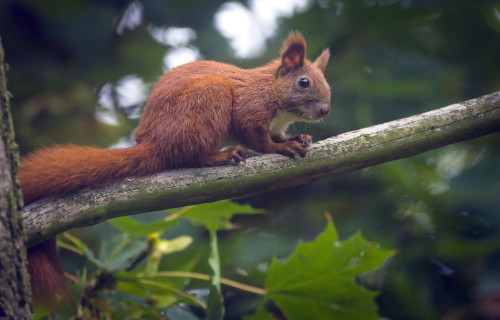
This breathtaking small mammal almost instantly captures the attention and interest of those fortunate enough to encounter it. Like its many relatives situated around the world, though, it typically does so more for its appearance, than because of any impressive measurements.
In terms of dimensions and outward form, it follows a pattern shared by those related species. That’s in the fact that, unlike many species, it displays no noticeable degree of the physiological characteristic of sexual dimorphism. Telling the sexes apart can be difficult for the observer.
Overall, individuals of both genders of this marvelous animal attain average head-and-body lengths equaling approximately 7.5 – 9 in (19 – 23 cm). The tail also adds an extra mean length of 6 – 8 in (15 – 20 cm). It’s therefore slightly smaller than the Eastern Gray Squirrel in the United States.
Weights for both sexes of the beautiful creature also remains roughly equal, at least as a general principle. During pregnancy, however, females understandably exceed that temporarily. Otherwise, an average mass for fully mature adults measures around 0.56 – 0.75 lb (0.25 – 0.34 kg).
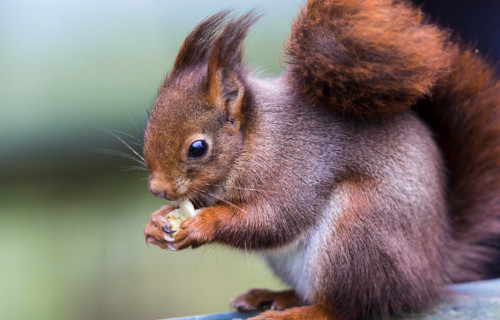
It’s the color of the aptly-named Eurasian Red Squirrel that usually garners the most interest among its admirers, though. Yet, despite the implications of the name, the animal isn’t always red in color. This pecific aspect varies in color due to both season of the year and geographical location.
Between these different factors, however, a certain range nonetheless remains prevalent. The shades it manifests on the back, sides, and head run from the namesake red, the most common, to as dark as black! Regardless of which of these appear, though, the stomach always shows an of-white.
- Kingdom: Animalia
- Phylum: Chordata
- Class: Mammalia
- Order: Rodentia
- Family: Sciuridae
- Genus: Sciurus
- Species: S. vulgaris
CCL: https://tinyurl.com/ysjddhbz
Eurasian Red Squirrel Distribution, Habitat, and Ecology
The beautiful Eurasian Red Squirrel evolved as native to a moderately large expanse of the surface of the earth. The location of that general zone of habitation isn’t surprising to many people, though. After all, the very name of this biological masterpiece indicates where that territory lies.
As implied, the awesome creature developed as endemic to a portion of both Europe and Asia. On the continent of Europe, the eye-catching rodent lives across most of its expanse. In Asia, though, it primarily appears in the more northerly parts of that particular part of its native range.
The remarkable fauna displays a decidedly strong degree of flexibility regarding its choice of habitat type. That’s true since it’s well known to inhabit multiple different ecosystems in various parts of the overall range. This high level of adaptability represents a powerful evolutionary advantage.
In both southern and western Europe, it mainly lives in areas of coniferous forests. These allow for a good mixture of shrubs and trees. In northern Europe and parts of Asia, however, the rodent often lives inside of coniferous forests. Here, it shows a clear preference for several types of pines.
The amazing Eurasian Red Squirrel developed as principally solitary in terms of its nature. The exceptions to this mostly consist of breeding season and occasionally sharing a nest for warmth in winter. These small, dome-shaped nests the animal generally constructs in the forks of trees.
The lovely mammal also evolved as almost entirely herbivorous in its dietary preferences. It principally consumes various seeds, nuts, berries, flowers, shoots, and even tree sap. Yet, on rare occasions, it’s even known to feed on the eggs of birds, or even on the young hatchlings.
CCL: https://rb.gy/ihdl2
5 Regal Mammals of Russia
We legitimately hope that each of you fully enjoyed reading, and hopefully learning something from, this article we’ve written about these 5 Regal Mammals of Russia. It’s also our fervent hope that doing so has left you with either a new or renewed appreciation for such wonders of Nature.
Unfortunately, however, many of their innumerable kindred around the world now find themselves facing strong threats to their continued existence as a species. Many of those dangers, in fact, stem from the actions of mankind. We must each do all we can to protect and preserve them all.
Check out our other articles on 7 Incredible Insects of Europe, Africa’s Many Geological Masterpieces, 4 Herbaceous Plants of England, The Mighty Tornado, 3 Remarkable South American Reptiles










Leave a Reply