CCL: https://tinyurl.com/mrx5uknb
We sincerely hope that each of you, our readers, will enjoy and appreciate this article we present about these 5 Remarkable Raptors of Asia. It was certainly our great pleasure to compile the information for you. May it serve to provide you with both education and increased awareness.
As amazing as they are, these few species listed herein represent only a portion of the natural wonders found throughout the region, though. Yet, it’s our belief that they serve as excellent representations of the wonders found here. Check out some of our other articles for similar marvels.
Snowy Owl
CCL: http://bit.ly/2REt4fw
Snowy Owl Facts
- Starting off this article about these 5 Remarkable Raptors of Asia we present the well-traveled wonder called the Snowy Owl.
- This breathtaking winged wonder most frequently goes by the fully descriptive common name that we’re using across much of its range. Yet, the stunning animal does have a few other general titles. These include the short terms white owl, Arctic owl, and polar owl.
- Within the scientific community, however, it’s likely more often referred to by its technical moniker. That tag, though, like many such, remains somewhat difficult for the layperson to pronounce. That’s because the bird bears the formal epithet Bubo scandiacus.
- This magnificent product of evolution received that designation due to the efforts of Carl Linnaeus. The esteemed Swedish biologist recorded the first recognition of the avian as a separate and distinct species. He managed that scientifically noteworthy feat in 1758.
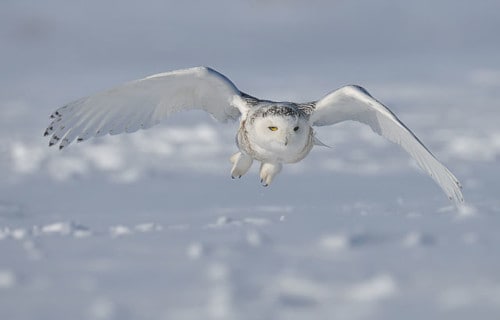
- This marvel distinguishes itself from its cousins in several ways. Among them stands the fact that it’s the only owl with primarily white plumage. Also separating it from the rest of the pack, so to speak, comes the fact that, unlike other owls, it’s often active during the day.
- Unfortunately, the population base of the marvelous Snowy Owl appears to be diminishing. This sad state further seems to exist across the entirety of its native range. The IUCN therefore presently lists the remarkable bird as Vulnerable on its Red List of Threatened Species.
- Lamentably, this wonder of the winged world now faces multiple threats to its continued existence. Like all species on earth today, most of these stem from the actions of mankind. They include, among others, the related perils of habitat loss and ongoing climate change.
Snowy Owl Physical Description
The stunning Snowy Owl truly unquestionably forms a sight to behold, and one that rarely fails to captivate those lucky enough to do so. Yet, the animal does not impress due to its sheer beauty alone. That’s true since the avian also boasts some highly respectable physical dimensions.
In this regard, as well as in appearance, the creature follows an evolutionary pattern common to many birds. That’s manifested in the fact that it displays a certain degree of the physiological characteristic of sexual dimorphism. In this case, females attain a greater average size than males.
The overall difference, however, remains relatively minor. As a general principle, this beautiful bird grows to become one of the largest of all known owls, with fully mature specimens having a wingspan of 4.2 – 4.8 ft (1.3 – 1.5 m). An average body length equals roughly 20 – 27 in (50 -68 cm).
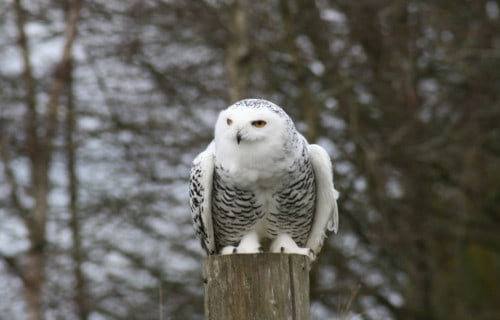
Like other owl species, this amazing creature evolved a facial disc, which represents a roughly circular arrangement of feathers around its equally unique eyes. This helps to funnel sound towards the ears, aiding in its exceptional hearing. It also has bright yellow eyes, creating a striking image.
The intriguing bird also possesses an extremely strong, hooked beak designed for tearing prey. Nature additionally provided the animal with powerful talons for catching and holding that. Its feathers developed as extremely dense, and even its feet have a protective covering of feathers.
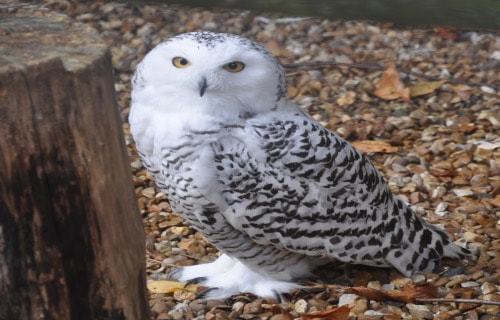
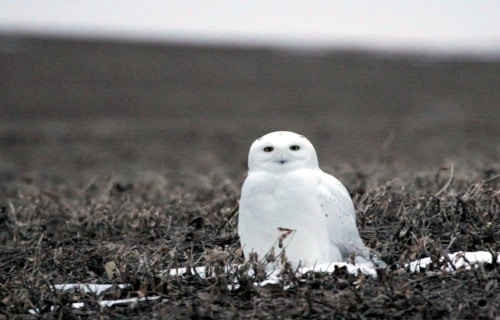
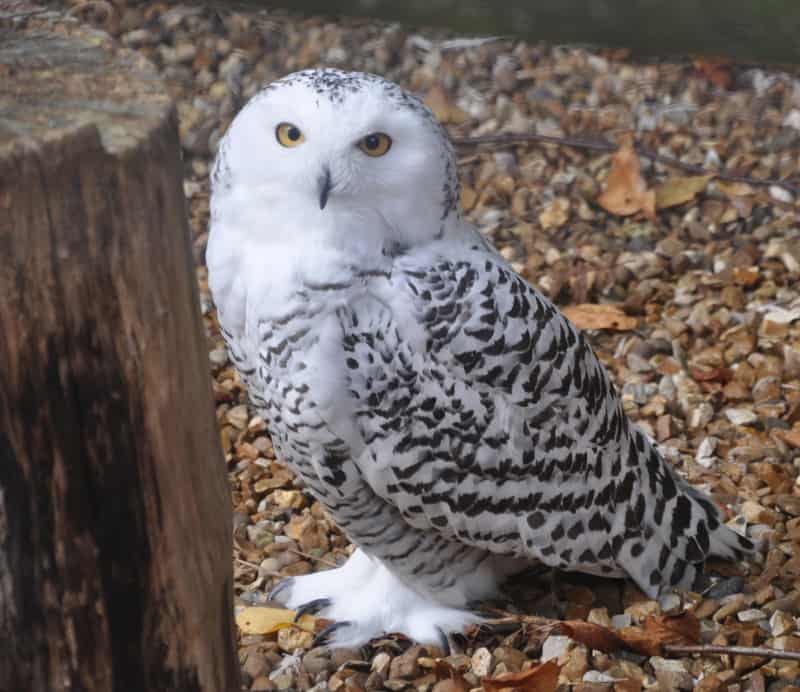
Yet, it’s the coloring of the aptly-named Snowy Owl that so captivates the viewer. The bird evolved principally white plumage that helps the species blend in perfectly with its particular habitat. Adult males also tend to be slightly whiter than females and juveniles, with less mottling or barring.
Despite its predominantly white color, though, this wonder of Nature often also presents a few dark markings. These sometimes include spots and bars of black or brown on the wings, back, and occasionally on the faces. The full extent of these markings typically varies between individuals.
- Kingdom: Animalia
- Phylum: Chordata
- Class: Aves
- Order: Strigiformes
- Family: Strigidae
- Genus: Bubo
- Species: B. scandiacus
CCL: http://bit.ly/2xQPH8p
Snowy Owl Distribution, Habitat, and Ecology
The truly beautiful Snowy Owl generally nests within the Arctic tundra of the northernmost stretches of Alaska and Canada, in North America, and also Eurasia. Most also winter south throughout Canada and northern Eurasia, with a presence occurring further south in some years.
Most of the stunning winged marvels like open areas like coastal dunes and prairies that appear somewhat similar to tundra. The animals have been reported as far south as the American states of Texas, Georgia, the American Gulf states, southernmost Russia, and northern China.
This particular owl remains an extraordinarily powerful animal for its size. It primarily preys on lemmings and other small rodents for food during the breeding season. However, at times of low prey density, or during the nesting period, it sometimes switches to favoring juvenile ptarmigan.
The incredible birds also evolved as primarily opportunistic hunters, like their many kindred. Typical prey for this powerful species varies considerably, especially in the winter. It therefore feeds on a comparatively wide variety of fairly small mammals such as meadow voles and deer mice.
But, the Snowy Owl occasionally veers from this pattern. The powerful raptor sometimes takes advantage of larger prey as well. Some of the larger mammal prey includes hares, muskrats, marmots, squirrels, rabbits, raccoons, prairie dogs, rats, moles, and even smaller birds.
Being flexible in its habits, the owl will also take fish from the surface of lakes. Each bird must capture roughly 7 -12 mice per day to meet its food requirement and can eat more than 1,600 lemmings per year. Like many other avians, the bird swallows its prey entirely whole.
CCL: http://bit.ly/2xQPH8p
Snowy Owl Behavior and Tactics
Though Snowy Owls have natural few predators, the adults still remain watchful at all times. Clearly, the mature individuals have been blessed by Nature for self-protection. This is true since each comes equipped to defend against any kind of threat towards them or their offspring.
During the nesting season, the impressive owls regularly defend the nests against any and all potential threats. These dangers include such predators as arctic foxes, corvids, and swift-flying jaegers. Other threats, however, include dogs, gray wolves and some avian predators.
The males of the remarkably adapted avian species faithfully and habitually defend the nest at all times. Consequently, these often act much like human sentries. This they accomplish by standing guard nearby, while the female incubates the vulnerable eggs and broods the young.
Yet, the females of the awesome Snowy Owl also readily attack approaching predators without fail. This defense often occurs with great ferocity. This the animals accomplish by dive-bombing their opponents and engaging in distraction displays to draw the predator away from a nest.
Eurasian Griffin Vulture
Eurasian Griffon Vulture Facts
- Now appearing in this compendium of 5 Remarkable Raptors of Asia comes the often-overlooked winged wonder named the Eurasian Griffon Vulture.
- This physically imposing creation of Nature and evolution typically goes by the informative common name across its entire territorial range. This amazing avian also holds at least one other, less often used general title, though. That’s the similar moniker of griffon vulture.
- Among scientists and related professionals, though, the animal typically goes by its technical designtion. Thankfully, that epithet remains much simpler for the layperson to pronounce than most such appellations. That’s because it has the short and simple tag Gyps fulvus.
- The animal received that appellation due to the efforts of Carl Ludwig von Hablitz. Though primarily a botanist, the respected Russian scientist recorded the first official recognition of it as a separate and distinct species. He managed that scientifically noteworthy feat in 1783.
- Fortunately, the amazing Eurasian Griffon Vulture seems to still be managing a population base that’s both stable and sufficient. That also appears to hold true across the entirety of its range. The IUCN therefore currently lists the bird as Least Concern on its published Red List.
- The biologicl wonder nevertheless still faces multiple threats to its continued existence as a species. Most of these dangers stem from the actions of mankind. It’s frequently endangered by poison traps set out by humans. Yet, it also faces the perils posed by ongoing climate change.
CCL: https://tinyurl.com/3ywffcfy
Eurasian Griffon Vulture Physical Description
The remarkable Eurasian Vulture Griffon quickly captures the attention of those individuals fortunate enough to encounter one. Though few consider it beautiful, it nevertheless has its own brand of interest. All species on earth have their place and attractions if one views them properly.
This particular member of its specific Family stands out from many of those numerous relatives for several reasons. For one, it boasts several subspecies itself. The sheer size of the bird also qualifies as one of those. While not the largest of them all, it’s still above-average in this specific regard.
It distinguishes itself from its kindred in this respect in yet another manner. That’s the fact that it displays an uncommon type of the physiological characteristic known as sexual dimorphism. This holds true since the intriguing animal shows gender-based differences in several categories.
Overall, individuals of the winged wonder attain a length equaling roughly 37 – 48 in (93 – 122 cm). Wingspan also varies, ranging from between 7.5 – 9.2 ft (2.3 – 2.8 m). Females do tend to reach slightly greater measurements in both these regards than their male counterparts, however.
Weights for the impressive animal, though, remain quite similar. Females average about 14.3 – 23 lb (6.5 – 10.5 kg). The males of the impressive avian, though, attain a mean weight ranging from approximately 13.7 – 23 lb (6.2 – 10.5 kg). Exceptional individuals occur, however, regardless of sex.
But the Eurasian Griffon Vulture also displays its gender-based differences in yet another way. It’s a bit of an unusual one, though. The males of the species typically possess both noticeably larger heads and longer bills. This does make distinguishing the genders slightly easier for the observer.
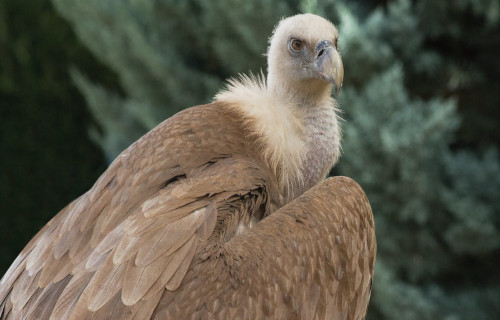
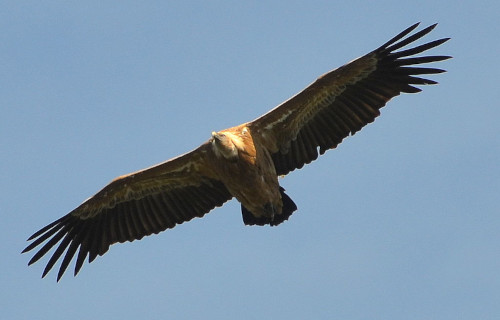
In terms of color, the interesting creature presents a truly striking image. The majority of the bird’s body shows either a light brown or tan shade. Its wings, however, present sharply darker brown hues. The large animal also manifests an off-white head, along with notably dark brown tail feathers.
- Kingdom: Animalia
- Phylum: Chordata
- Class: Aves
- Order: Accipitriformes
- Family: Accipitridae
- Genus: Gyps
- Species: G. fulvus
Eurasian Griffon Vulture Distribution, Habitat, and Ecology
The impressive Eurasian Griffon Vulture evolved as native to a moderately broad swathe of the surface of the earth. The exact region its zone of habitation, however, is clearly indicated by its very name. That’s true since the spectacular avian inhabits certain parts of both Europe and Asia.
Within its European range, though, its presence remains restricted mainly to those countries that abut the Mediterannean Sea. This area includes countries such as Greece and Cyprus. From there, however, the bird extends its range throughout Arabia and Turkey, and into central Asia.
Nature and evolution provided this particular species of vulture with a moderate degree of adaptability in terms of its choice of habitat. This flexibility serves to provide it with an evolutionary advantage that some of its kindred lack. It’s adapted to a range of ecosystems across its native range.
In parts of its indigenous territory, the creature resides relatively close to sea level. Yet, in other sections where the animal appears, it occasionally live at altitudes of up to 5,905 ft (1,800 m). On average, though, the creature typically builds its nests at heights roughly in the middle of these.
But, regardless of the altitude at which it chooses to make its home, the bird displays decidedly strong preferences regarding the type of ecosystem. This principally consists of regions of either open shrub and grasslands, or cliffs and rocky slopes. Few individuals live outside of such areas.
Like its relatives around the world, the Eurasian Griffon Vulture developed as a carnivore. Just like them, it also mainly feeds as a scavenger, consuming the flesh of carcasses it finds while soaring high. It’s also highly opportunistic in nature, showing no preference for type or size of animal.
The animal sometimes lives alone, but often forms loose colonies. It typically breeds on rocky cliff faces, where it places its nest for safety. Females generally lay a single egg, which takes about two months to hatch. An average lifespan in the wild currently remains unknown to ornithologists.
Golden Eagle
CCL: https://tinyurl.com/mrx5uknb
Golden Eagle Facts
- Our next choice for inclusion in this gathering of these 5 Remarkable Raptors of Asia bears the fitting title of the Golden Eagle.
- This stunning winged wonder most often goes by the descriptive common name provided in this articles across most its territory. Yet, it does have a few other alternate titles by which it’s known. These include the terms War eagle, King of birds, Brown eagle, and Mountain eagle.
- Inside of the scientific community, however, it’s possibly much better known by its entirely technical designation. Fortunately, the avain holds a tag relatively simple for the layperson to pronounce. That’s because the amazing raptor also bears the formal name Aquila chrysaetos.
- This breathtaking marvel of Nature received that specific epithet due to the efforts of Carl Linnaeus himself. That eminent researcher accomplished the first official recognition of it as a separate and distinct species. He achieved that scientifically noteworthy deed in the year 1758.
- Along with its sheer beauty, this majestic creature holds a certain distinction among scientists and nature lovers alike. That’s true given the fact that it has the broadest native range of any known species of eagle. It also forms one of the most widely employed bird in falconry.
- Thankfully, the population base of the remarkable Golden Eagle appears to continue to be both stable and sufficient. That pleasant state also seems to hold true throughout the entirety of its range. Appropriately, the IUCN thus currently shows it as Least Concern on its Red List.
- The marvelous avian nevertheless shouls still be considered as facing numerous potential threats to its continued existence as a species. It this, it faces the same dangers as all forms of life on earth today. Most of those stem from the actions of man, and include climate change.
CCL: https://tinyurl.com/mvafnmn2
Golden Eagle Physical Description
The magnificent Golden Eagle virtually never fails to capture the immediate attention and appreciation of those individuals fortunate enough to encounter one. Unlike some of its relatives, though, it does so due to more than just its beauty. This avian also ranks as comparatively large.
In terms of its physical appearance, however, it also follows a well-established pattern typical among its kindred. That’s true since it displays a certain degree of the physiological characteristic of sexual dimorphism. In its case, however, this mainly manifests in regards to its size alone.
In general, the body length for this raptor varies markedly, ranging from approximately 26 – 40 in (66 – 102 cm). Wingspans also fluctuate notably, from about 5.9 – 7.7 ft (1.8 – 2.34 m). Body masses display the same degree of variation, as well. Bulkiness of the body even differs between individuals.
Typically, these physical differences represent the way in which the animal presents the gender-based difference. Females of this amazing species achieve larger average measurements in all the categories. This tendency remains typical of the known varieties of raptors throughout the world.
Females reach weights that run from 10 – 15 lbs (4.5 – 7 kg). Males, however, only average between 6.6 – 10 lbs (3 – 4.5 kg). Females, meanwhile, have broader wings and slightly larger bodies. The males of the species, though, develop as slimmer in build, and with proportionally narrower wings.
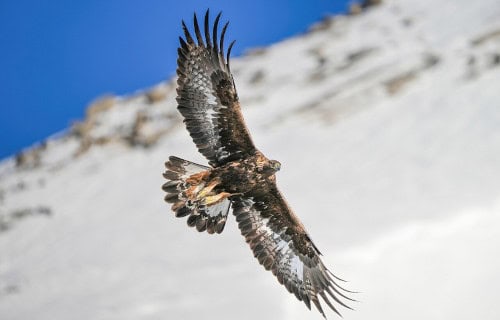
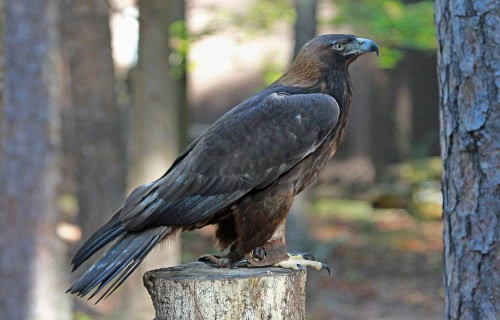
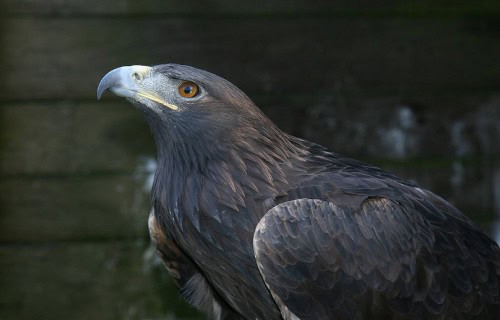
Otherwise, the two sexes of the Golden Eagle present the same basic appearance to the viewer. Adults seem dark brown overall, appearing almost black at a distance. Yet, it also manifests a highly distinctive combination of golden to tawny feathers evolved on the back of the head and nape.
Other parts of the body compliment this pattern well. Its underparts appear dark brown, often with lighter mottling. The tail, however, develops as long, usually being brown with faint grayish bands. The gorgeous wings of the powerful bird develop as very broad, with slightly upturned tips in flight.
This marvel of evolution also boasts a very strong, hooked bill that’s dark at the tip, fading to a lighter yellowish base. The awesome bird also has large, piercing eyes that show dark brown to amber. Contrasting this sharply, a bright yellow patch of skin appears at the base of the bill.
- Kingdom: Animalia
- Phylum: Chordata
- Class: Aves
- Order: Accipitriformes
- Family: Accipitridae
- Genus: Aquila
- Species: A. chrysaetos
CCL: https://tinyurl.com/btdm3sjj
Golden Eagle Distribution, Habitat, and Ecology
The mesmerizing Golden Eagle evolved as indigenous to an extrmely broad swathe of the surface of the earth. The full extent of that massive zone of habitation, however, might surprise many of you. That’s because this stunning avian evolved as native to most of the Northern Hemisphere.
In North America, it’s found throughout western and northern regions. It’s especially common in Alaska, western Canada, and the western United States, but less common in the eastern areas. In North Africa, meanwhile, the animal lives in the Atlas Mountains and other suitable upland habitats.
In Europe, it evolved as common across the northern, central, and southern sections. Strong populations live in Scotland, the Alps, the Pyrenees, Scandinavia, and the east. Also present in Asia, it has a broad range from the Middle East and Caucasus across Russia, Mongolia, China, and Japan.
In keeping with the patterns typical of its relatives, it displays extremely strong preferences regarding its choice of habitat. These wonders of Nature and evolution thrive best in open, rugged landscapes where they can soar freely and hunt effectively, so they only reside in these areas.
This includes such settings as the cliffs, crags, and rocky outcrops omnipresent in mountains and highlands. Grasslands, shrublands, and tundra also appear preferable. Across parts of its range, it lives in steppes and deserts. It also often makes its home in edges of forests and alpine meadows.
Given its nature, the magnificent Golden Eagle evolved entirely as a carnivore. It also represents an apex predator in all regions it inhabits. Due to that nature, it constitutes as important ecosystem stabilizer. Its activities help balance prey populations and indirectly shape vegetation dynamics.
The bird mainly hunts medium-sized prey, including such fare as hares, rabbits, ground squirrels, marmots, and prairie dogs. Yet, it also feeds on deer fawns, mountain goat kids, lambs, and even reptiles, fish, and insects when other prey is scarce. Scavenging of carrion also sometimes occurs.
Pairs often mate for life, maintaining territories year-round. These remain quite large, occasionally reaching 77 sq mi (200 sq km) in size. Nests often reach 6.6 ft (2 m) across, and places in difficult to reach locations. Breeding occurs in late winter to spring, with a typicl clutch numbering 1 – 3 eggs.
Long Eared Owl
Long Eared Owl Facts
- Next up in this compilation of 5 Remarkable Raptors of Asia appears the mesmerizing avian known and loved as the Long Eared Owl.
- Perhaps most notably, the descriptive term appropriately serves as one of the more common names for a truly majestic type of raptor. The remarkable animal does, however, also possess several other general names. These are used in many different parts of its widespread range.
- These alternate general names include several highly descriptive terms. Some even qualify as highly distinctive. They include such appellations as the cat owl, the lesser horned owl, and the northern long-eared owl. These monikers reflect both its appearance and its habitat range.
- In the scientific community, though, it’s perhaps better known by its technical designation. Thankfully, that’s a significantly simpler one for the layperson to pronounce than many related names. That’s because the stunning avian holds the simple formal tag of Asio otus.
- This gorgeous creature additionally shares a great portion of its native range with another, closely related avian. That’s the visually quite similar species ironically, yet appropriately, known as the short-eared owl. The two animals can most easily be distinguished while at rest.
- That’s because, at that time, the ear tufts of the Long Eared Owl become clearly visible to the observer. This constitutes the most easily recognizable physical difference between the two species. The eyes of the two different creatures additionally display different colors.
- A total of four recognized subspecies of this remarkable avian currently exist around the world. But, this product of Nature and evolution has a decided advantage over many of them. Unlike some of them, this wonderful bird appears to have a sizable and stable population.
- Due to this pleasant situation, the IUCN presently lists the wonder as a Species of Least Concern. This ranking appears on its Red List. It nonetheless must be considered to be facing at least a few threats to its existence. These perils include habitat loss and climate change.
CCL: https://bit.ly/3xCgRxu
Long Eared Owl Physical Description
The mesmerizing Long Eared Owl instantly captivate those individuals fortunate enough to encounter one of these marvels. Yet, the animal usually does so due more to its striking appearance than impressive dimensions. That’s true since it only ranks as a medium-to-large variety of owl.
In that regard, though, the captivating bird follows a well-established pattern typical of its kind. That’s the fact that it displays a certain degree of the physiological characteristic of sexual dimorphism. In its case, this evolutionary trait manifests itself in terms of pure physical size.
Overall, members of the species attain a respectable body size. Mature specimens average approximately 16 in (40 cm) in total length. Wingspan, meanwhile, reaches a mean measurement of roughly 39 in (1 m). Adult weight varies significantly, but generally averages around 15.3 oz (435 g).
As a general principle, females of this astonishing species typically achieve greater measurements in all of these categories than their male counterparts. Exceptional specimens do occasionally occur, however. When these do appear, it’s regardless of gender, and they rarely exceed the norm by much.
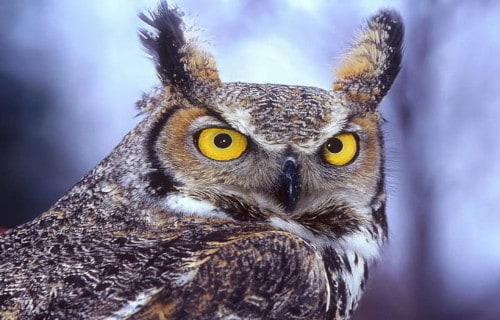
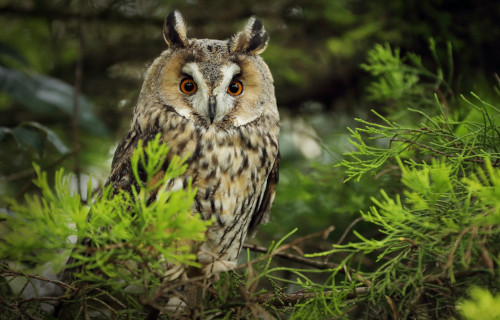
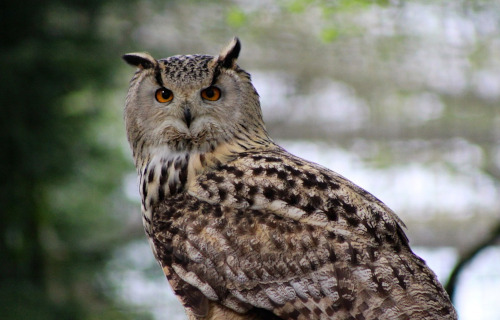
The body of each sex also develops as slimmer and more elongated than most owls. Long, prominent tufts develop on the side of the head. The bird has a distinctive orange to buff-colored face with a dark outline. It also has large round eyes, that typically show a yellow to orange in color.
The plumage of the amazingly evolved Long Eared Owl usually receives the most attention from those who see it, however. In both sexes, the bird shows a mottled brown, gray, and buff with streaks and speckles. However, the underside’s streaked with dark brown on a pale background.
Here too, though, the biological wonder presents gender-based differences. The overall patterns remain the same, but vary in the intensity of the colors. Females tend to be darker and more heavily marked than males. Their stomach also often has a more pronounced reddish-brown or buff tone.
- Kingdom: Animalia
- Phylum: Chordata
- Class: Aves
- Order: Strigiformes
- Family: Strigidae
- Genus: Asio
- Species: A. otus
Long Eared Owl Distribution, Habitat, and Ecology
Much like many related species, the breathtaking Long Eared Owl evolved as partially migratory in nature. However, to the surprise of many people, this beautiful avian inhabits a relatively broad swathe of the earth’s surface. That’s due to the fact that it appears on several different continents.
More precisely, however, the marvel appears on a total of three separate one’s. These broader locations consist of the continents of Asia, Europe, and North America. Like many birds, the fascinating animal commonly moves southward within its native range during the winter months.
Nature provided this visually distinctive creature with an extremely strong natural advantage over many competing birds. That’s the fact that the avian developed as a highly adaptable species with a decided preference for an impressively wide variety of both woodland and semi-open habitats.
It does display its greatest preference, though, for a select few types of ecosystems. These favorites include regions comprising dense woodlands, coniferous forests, and mixed forests, allowing for roosting and nesting. Yet it’s also often found near grasslands, meadows, farmland, or wetlands.
It prefers to roost in thickets, dense trees, and even sometimes shrubs. The animal frequently does so in evergreen trees, such as pines and spruces. It doesn’t build its own nest, but reuses old nests of other birds, like crows, magpies, or hawks. It also sometimes roosts in the cavities of trees.
The Long Eared Owl plays a crucial role in its ecosystem as a nocturnal predator that helps regulate small mammal populations. This prey especially includes voles, mice, shrews, and young rabbits. It also occasionally eats small birds, bats, reptiles, and large insects when other prey’s unavailable.
Breeding season generally occurs between March to July, depending on the exact location. Following mating, the females lay 3 – 10 eggs, with 4 – 6 being the most common. These appear white, oval, and about 1.6 in (4 cm) in size. Incubation generally requires between 26 – 28 days.
Indian Vulture
CCL: https://rb.gy/041lz
Indian Vulture Facts
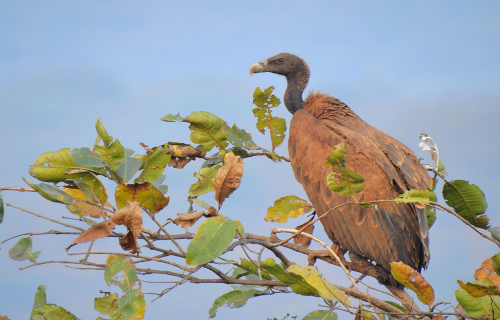
- Closing out this article about these 5 Remarkable Raptors of Asia we present the other vulture on the list, the aptly-named Indian Vulture.
- This impressive product of Nature and ages of evolution most frequently goes by the informative common name for good reason. It has no other accepted general name in english. But, it’s named Vautour indien in French, and Indiengeier in German, among others.
- Within the scientific community, however, it’s possibly much better known by its technical title. Thankfully for the layperson, that’s a much simpler term to pronounce than many such. That’s because this natural marvel holds the short scientific moniker of Gyps indicus.
- The remarkable avian received that relatively easy to pronounce name due to the efforts of the Italian naturalist, Giovanni Antonio Scopoli. The respected researcher accomplished the first recorded recognition of the intriguing animal. He achieved that noteworthy deed in 1786.
- Unfortunately, the bird has a population base that’s already seen a sharp decline in numbers. Estimates consider that loss to be at least 97% across the entirety of its range. The IUCN thus accordingly lists it as Critically Endangered on the Red List of Threatened Species.
- The primary cause of that precipitous decline among the Indian Vulture seems to have been a drug given to cattle in its range. Upon feeding on the flesh of the injected cattle, that medicine, named diclofenac, entered their systems. For the birds, it constitutes a very powerful toxin.
- Given its precarious population situation, other factors now only serve to augment its perils. Most of these dangers stem from the actions of humans, either directly or indirectly. These many perils include such threats to its existence as habitat loss and ongoing climate change.
CCL: https://rb.gy/aadn1
Indian Vulture Physical Description
Like many of its relatives around the world, the Indian Vulture often has a bad reputation in the minds of many. Yet, objectively speaking, it remains a fascinating creation of Nature and evolution. It captures the attention of many who encounter it, due its characteristic physical appearance.
In that particular regard, however, it follows a natural pattern strongly prevalent among birds. That’s true since it displays a certain degree of the physiological characteristic called sexual dimorphism. In the case of this impressive species, that trait only manifests itself in terms of sheer size.
More specifically, females of the avian attain a greater average size than their male counterparts. The overall difference in this respect, though, remains relatively slight. To the untrained eye, therefore, distinguishing the two genders of this species based on this trait becomes extremely difficult.
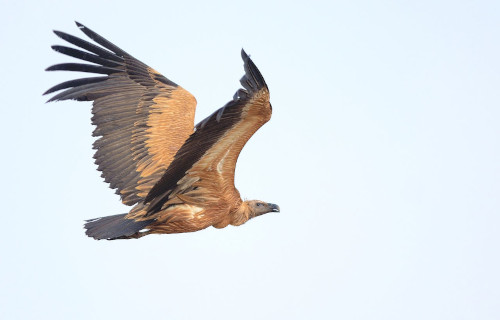
As a general principle, however, specimens grow to an average body length of approximately 32 – 41 in (81 – 103 cm). An average wingspan, though, measures an impressive 6.4 – 7.8 ft (1.96 – 2.38 m). Exceptional individuals do occasionally occur, of course, wholly regardless of gender.
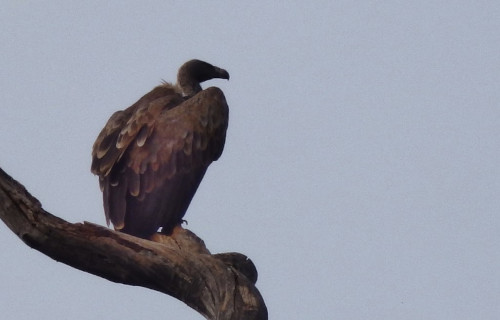
The body of the Indian Vulture is considered medium-sized among its numerous kindred. It does have a slightly bulkier form to it than many of those relatives, however. The neck and head also appear nearly bald. Its broad wings develop as tapered, while the tail feathers are relatively short.
Its upper layer of feathers, known as covert feathers, show a comparatively pale shade. The lower, primary feathers, on the other hand, display a significantly darker brownish-gray color. The bird also manifests a markedly pale shaded collar-like pattern that’s most highly visible behind the neck.
- Kingdom: Animalia
- Phylum: Chordata
- Class: Aves
- Order: Accipitriformes
- Family: Accipitridae
- Genus: Gyps
- Species: G. indicus
CCL: https://rb.gy/if2rb
Indian Vulture Distribution, Habitat, and Ecology
The Indian Vulture evolved as indigenous to a moderately small portion of the surface of the globe. For the moment, no evidence exists that it ever appeared anywhere outside of its present general zone of habitation. The precise reason for that lack of expansion still remains undetermined.
As its name obviously implies, the creature appears inside the country of India, placed in the southern part of Asia. Even there, however, the intriguing avian only lives in the peninsular region. The species does exist, although in even smaller numbers, within the southeast section of Pakistan.
The wonder of Nature also displays decidedly strong and clear preferences regarding its habitat. In this, it also follows a pattern common to its many relatives. Most of the regions where it appears have a relatively hot, dry climate. It typically nests on rugged, remote cliffs or sometimes in trees.
Yet, it doesn’t always shy away from human inhabited areas, either. That’s because, within its native range, it sometimes makes its home in villages, towns, and sometimes even smaller cities. There, it occasionally builds its nest in man-made structures, including some temples found in the region.
Once again maintaining the pattern of behavior common to its kind, the Indian Vulture feeds as a scavenger. Its food primarily consists of carrion, of virtually any species. This the highly evolved creature searches for by quietly soaring high over the landscape, entirely regardless of location.
Breeding season most often takes place between the months of November to March. This generally occurs in larger colonies. Females typically lay a single egg, which both parents incubate. Hatching usually requires roughly 45 days. Individual examples sometimes live for up to 40 – 45 years.
CCL: https://tinyurl.com/btdm3sjj
5 Remarkable Raptors of Asia
We hope that each of you thoroughly enjoyed reading, and hopefully learning from, this article we’ve written for you about these 5 Remarkable Raptors of Asia. It’s also our fervent hope that doing so has left you with either a new or renewed appreciation for such awesome wonders of Nature.
Unfortunately, however, many of their kindred scattered around the world now find themselves facing strong threats to their continued existence as a species. Many of those varied dangers, in fact, stem from the actions of mankind. We must do all we can to protect and preserve them all.
Check out our other articles on 7 Endemic Socotran Species, Africa’s Many Geological Masterpieces, 7 Incredible Insects of Europe, Earth’s 7 Mightiest Rivers, 5 Magical Mammals of Ohio










Leave a Reply