CCL: http://tinyurl.com/462rnnjn
We truly hope that each of you, our readers, will sincerely enjoy and appreciate this article we present to you about these 5 Stunning North Carolina Angiosperms. It was certainly our pleasure to gather the information for you. May it provide you with both education and increased awareness.
Certainly, these few magnificent species listed herein represent only a tiny portion of the similar species found throughout this region. It’s our belief, though, that they serve as excellent representations of the members of this Class. Check out our other articles for similar marvels.
Fall Phlox
CCL: https://tinyurl.com/22y23f9m
Fall Phlox Facts
- Leading off this article about these 5 Stunning North Carolina Angiosperms we present you with the glorious plant named the Fall Phlox.
- The most frequently used common name for this gorgeous product of Nature and evolution continues to be this one across its full range. The botanical beauty does, however, have other general titles. These include garden phlox, paniculed phlox, and perennial phlox.
- Within the scientific community, though, it’s perhaps better known by its technical designation. Thankfully, that term’s comparatively easy for the layperson to pronounce, as such things go. That’s because the delicate Angiosperm holds the official epithet of Phlox paniculata.
- The flora received that relatively simple moniker due to the efforts of Carl Linnaeus himself. The highly esteemed Swedish biologist accomplished the first formal recognition of it as a separate and distinct species. He achieved that scientifically noteworthy deed in the year 1753.
- Due to its great beauty, it’s been introduced to numerous other areas around the world, outside its native range. In these non-native regions, it’s been imported and used as an ornamental plant. In many of these areas, though, it escaped cultivation and established itself in the wild.
- Fortunately, even within its native region, the Fall Phlox seems to be maintaining a fully thriving population base. Combined with its artificially expanded range, this currently gives it a reasonable degree of stability. The IUCN therefore has no listing for the plant on its Red List.
- Nevertheless, it faces the same potential threats to its continued existence as a species as all other forms of life on earth today. Like them, the great majority of these stem from the actions of mankind. They include the related perils of habitat loss and ongoing climate change.
CCL: https://tinyurl.com/2s4apsss
Fall Phlox Physical Description
The captivating Fall Phlox remains renowned for its beauty and charm. Both of these serve to capture the attention of most individuals who view the marvel. This forms the very reason it’s become so popular in regions around the globe as an ornamental. It also boasts other attractions.
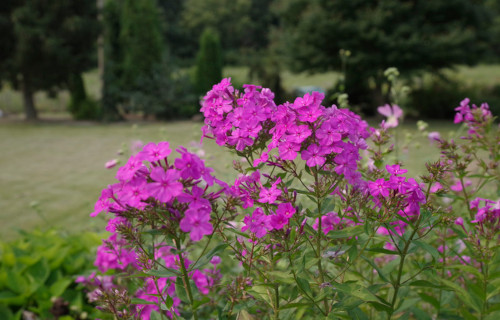
This perennial plant achieves moderately impressive average physical dimensions. In height, specimens typically grow to between 2 – 4 ft (0.6 – 1.2 m). The mean width for the same examples measures 1 – 2 ft (0.3 – 0.6 m). Under ideal conditions, though, the flora occasionally exceeds this.
The stunning plant evolved a fibrous root system that allows it to establish itself well in garden beds, as well as its native environment. From there, it grows in a vertical direction. Its stems also manifest as sturdy, erect, and slightly branched. These appear green, and often tinged with purple.
The leaves merit their own appreciation, as well. These develop placed opposite, and lance-shaped in structure. Each also possesses smooth edges, and usually shows a rich green color. In terms of length, these average extending 2 – 5 in (5 – 13 cm), and usually end with a pointed tip.
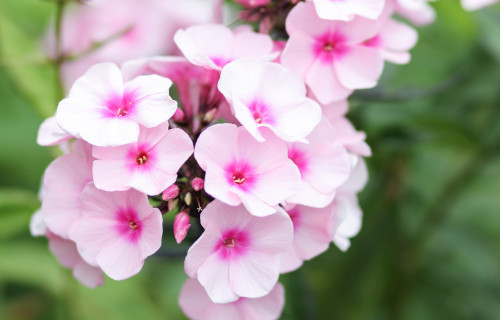
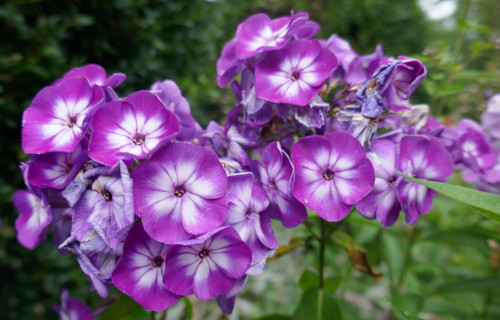
It’s clearly the flowers of the amazing Fall Phlox that typically garner the most attention, however. These breathtaking blooms develop as comparatively small, tubular, and star-shaped, and display five petals. The blossoms also grow in large, dense clusters or panicles at the top of the stems.
These remain well known for two distinct attributes. Nature blessed them with a strong, sweet fragrance. Many cultivars exist, presenting a wide range of colors and shade. The original plant, however, has blooms showing a range from pink to light purple, with a dark pink or magenta center.
The magnificent Angiosperm also produces a tiny fruit, following flowering. This remains far more obscure than the attractive flowers, though. These consist of small, inconspicuous seed capsules. The seeds themselves also develop as quite small, but each pod contains large quantities of these.
- Kingdom: Plantae
- Phylum: Tracheophyta
- Class: Eudicots
- Order: Ericales
- Family: Polemoniaceae
- Genus: Phlox
- Species: P. caniculata
CCL: https://tinyurl.com/ysjddhbz
Fall Phlox Distribution, Habitat, and Ecology
The beautiful Fall Phlox evolved as indigenous to a moderately broad expanse of the surface of the earth. Its natural zone of habitation lies within a region that won’t surprise many people, though. That’s because it developed as native to an area well known for its abundance of similar wonders.
It evolved as native to a specific portion of North America. Within that greater landmass, it only appears naturally in certain portions of the United States. There, it appears in both the central and eastern sections of the country. It’s particularly prevalent in the southeastern regions of the nation.
Perhaps its greatest natural concentration lies within the Appalachian Mountains. Across that range, the botanical wonder thrives in parts of Alabama, North Carolina, Georgia, and Tennessee. Further west, though, it lives in smaller concentrations in the Great Plains and the Mississippi Valley.
Like many related species, this creation of evolution displays decidedly clear preferences regarding its choice of habitat. It typically thrives in habitats that provide a balance of sunlight, moisture, and fertile soil. It thrives best in full sun to partial shade and in moist, well-drained, and rich soils.
The plant prefers the edges of forests where it generally receives some sunlight while still being protected from harsh conditions. Meadows and grasslands also comprise favored areas. These open regions allow for plenty of sunlight and provide the well-drained, rich soil that the flora requires.
Still other regions meet its specific needs. Riverbanks and stream edges additionally form a favorite location. The moist, well-drained soils near bodies of water are ideal for the plant’s growth. This marvel of Nature’s also often found growing on sunny hillsides or slopes with good air circulation.
The mesmerizing Fall Phlox achieves its pollination via the actions of several different types of pollinators. Most frequently, these include various species of butterfly. Its small yet numerous tubular flowers serve as an excellent nectar source for these, including swallowtails and monarchs.
Several varieties of local bees, such as bumblebees, also represent frequent visitors. They remain essential for cross-pollination. It’s also extremely popular with many species of hummingbird. The plant’s bright, fragrant flowers, especially in red or pink hues, attract the winged wonders for nectar.
American Tiger Lily
CCL: http://tinyurl.com/462rnnjn
American Tiger Lily Facts
- Now appearing in this compilation of 5 Stunning North Carolina Angiosperms we give you the wondrous flora known as the American Tiger Lily.
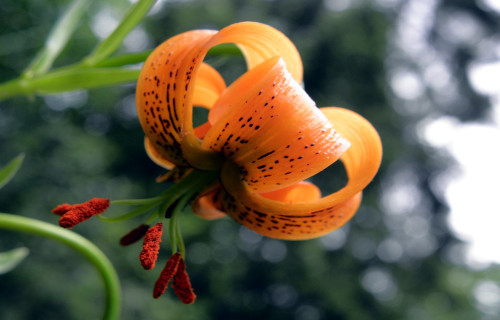
- This stunning variety of true lily most frequently goes by the descriptive and informative common name that we’re applying herein. Yet, it also has multiple other general titles it’s sometimes known by. These include such terms as turban lily, swamp lily, and Turk’s cap lily.
- Within the scientific community, however, it’s perhaps much better known by its purely technical designation. Thankfully, that’s a much simpler term for the layperson to pronounce than most such tend to be. That’s because the plant holds the formal tag of Lilium superbum.
- This natural biological beauty received that epithet due to the concerted efforts of Carl Linnaeus. The highly esteemed Swedish biologist accomplished the first recognition of it as a separate and distinct species. He managed that scientifically noteworthy feat in the year 1753.
- In addition to its obvious natural beauty, the amazing flora has long held extremely important cultural significance for several tribes of Indigenous Peoples native to the region. It’s long been deeply incorporated into various tribal folklore, ceremonies, and traditional rituals.
- Fortunately, the breathtaking American Tiger Lily appears to be maintaining a comparatively stable and sufficient population base. That pleasant state also seems to hold true throughout the entirety of its range. It thus does not currently show on the Red List of the IUCN.
- The breathtaking Angiosperm nevertheless still faces several potential threats to its continued existence as a species. In this, however, it but mimics the perils all species on earth now face. Like all of us, it’s now dealing with the dangers of habitat loss and ongoing climate change.
CCL: http://tinyurl.com/22y23f9m
American Tiger Lily Physical Description
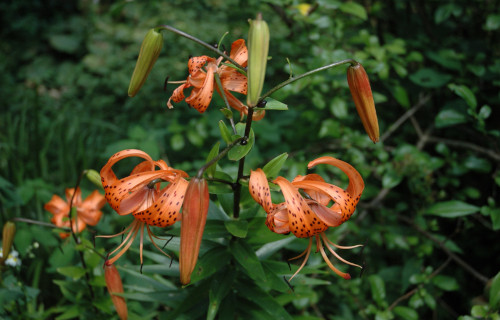
Like most of its many relatives around the globe, the fabulous American Tiger Lily rarely fails to capture the attention of those individuals fortunate enough to encounter it. Unlike some of them, however, it doesn’t rely on its great beauty alone. That’s true since it also achieves a significant size.
Typically, each plant produces a single strongly erect, but relatively thin stem. Despite its narrow nature, its quite sturdy. Most achieve an average height ranging between 3 – 8 ft (0.91 – 2.44 m). Under ideals conditions, though, some specimens grow as tall as an astounding 10 ft (3 m).
The primary stem also usually manifests a highly unique combination of attributes. Its surface generally remains quite smooth to the touch, though it does often manifest a slightly mottled appearance. Meanwhile, the shorter stem of the plant’s foliage also shows the same tendencies.
Those same leaves evolved to develop as notably elongated and lance-shaped in design. It’s also most often arranged in whorls around the stem. These appear dark green in color and generally display prominent veins running through them. In length, they often reach up to 6 i (15 cm).
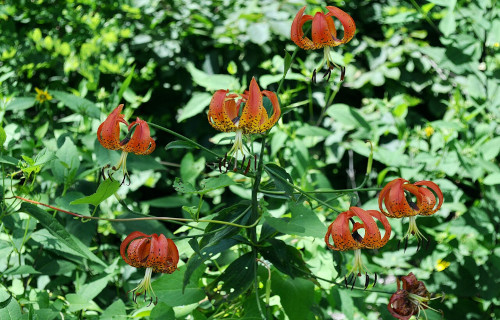
Yet, it’s without doubt the gorgeous blooms of the American Tiger Lily that gather the most interest among most of its viewers. Each stem usually produces between 3 – 7 flowers, but sometimes as many as 40 appear! When open, these measure an average width equaling about 3 in (7.6 cm).
Its color also tends to dazzle the eye of the observer. Intriguingly, this often varies quite widely between individual plants. This ranges from a deep shade of yellow to an reddish-orange shade, often considered a flame-color. The tips of the petals occasionally show slight reddish-purple hues.
- Kingdom: Plantae
- Phylum: Tracheophyta
- Class: Monocots
- Order: Liliales
- Family: Liliaceae
- Genus: Lilium
- Species: L. superbum
CCL: http://tinyurl.com/3ywffcfy
American Tiger Lily Distribution, Habitat, and Ecology
The enthralling American Tiger Lily evolved as native to a moderately broad expanse of the earth’s surface. However, its own common name clearly provides a partial indication of that native zone of habitation. That’s because it developed as indigenous to a certain portion of North America.
Yes, as strongly implied by the moniker, that includes the United States. There, though, it primarily appears in the eastern regions. This extends from the costal regions, to as far south as the state of Georgia. To the west, its territory extends roughly to sections of both Minnesota and Missouri.
Northward, however, the marvel of Nature and botanical evolution extends that range as far as southeastern Canada. This area of habitation mainly consists of parts of Ontario. Along the way, though, the botanical beauty remains especially prevalent in the Appalachian Mountains.
Like many lilies found around the world, it displays strong preferences regarding its choices of habitat. In its case, it’s commonly found in habitats with consistently moist or wet conditions. This includes marshes, wet meadows, bogs, and along the banks of streams, rivers, and ponds.
It’s especially fond of swampy areas, most likely due to the specific combination of water-logged soil and extremely high levels of organic matter. Though the flora prefers partial shade, it’s flexible enough to manage in most light levels. It’s quite often found growing under the tree canopy.
The awe-inspiring wonder achieves its pollination via the activities of a truly wide variety of insects. This includes locally prevalent types of beetles, butterflies, and bees, among numerous others. The natural evolutionary design and sheer size of its blooms provide easy access for their visits.
Once pollinated, the amazing American Tiger Lily produces multiple capsules filled with many small seeds. These capsules later split open when ripe, releasing the many seeds. These in turn may be dispersed by wind, water, or animals, helping to colonize new areas within the wetland habitat.
The remarkable plant also plays a vital role in the ecology of wetland ecosystems in often inhabits. The natural marvel does so by providing habitat and food for various organisms. Its foliage frequently offers shelter for small animals, and its flowers provide nectar and pollen for pollinators.
Great Rhododendron
Great Rhododendron Facts
- Our next choice for inclusion in this gathering of these 5 Stunning North Carolina Angiosperms is the majestic floral beauty best known by the title Great Rhododendron.
- This magnificent botanical marvel most frequently goes by the fully deserved common name across its native range. Yet the stunning plant also has several other, less often used general titles. These include the terms rosebay rhododendron and great laurel, among others.
- In the scientific community, though, it’s perhaps much better known by its technical title. That’s a term that, while somewhat lengthy, remains reasonably simple for the layperson to pronounce. That’s because it holds the technical moniker of Rhododendron maximum.
- This breathtaking variety of flora received that particular appellation due to the efforts of Carl Linnaeus himself. The esteemed Swedish botanist accomplished the first official recognition of the plant as a separate and distinct species. He achieved that notable deed in 1753.
- It stands out from its many related species due to sheer size. That’s true since it represents one of the largest of all known varieties of rhododendron. Due to the combination of beauty and dimensions, it’s become extremely popular for landscaping in appropriate climates.
- Although the Great Rhododendron appears in a very specific range, it seems to be maintaining an abundant wild population. That further seems to hold true across the entirety of its known native range. The ICUN thus lists it as Least Concern on its Red List of Threatened Species.
- It nevertheless still faces at least a few potential threats to its continued existence as a species in the wild. Most of these dangers stem from human activities, both directly and indirectly. Chief among these are the dual related threats of habitat loss and ongoing climate change.
CCL: https://rb.gy/h352f
Great Rhododendron Physical Description
The stunning Great Rhododendron truly merits its name. It also quickly captivates those who encounter it, either in the wild or when cultivated. Its beauty alone isn’t the only reason for this, though. That’s due to the fact that it clearly earns the title great, given its impressive size.
This variety of evergreen shrub generally attains heights measuring around 13 ft (4 m) at its full growth. Some specimens, however, grow significantly larger than this. In fact, under fully ideal environmental conditions, the amazing Angiosperm sometimes reaches heights of 33 ft (10 m)!
Its primary branches occasionally become quite thick and sturdy. These often display a thick, broken bark-like texture, quite similar to a tree. This also typically shows as a light brownish-tan shade. Its numerous smaller branches, meanwhile, generally display a lighter green color.
The breathtaking plant also boasts some remarkable foliage. Its leaves develops as bluish-green elongated ovals, with a leathery texture. Depending on the size of plant, these range in length from 3.5 – 7.5 in (9 – 19 cm). Each also usually measures from 0.8 – 1.57 in (2 – 4 cm) in total length.
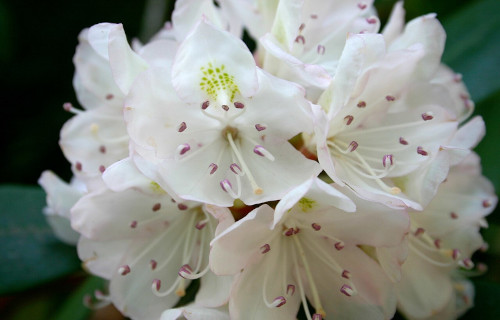
Yet its unquestionably the flowers of the Great Rhododendron that unquestionably form its most appealing feature. These fabulous bell-shaped blooms typically appear in clusters. Normally, a group holds between 16 – 24 of these, all of which range in color from a pale white to purplish pink hue.
The fruit of this marvel of botanical beauty develops as an extremely dry capsule structure. This part of the plant averages approximately 0.6 – 0.8 in (1.5 – 2 cm) in length. Despite its comparatively small size, though, each of these structures contains a large number of extremely small seeds.
- Kingdom: Plantae
- Phylum: Tracheophytes
- Class: Eudicots
- Order: Ericales
- Family: Ericaceae
- Genus: Rhododendron
- Species: R. maximum

CCL: https://rb.gy/zlyjl
Great Rhododendron Distribution, Habitat, and Ecology
The aptly-named Great Rhododendron evolved as endemic to a moderately broad expanse of the surface of the globe. That exact location, however, likely won’t surprise many people. That’s because this remarkable flora evolved as native to a portion of the continent of North America.
There, the hauntingly beautiful plant appears mostly within the United States, with a small portion occurring in southeastern Canada. It lives almost exclusively in the Appalachian Mountains, along the eastern section of the United States. That range extends from Alabama to Nova Scotia.
Although it’s proven itself to be adaptable, it shows decided preferences in its choice of habitat. That’s reflected in the fact that it evolved in the mountains. There, it principally occurs in regions of partial shade, possessing a precise combination of rich, moist, acidic, and well-drained soils.
The greatest concentration of the Angiosperm occurs in what’s now the Great Smoky Mountains National Park. This protected area straddles the borders of Tennessee and North Carolina. In total, the plant appears in 12,000 sq mi (31,080 sq km) in the southern portions of these mountains.
In its native environment, the Great Rhododendron tends to dominate much of the understory. The floral marvel mainly reproduces via vegetative cloning, but also does so through sexual means. Its primarily pollinators consist of mulitiple local insect species, such as bees and butterflies.
Following blooming, the dry seed capsules appear between the months of March and August. Each contains about 400 small seeds. Some animals, mainly deer, feed on the plant. But, for humans, the leaves are relatively toxic. Certain chemicals in the species do have medicinal uses, though.
Red Trillium
CCL: http://tinyurl.com/33psz7af
Red Trillium Facts
- Next up in this compendium of 5 Stunning North Carolina Angiosperms comes the next fabulous selection, the aptly-named Red Trillium.
- This deceptively simple term serves as only one of multiple common names applied to this gorgeous product of Nature and evolution. These alternates vary quite widely, though. They include such diverse tags as wake robin, stinking benjamin, beth root, and birthroot.
- Inside of scientific circles, however, the wonder holds a much different title. Fortunately, at least as such things go, that’s a comparatively simple one for the layperson to pronounce. That’s because the stunning plant currently holds the technical designation Trillium erectum.
- This marvel of Nature received that particular epithet due to the efforts of Carl Linnaeus himself. The highly esteemed Swedish botanist recorded the first acknowledgement of it as a separate and fully distinct species. He managed that scientifically noteworthy feat in 1753.
- In widely scattered, individual portions of its greater overall native range, it now holds various levels of threatened status. This state occurs due to dangers posed purely to local populations of the beautiful Angiosperm. In each case, the precise reason for the status varies.
- Overall, though, the amazing Red Trillium continues to maintain a population base that’s still stable and sufficient. That also holds true across the majority of its range. The IUCN therefore currently lists it as Least Concern on its published Red List of Threatened Species.
- The species as a whole nevertheles still faces potential threats to its continued existence as a species. In this, however, it only mirrors the situation all life on the planet finds itself in now. We’re all dealing with the serious perils posed by habitat loss and ongoing climate change.
Red Trillium Physical Description
The highly distinctive beauty of the amazing Red Trillium rarely fails to captivate and enthrall those people fortunate enough to encounter it. This fabulous member of the lily Family clearly boasts some truly eye-catching characteristics. By its nature, it’s also a perennial herbaceous plant.
The plant evolved a rhizomatous root system, with comparatively thick, creeping rhizomes just below the soil surface. From this, however, the plant grows strongly vertically, thus the erectum base in the name. Ranging in height from 6 – 16 in (15 – 40 cm), it also typically remains unbranched.
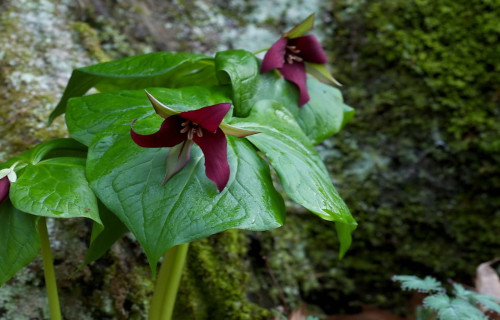
Each separate stem generally produces three relatively large leaves. These structures display an ovoid shape, usually coming to a notably sharp point at the end. In color these present a moderate shade of green, and have a smooth texture. Each averages 6 in (15 cm) long and 2 in (5 cm) wide.
Intriguingly, the fruits of the remarkable plant technically qualify as berries, and remain small in size. This typically ranges from about 0.25 – 0.5 in (0.6 – 1.2 cm). Each begins as green in color, yet turns purplish as they ripen. The interior has a fleshy quality, and contains multiple small seeds.
Without doubt, though, the most distinctive and appealing feature of the Red Trillium for most who view the wonder is its flowers. This fact holds true despite their comparatively small dimensions. This just goes to further demonstrate that Nature does not ever equate size with impressiveness.
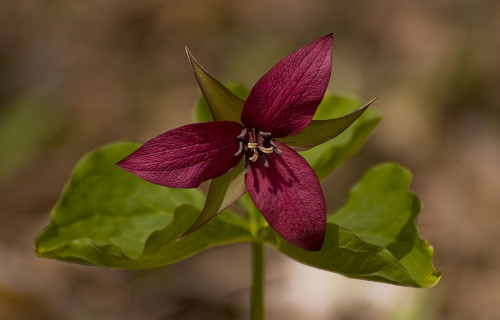
Each magnficent bloom averages measuring between 1 – 2 in (2.5 – 5 cm) in diameter. These consist of three elongated, oval-shaped petals. Each also usually shows a slight recurving, along with wavy edges. Perhaps most amazingly, though, in color, they present a deep red to maroon shade.
- Kingdom: Plantae
- Phylum: Tracheophyta
- Class: Liliopsida
- Order: Liliales
- Family: Melanthiaceae
- Genus: Trillium
- Species: T. erectum

Red Trillium Distribution, Habitat, and Ecology
Fortunately, the visually enthralling Red Trillium evolved as native to a reasonably moderate expanse of the suface of the earth. The exact location of that zone of habitation comes as no great surprise to those who know the region, though. It’s native to a certain portion of North America.
The breathtaking flora principally lives within the confines of the eastern portion of the United States and Canada. In the United States, the plant appears as far south as northern Georgia, and as far west as Minnesota. Meanwhile, in Canada, it lives as far north as Newfoundland and Labrador.
Much like many related species around the world, it displays decidedly clear preferences regarding its choice of habitat. Due to these, it most commonly appears in regions consisting of rich, moist, deciduous forests. Such locations provide it with the specific conditions which it needs to thrive.
One key component of this is very precise. This marvel of Nature needs soil that’s well-drained, but still maintains adequate moisture for its needs. It also requires high levels of nutrients in the soil, as well as shaded conditions. Given these, it most often lives as part of the forest understory.
The mesmerizing Red Trillium also serves a vital role in its local ecosystem. Its distinctive scent, often compared to a wet dog, attracts numerous insects, including beetles and carrion flies. While these pollinate the plant, ants subequently disperse the seeds, after taking them to their nest.
Its usefulness to the forest doesn’t simply end there, though. The many leaves and lovely flowers may be browsed by deer, while the seeds can be eaten by birds and small mammals. When its leaves and other organic matter decompose, they add organic material to the soil, enriching it.
Mountain Laurel

CCL: https://rb.gy/ebrx9
Mountain Laurel Facts
- Closing out this article about these 5 Stunning North Carolina Angiosperms we give you yet another mesmerizing marvel, the Mountain Laurel.
- This stunningly beautiful variety of flora most frequently goes by the largely descriptive common name for obvious reasons. The beauty does have at least two other general names, though. These consist of the somewhat unsual terms of spoonwood and calico-bush.
- In the halls of science, however, it’s perhaps much better known by its technical title. Fortunately, that’s a much simpler term for the layperson to pronounce than most such tend to be. That’s because this natural marvel bears the official moniker of Kalmia latifolia.
- The Indigenous Peoples of its region long knew of its existence, of course. But the first recorded mentioning of the plant by European explorers occurred in the year 1624. Much later, in 1750, the Swedish explorer, Pehr Kalm, sent samples of the amazing flora to his friend.
- That friend was none other than the highly esteemed Swedish botanist, Carl Linnaeus himself. Subsequent to his reception of the delivered specimens, he accomplished the first formal acknowledgement of the magnificent plant as a separate and distinct species of shrub.
- Thankfully, the remarkable Mountain Laurel continues to possess a base population in the wild that’s both stable and sufficient. That pleasant trend further seems to hold true throughout its native range. The IUCN thus currently lists it as Least Concern on its published Red List.
- Yet it nonetheless faces many potential threats to its continued existence as a species. Most of these dangers stem from the actions of humans, like most species on earth today. These perils include such dangers as habitat degradation and loss. It also faces the threat of climate change.
Mountain Laurel Physical Description
The visual splendor known as the Mountain Laurel generally captures the full attention of those fortunate enough to encounter it. While some flora do so due solely to their beauty, this marvel of evolution takes things up a notch. That’s because it also boasts some respectable measurements.
The mesmerizing Angiosperm attains an average height that ranges from roughly a surprising 6.5 – 10 ft (2 – 3m). Under ideal conditions, though, some individual specimens greatly exceed this. In point of fact, the remarkable species remains capable of reaching up to as much as 40 ft (12 m).
Each specimen produces multiple thin, branching trunks. These structures each show many separate stems, even thinner, yet equally branching in structure. Both the trunks and the numerous stems display a mainly smooth surface that ranges in color from light green to light brown with age.
The foliage of this remarkable gift of Nature develops as fully evergreen. These also evolved as notably elongated in shape. But they vary significantly in size from plant to plant. Overall, though, the leaves average 0.75 – 4 in (2 – 10 cm) in length. Their width ranges from 1 – 2 in (2.5 – 5 cm).
While these leaves, themselves worthy of notice, present a deep, waxy green, the flowers of the Mountain Laurel present a vastly different appearance. Astonishingly, these usually appear with a hexagonal shape. Occasionally, however, some examples produce blooms with a hexagonal shape!
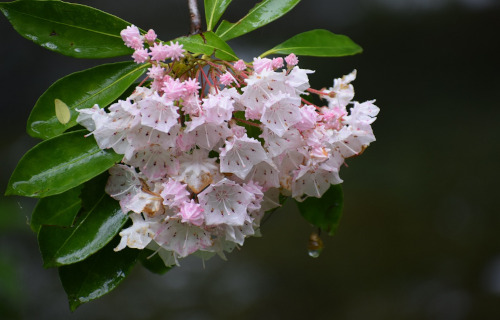
These breathtaking flowers undoubtedly represent the most appealing aspect of the plant for most viewers. The impressive Angiosperm produces these in large clusters, suspended from thin stems. Blooms present either bright white or light pink shades, varying from specimen to specimen.
- Kingdom: Plantae
- Phylum: Tracheophytes
- Class: Eudicots
- Order: Ericales
- Family: Ericaceae
- Genus: Kalmia
- Species: K. latifolia

Mountain Laurel Distribution, Habitat, and Ecology
The fabulous Mountain Laurel evolved as indigenous to a zone of habitation that’s reasonable in size, yet also quite specific in its nature. The general location of its presence likely won’t surprise many people, however. That’s true since its native to a portion of what’s now North America.
Within that range, though, the species appears naturally almost exclusively within the borders of the United States. But even there the plant only developed as native to the Appalachian Mountains, and the surrounding regions. A tiny portion of that range also extends as far as Ontario, Canada.
The breathtaking Eudicot also manifests very precise requirements and preferences for its choice of habitat. Those remain reflected in the very name of the flora. It’s evolved to flourish best in the environmental and geographical conditions common to temperate mountainous regions.
The impressively versatile plant typically appears in mountainous forest regions, and on rocky slopes. It also typically prefers soils with a moderately high level of acidity. These frequently include such varied locations as pastures and cool meadows, in addition to the local wooded areas.
The charming Mountain Laurel achieves its pollination through the concerted actions of a great multitude of sources. Like most flowering plants, that includes local bees species. Yet the wonder of creation also attracts a large number of butterflies and hummingbirds to its fragrant blooms.
This ingenious flora also evolved a surprising and extremely unique method of assuring success in this area. The filaments of the stamens in the flower bend under tension as the gorgeous bloom grows. That’s released upon the landing of an insect, thereby forcefully flinging the pollen onto it.
Regardless of its obvious beauty, though, this fabulous species remains quite toxic to many creatures. That includes goats, cattle, deer, horses, and sadly, humans. Despite this, it served several uses in herbal medicine in the past. This included various applications as a natural analgesic.
CCL: https://rb.gy/h352f
5 Stunning North Carolina Angiosperms
We hope that each of you enjoyed reading, and learning something from, this article we’ve written about these 5 Stunning North carolina Angiosperms. It’s also our fervent hope that doing so has left you with either a new or greatly renewed appreciation for such amazing wonders of Nature.
Unfortunately, however, many of their kindred around the world now find themselves facing strong threats to their continued existence as a species. Many of those dangers, in fact, stem from the actions of mankind. We must continue to do all we can to protect and preserve them all.
Check out our other articles on 5 Wonderful North American Wild Canines, 7 Captivating United States Lakes, 5 Stunning Pacific Ocean Sharks, 5 Geological Wonders of Wyoming










Leave a Reply