We sincerely hope that each of you, our readers, will thoroughly enjoy and appreciate this article we present about these 5 Wonderful Canadian Woody Shrubs. It was certainly our pleasure to gather the information for you. May it provide you with both education and increased awareness.
Certainly, these few species listed herein represent only a very limited portion of the similar marvels found in this area. It’s our belief, though, that they serve as excellent representations of the wonders that exist here. Check out some of our other articles for wide variety of similar marvels.
American Wintergreen
American Wintergreen Facts
- Leading off this article about these 5 Wonderful Canadian Woody Shrubs we present the deceptively-named American Wintergreen.
- This botanical beauty most frequently goes by the informative common name throughout its range, despite a certain confusion. It does have other names, though. These include such distinctive terms as checkerberry, boxberry, and the eastern teaberry.
- Many scientific professionals often refer to it by yet another term, however. These individuals, such as researchers, commonly use its technical name when speaking of it. But that’s the somewhat difficult to pronounce moniker of Gaultheria procumbens.
- The remarkable Angiosperm received that official name due to the work of the renowned Swedish botanist, Carl Linnaeus. He recorded the first formal acknowledgement of it as a separate and distinct species, as he did with many others.
- Fortunately, this stunning product of Nature and evolution appears to be maintaining a population base that’s both stable and sufficient. This pleasantly surprising state further seems to hold true throughout the entirety of its known native range.
- The IUCN, therefore, does not currently have a listing for the American Winterberry. Any such listing would appear on the organization’s published Red List of Threatened Species. That status remains open to change, however. It’s future isn’t fully secure.
- As most, if not all, species, it faces potential threats to its continued existence. These include such factors as habitat degradation or outright loss. Human expansion serves as the chief cause of these. Its greatest danger, though, likely comes from climate change.
CCL: https://bit.ly/3MnYCCK
American Wintergreen Physical Description
The stunning flora known as the American Wintergreen likely qualifies as one of the most easily recognized plants in its habitat range. It also possesses a distinctive visual appeal. It easily catches the eye of those who encounter it for reasons wholly other than size.
That’s because this marvelous work of evolution also ranks as a small variety of low-growing, ground hugging shrub. It’s so small, in fact, that most mature specimens only average 4 – 6 in (10 – 15 cm) in height. Nature, however, packs a lot of beauty into its small form.
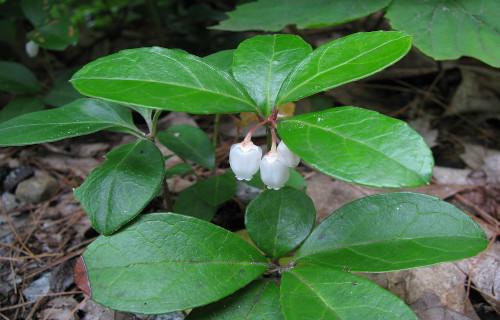
It’s leaves additionally develop as evergreen in nature. This foliage also typically develops as either ovoid or elliptical in shape. Each typically ranges in length from 0.75 – 2 in (2 – 5 cm). They remain relatively narrow, though, ranging in width from 0.5 – 0.75 in (1 – 2 cm).
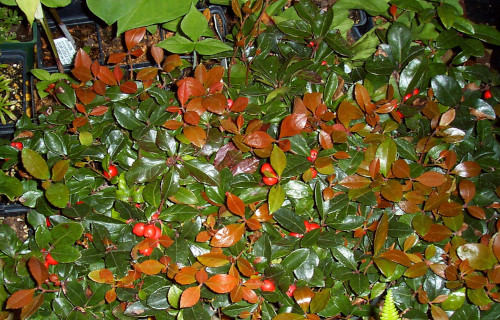
Distinctively, these also change color with the seasons. The color begins as a deep, forest-green shade for much of the year. In the Autumn, though, this slowly changes. As this season approaches, the leaves transform their coloring to a startlingly deep purple hue.
The deep green of the early leaves augments the beauty of the flowers it also develops. These form in early summer, remaining small. These hang in groups, in a pendulous manner. Their coloring typically presents as bright white, but a light pink sometimes appears.
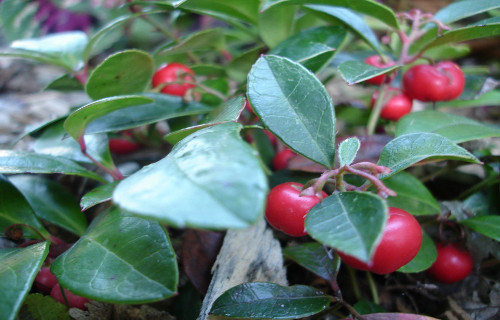
The fruit of the American Wintergreen also draws attention. That’s due to the fact that this aspect of the plant develops as a bright red in color. Each remains small, though. Its dazzling berries, their color standing out from the foliage, averages 0.25 – 0.35 in (6 – 9 mm) across.
- Kingdom: Plantae
- Phylum: Tracheophytes
- Class: Angiosperms
- Order: Ericales
- Family: Ericaceae
- Genus: Gaultheria
- Species: G. procumbens
Public Domain Image
American Wintergreen Distribution, Habitat, and Ecology
The stunning American Wintergreen evolved as native to a region of the globe well known for its abundance of natural beauty. More precisely, as its most popular common name hints at, it developed, and remains solely native to, parts of the continent of North America.
Even there, though, it only appears in portions of the continent. The plant makes its natural home in the northeastern sections of Canada and the United States. It’s seen as far north as Newfoundland, westerly to Manitoba and as far to the south as the state of Alabama.
The very nature of the flora also restricts its own natural expansion. That’s true since it evolved to strongly prefer soils with a high acidity level. Most frequently, these regions occur in deciduous, hardwood or pine forests. Specimens rarely appear anywhere else, in fact.
These regions provide it with its optimal habitat requirements. The plant prefers shaded or semi-shaded areas, which such areas provide, along with the soil needs. Intriguingly, however, the amazing Angiosperm usually only produces fruit when it grows in sunny areas.
The beautiful American Wintergreen develops from rhizomes, rather than seeds. These rarely survive forest fires, leaving it vulnerable. Pollination, meanwhile, takes place due to the actions of a wide variety of insects, including beetles, flies, and various species of bee.
It also serves a vital role in its ecosystem. Many animals consume the edible fruits, though rarely in large quantities. The fruits and berries alike remain throughout the winter, providing food for numerous species. This includes deer, turkey, grouse, bear, moose, and fox.
Mountain Laurel

CCL: https://rb.gy/ebrx9
Mountain Laurel Facts
- Next up in this compilation of 5 Wonderful Canadian Woody Shrubs comes the masterpiece of Nature appropriately named the Mountain Laurel.
- This stunningly beautiful variety of flora most frequently goes by the largely descriptive common name that we’ve used herein. It does have at least two other general names, though. These consist of the unsual terms of spoonwood and calico-bush.
- In the halls of science, however, it’s perhaps better known by its technical title. Fortunately, that’s a much simpler term for the layperson to pronounce than most such. That’s because this natural marvel bears the official moniker of Kalmia latifolia.
- The Indigenous Peoples of its region long knew of its existence, of course. But the first recorded mentioning of the plant by European explorers occurred in 1624. Later, in 1750, the Swedish explorer, Pehr Kalm, sent samples of the flora to his friend.
- That friend was none other than the esteemed Swedish botanist, Carl Linnaeus. Subsequent to his reception of the samples, he accomplished the first formal acknowledgement of the magnificent plant as a separate and distinct species of shrub.
- Thankfully, the remarkable Mountain Laurel continues to possess a base population in the wild that’s both stable and sufficient. That pleasant trend further seems to hold true throughout its native range. The IUCN thus currently lists it as Least Concern.
- Yet it nonetheless faces many potential threats to its continued existence as a species. Most of these stem from the actions of humans, like most species. These perils include such dangers as habitat degradation and loss. It also faces the threat of climate change.
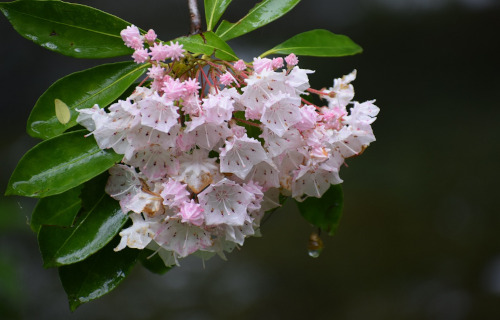
Mountain Laurel Physical Description
The visual splendor known as the Mountain Laurel captures the full attention of those who encounter it. While some flora do so due solely to their beauty, this marvel of evolution takes things up a notch. That’s because it also boasts some respectable measurements.
The mesmerizing Angiosperm attains an average height that ranges from roughly 6.5 – 10 ft (2 – 3m). Under ideal conditions, though, some specimens greatly exceed this. In point of fact, the remarkable species remains capable of reaching up to as much as 40 ft (12 m).
Each specimen produces thin, branching trunks. These each show many stems, even thinner, yet equally branching in structure. Both the trunks and the numerous stems display a mainly smooth surface that ranges in color from light green to light brown with age.
The foliage of this gift of Nature develop as evergreen. They also evolved as elongated in shape. But they vary significantly in size from plant to plant. Overall, though, the leaves average 0.75 – 4 in (2 – 10 cm) in length. Their width ranges from 1 – 2 in (2.5 – 5 cm).
While these leaves present a deep, waxy green, the flowers of the Mountain Laurel present a vastly different appearance. Astonishingly, these usually appear with a hexagonal shape. Occasionally, however, some examples produce blooms with a hexagonal shape!
These breathtaking flowers represent the most appealing aspect of the plant. The impressive Angiosperm produces these in large clusters, suspended from thin stems. Blooms present either bright white or light pink shades, varying from specimen to specimen.
- Kingdom: Plantae
- Phylum: Tracheophytes
- Class: Eudicots
- Order: Ericales
- Family: Ericaceae
- Genus: Kalmia
- Species: K. latifolia

Mountain Laurel Distribution, Habitat, and Ecology
The fabulous Mountain Laurel evolved as native to a zone of habitation that’s reasonable in size, yet also quite specific. The general location of its presence likely won’t surprise many people, however. That’s true since its native to a portion of what’s now North America.
Within that range, though, the species appears naturally almost exclusively within the United States. But even there the plant is only native to the Appalachian Mountains, and the surrounding regions. A tiny portion of that range also extends to Ontario, Canada.
The Eudicot developed very precise requirements and preferences for its choice of habitat. Those remain reflected in the very name of the flora. It’s evolved to flourish best in the environmental and geographical conditions common to temperate mountainous regions.
The versatile plant typically appears in mountainous forest regions, and on rocky slopes. It also prefers soils with a moderately high level of acidity. These frequently include such varied locations as pastures and cool meadows, in addition to the local wooded areas.
The charming Mountain Laurel achieves pollination through the actions of a multitude of sources. Like most flowering plants, that includes local bees species. Yet the wonder of creation also attracts a large number of butterflies and hummingbirds to its fragrant blooms.
This ingenious flora also evolved a surprising and unique method of assuring success in this area. The filaments of the stamens in the flower bend under tension as the bloom grows. That’s released upon the landing of an insect, forecfully flinging the pollen onto it.
Regardless of its beauty, though, this species is quite toxic to many creatures. That includes goats, cattle, deer, horses, and sadly, humans. Despite this, it served several uses in herbal medicine in the past. This included various applications as a natural analgesic.
Great Rhododendron
Great Rhododendron Facts
- Now appearing in this gathering of these 5 Wonderful Canadian Woody Shrubs we give you the breathtaking wonder known as the Great Rhododendron.
- This magnificent botanical marvel most frequently goes by the fully deserved common name for obvious reasons. Yet it also has several other, less often used general titles. These include the terms rosebay rhododendron and great laurel, among others.
- In the scientific community, though, it’s better known by its technical title. That’s a term that, while somewhat lengthy, remains reasonably simple for the layperson to pronounce. That’s because it holds the technical moniker of Rhododendron maximum.
- This breathtaking variety of flora received that appellation due to the efforts of Carl Linnaeus. The esteemed Swedish botanist accomplished the first official recognition of the plant as a separate and distinct species. He achieved that notable deed in 1753.
- It stands out from related species due to sheer size. That’s true since it’s one of the largest of all known varieties of rhododendron. Due to the combination of beauty and dimensions, it’s become extremely popular for landscaping in appropriate climates.
- Although the Great Rhododendron appears in a very specific range, it seems to be maintaining an abundant wild population. That further seems to hold true across the entirety of its native range. The ICUN therefore lists it as Least Concern on its Red List.
- It nevertheless faces at least a few potential threats to its continued existence in the wild. Most of these stem from human activities, both directly and indirectly. Chief among these are the dual threats of habitat loss and ongoing climate change.

CCL: https://rb.gy/h352f
Great Rhododendron Physical Description
The stunning Great Rhododendron truly merits its name. It also quickly captivates those who encounter it, either in the wild or when cultivated. Its beauty alone isn’t the only reason for this, though. That’s due to the fact that it clearly earns the title great, given its size.
This variety of evergreen shrub generally attains heights of around 13 ft (4 m) at full growth. Some specimens, however, grow much larger than this. In fact, under ideal environmental conditions, the amazing Angiosperm sometimes reaches heights of 33 ft (10 m)!
Its primary branches occasionally become quite thick and sturdy. These often display a thick, broken bark-like texture, similar to a tree. This typically shows a light brownish-tan shade. Its numerous smaller branches, meanwhile, generally display a lighter green color.
The plant also boasts some impressive foliage. Its leaves develops as bluish-green elongated ovals, with a leathery texture. Depending on the size of plant, these range in length from 3.5 – 7.5 in (9 – 19 cm). Each also usually measures from 0.8 – 1.57 in (2 – 4 cm) in total length.
Yet its the flowers of the Great Rhododendron that unquestionably form its most appealing feature. These fabulous bell-shaped blooms typically appear in clusters. Normally, a group holds 16 – 24 of these, all of which range in color from a pale white to purplish pink hue.
The fruit of this marvel of botanical beauty develops as a dry capsule structure. This part of the plant averages approximately 0.6 – 0.8 in (1.5 – 2 cm) in length. Despite its small size, though, each of these structures contains a large number of extremely small seeds.
- Kingdom: Plantae
- Phylum: Tracheophytes
- Class: Eudicots
- Order: Ericales
- Family: Ericaceae
- Genus: Rhododendron
- Species: R. maximum

CCL: https://rb.gy/zlyjl
Great Rhododendron Distribution, Habitat, and Ecology
The aptly-named Great Rhododendron evolved as endemic to a moderately broad expanse of the globe. That exact location, however, likely won’t surprise many people. That’s because this remarkable flora evolved as native to a portion of the continent of North America.
There, the plant appears mostly in the United States, with a small portion occurring in southeastern Canada. It lives almost exclusively in the Appalachian Mountains, along the eastern section of the United States. That range extends from Alabama to Nova Scotia.
Although adaptible, it shows decided preferences in its choice of habitat. That’s reflected in the fact that it evolved in the mountains. There, it principally occurs in regions of partial shade, possessing a precise combination of rich, moist, acidic, and well-drained soils.
The greatest concentration of the Angiosperm occurs in what’s now the Great Smoky Mountains National Park. This straddles the borders of Tennessee and North Carolina. In total, it appears in 12,000 sq mi (31,080 sq km) in the southern portions of these mountains.
In its native environment, the Great Rhododendron dominates much of the understory. It primarily reproduces through vegetative cloning, but also does so through sexual means. Its primarily pollinators consist of mulitiple local insect species, such as bees and butterflies.
Followig blooming, the seed capsules appear between March and August. Each contains about 400 small seeds. Some animals, mainly deer, feed on the plant. But, for humans, the leaves are relatively toxic. Certain chemicals in the species do have medicinal uses, though.
Kinnikinnick
CCL: https://bit.ly/3BjuK7g
Kinnikinnick Facts
- Making its presence known now in this listing of 5 Wonderful Canadian Shrubs is the one with the most distinctive name, the Kinnikinnick.
- This somewhat difficult term serves as the most frequently used common name for this beautiful variety of woody plant. The marvel does have a few other names, though. These include such titles as pinemat manzanita and bearberry. That also applies to others.
- Inside the scientific community, however, it’s typically referred to by its technical moniker. As often happens, though, that’s a hard name for the layperson to pronounce. That’s because the marvel of Nature holds the formal name of Arctostaphylos uva-ursi.
- The tongue-twisting common name comes directly from the language of a Native American nation living in its region. The Algonquian People long knew of and utilized the marvelous flora. By any of these terms, however, it’s an impressive little beauty.
- As mentioned above, the alternate term of bearberry applies to other species as well. This often creates confusion. That state arises due to the fact that a remarkable 14 known subspecies of the Angiosperm exist. In many instances, their areas overlap.
- Forunately, the beautiful Kinnikinnick seems to be maintaining a population base that’s both stable and sufficient. That pleasant condition also appears to hold true throughout its range. The IUCN thus lists it as Least Concern on its published Red List.
- Neveretheless the wonder of Nature faces several potential threats to its continued existence. These mainly include human created conditions. Those perils include habitat degradation and loss. Its greatest, though, likely comes from climate change.
CCL: https://bit.ly/41nG50E
Kinnikinnick Physical Description
The intriguing Kinnikinnick quickly appeals visually to most people fortunate enough to encounter it. Yet it does so principally due to its beauty and colors. That’s because, regardless of other factors, it’s a small member of its Family. Nature doesn’t care about that.
Individual specimens develop as small, ground-hugging shrubs. The height of each separate plant varies significantly, however. This naturally holds true in different parts of its range, but even occurs among examples in close proximity. The exact reason’s a small mystery.
Overall, though, individual plants attain vertical measurements ranging from only 2 – 12 in (5 – 30 cm). But, as a general principle, this flora rarely exceeds 6 in (15 cm) in height. The Angiosperm makes up for this, though, by typically growing in extremely dense clusters.
It produces long, flexible stems from single roots. From these, numerous branching twigs develop, usually growing vertically. These start out displaying either a pale green or white color. As they mature, their color changes to reddish-brown, and with a smooth texture.
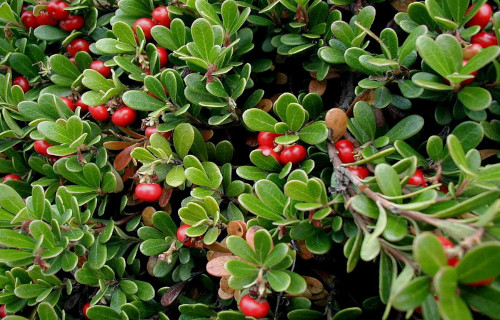
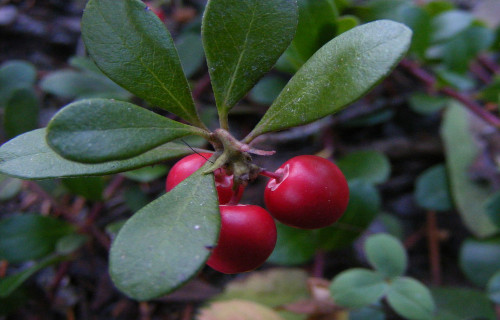
The leaves of the dazzling Kinnikinnick remain small, averaging 1.5 in (4 cm) in length. Each also averages 0.5 in (1 cm) in width. The upper side of each displays a shiny dark green shade. Meanwhile, the underside shows a lighter hue. These feel thick and stiff in nature.
Yet it’s the flowers and fruits that catch the most attention. The blooms develop in clusters, and develop a urn-shape. Each varies in color from white to light pink. Its tiny fruits range in diamater from 0.25 – 0.5 in (0.6 – 1.3 cm). They remain on the plant until early winter.
- Kingdom: Plantae
- Phylum: Tracheophytes
- Class: Eudicots
- Order: Ericales
- Family: Ericaceae
- Genus: Arctostaphylos
- Species: A. uva-ursi

CCL: https://bit.ly/3LSBoX3
Kinnikinnick Distribution, Habitat, and Ecology
The breathtaking Kinnikinnick evolved as native to an extraordinarily broad swathe of the globe. The full extent of that range might surprise some people, though. That’s true since it has a circumpolar distribution, appearing throughout most of the Northern Hemisphere.
In North America, it lives in Alaska, Canada, and much of the United States. It’s especially prevalent in the Appalachian Mountains. In Asia, the plant grows from Siberia to Turkey and through the Himalayas. Meanwhile, in Europe, it grows from Iceland to Greece.
This marvelous plant developed as highly versatile and adaptible in its choice of habitat. It therefore appears in a wide range of environmental conditions. The remarkable product of nature and evolution does demonstrate a preference for moderate temperatures.
Due to that, it typically only appears at higher altitudes in the more northerly part of its range. Other than that, it most commonly grows in temperate forest regions. Yet it also feels at home even in urbanized areas. It’s commonly seen in parks and rock gardens.
The gorgeous Kinnikinnick typically blooms from May to June across most of its range. A wide variety of insects pollinate the species, including various locally prevalent bees. It serves as a vital food source for numerous types of animals, including deer and bears.
Native Americans consumed its fruits as well. They also used its dried leaves for smoking. Young leaves were also often used to make tea. Various parts of the plant also played a prominent role in local herbal medicines. Other parts even serves as a source of dyes.
American Cranberrybush
CCL: https://bit.ly/3sNPdwi
American Cranberrybush Facts
- Closing out this compendium of these 5 Wonderful Canadian Woody Shrubs we present you with the other deceptively-named marvel, the American Cranberrybush.
- This stunning creation of countless ages of evolution most frequently goes by the slightly confusing common name applied to it here. It does have other, less often used names, however. That’s a normal situation, though, holding true for many species.
- These alternate general appellations include the terms highbush cranberry and the similar high bush cranberry, for starters. However, it’s also known to some people in its range as the cranberrybush viburnum. Whichever term one uses, though, it’s gorgeous.
- Professionals, such as researchers, though, generally refer to it by its formal, technical name. That’s the somewhat difficult to pronounce term of the Viburnum trilobum. It also bears an extremely close relationship to similar species in other parts of the world.
- The Angiosperm further received the technical name at the hands of the American botanist Humphrey Marshall. The noted researcher and plant dealer accomplished the first recorded official recognition of the plant as a separate and distinct species.
- For the moment, the American Cranberrybush appears to be maintaining a population base that’s both sizeable and sufficient. This fact also seems to hold true throughout the entirety of its range. The IUCN, therefore, has no listing for it on its Red List.
- The natural wonder must be considered to be facing at least some threats to its existence, however. That’s because most species now do. Habitat loss, due to human expansion, poses a threat. Its greatest danger, though, comes from climate change.
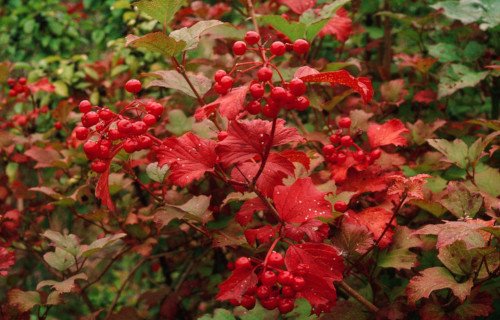
CCL: https://bit.ly/3H4JEys
American Cranberrybush Physical Description
The gorgeous American Cranberrybush easily impresses those fortunate enough to encounter it. It does so, though, for several reasons. While sheer physical size isn’t its only appeal, this characteristic of the plant nevertheless does merit a certain level of appreciation.
The flora evolved as an excellent example of a deciduous shrub. In this category, however, it ranks as an above average sized member. That’s due to the fact that individual specimens attain heights of as much as 13 ft (4 m). Most, though, remain slightly smaller in size.
The natural construction of this particular flora further enhances its distinctiveness. The bark of the shrub develops as relatively rough, with a somewhat scaly texture. This aspect of the amazing Angiosperm also presents a gray color, that varies from light to dark.
Its stems also arch sharply vertically, and develop as quite densely packed. The short, thin twigs that branch off of these typically manifest a reddish-brown hue. These it also tends to produce in copious quantities, making for yet another relatively dense structure.
Its foliage, meanwhile, usually develops opposite, and three-lobed in structure. These develop as moderate-sized, though. Each averages 2.25 – 4.75 in (6-12 cm) in length, and 2-4 in (5-10 cm) in width. Their shape actually remains very similar to maple leaves.
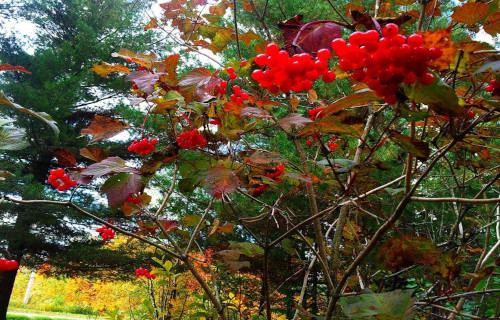
The stuning flowers of the American Cranberrybush also stand out. These present a brilliant white shade, and generally appear in groupings up to 5 in (13 cm) in diameter. The fruit develops as small, with an oblong shape. Each averages 0.6 in (1.5 cm) by 0.5 in (1.2 cm).
- Kingdom: Plantae
- Phylum: Angiosperms
- Class: Eudicots
- Order: Dipsacales
- Family: Adoxaceae
- Genus: Viburnum
- Species: V. trilobum
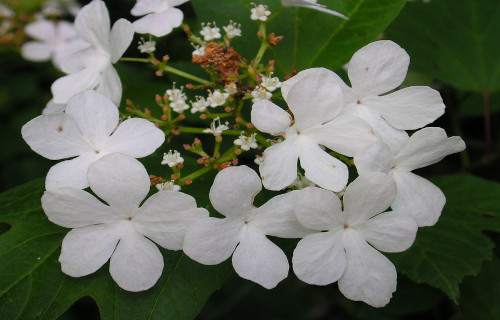
CCL: https://bit.ly/3sT6mER
American Cranberrybush Distribution, Habitat, and Ecology
The remarkable American Cranberrybush evolved as native to a region of the globe well known for its abundance of natural beauty. That’s due to the fact that it developed in the portion of the earth that now forms the continent known as North America.
As its very name indicates, the majority of the zone of native habitation consists of part of the United States. There, though, it only lives in the far northern sections, from coast to coast. The great majority of its population, however, appears in the northeast.
Yet its habitat range also extends into the extreme southeast sections of Canada. Outside of these two areas, a handful of small, thinly populated concentrations also appear elsewhere in both countries. Its presently unknown if this is a natural occurrence, though.
Within these areas, however, it seems to be highly adaptible in its habitat requirements. Due to this, it makes its home in a wide variety of regions. These include such diverse ecosystems as sandy swamps, moist woodlands, forested bogs, and even roadside ditches.
Like most of its kindred, the American Cranberrybush achieves pollination via the actions of various local insects. Mosts specimens produce fruit after 5-6 years. At that time, numerous animals consume the fruits, especially birds, thereafter spreading the seeds via droppings.
Despite its name, however, it’s not actually a variety of cranberry at all. The name derives from the strong resemblance of its fruit to true cranberries. Though rather sour to human taste, the fruits are fully edible, and contain high amounts of several types of vitamins.
5 Wonderful Canadian Woody Shrubs
CCL: https://rb.gy/h352f
We truly hope that each of you greatly enjoyed reading, and hopefully learning from, this article we’ve written about these 5 Wonderful Canadian Woody Shrubs. It’s also our hope that doing so has left you with either a new or renewed appreciation for such wonders of Nature.
Unfortunately, however, many other species located around the world now find themselves facing strong threats to their continued existence. Many of those dangers, in fact, stem from the detrimental actions of mankind. We must do all we can to protect and preserve them all.
Check out our other articles on 5 Magnificent Mammals of Greenland, Earth’s Amazingly Abundant Avians, 5 Amazing Animals of Greece, Africa’s Many Geological Masterpieces










Leave a Reply