CCL: https://tinyurl.com/hp6b93c7
We hope that each of you, our readers, will enjoy and appreciate this article we present to you about these 5 Wonderful West Virginia Insects. It was our very great pleasure to compile the various information for you. May it serve to provide you with both education and increased awareness.
Certainly, these few species listed within this article represent only a portion of the similar marvels in this region. It’s our belief, though, that they nonetheless serve as excellent representations of the wonders that exist. Check out some of our other numerous articles for similar marvels.
Baltimore Checkerspot

Baltimore Checkerspot Facts
- Starting off this article about these 5 Wonderful West Virginia Insects we present you with the stunning creature known as the Baltimore Checkerspot.
- This beautiful Lepidoptera most often goes by the somewhat deceptive common, as well as informative, name across its entire range. Yet, it does have a few other general titles. These consist of the similar appellations Phaeton checkerspot and Baltimore butterfly.
- Within the scientific community, however, it’s perhaps better known by its technical designation. Like many such epithets, though, that’s generally rather difficult for the layperson to pronounce. That’s because the delicate Arthropod holds the tag of Euphydryas phaeton.
- The amazing invertebrate received that name due to the efforts of Dru Drury. The well-respected British entomologist accomplished the first official recognition of the insect as a separate and distinct species. He achieved that scientifically noteworthy deed in the year 1773.
- Its most popular general title stems from several historical and cultural bases in part of its greater range. It received that due to its similarity of colors to the family crest of the first Lord Baltimore, during the colonial period in the region. Today, it’s also an official state insect.
- Thankfully, the gorgeous Baltimore Checkerspot seems to still be maintaining a popultion base that’s both stable and sufficient. That pleasant state also appears to hold true throughout the entirety of its range. The IUCN thus presently has no listing for the creature on its Red List.
- It nevertheless still faces numerous potential threats to its continued existence as a species. In this respect, it faces the same dangers as all forms of life on earth today. Most of these perils stem from the actions of man, and include the dangers of habitat loss and climate change.
CCL: https://tinyurl.com/462rnnjn
Baltimore Checkerspot Physical Description
The fascinating Baltimore Checkerspot typically draws the attention of those individuals who encounter it with relative ease. The animal usually does so, though, due more to its striking appearance than size. That’s true since, in that respect, it ranks as an average-sized butterfly.
The creature also follows a pattern common to many of its relatives, both in terms of physical size and appearance. That’s demonstrated by the fact that it manifests a certain degree of the physiological trait of sexual dimorphism. In its case, however, this trait remains relatively mild.
Though exceptions occur, specimens typically attain wingspans averaging between 1.75 – 2.5 in (4.5 – 6.5 cm). Females of the species, though, tend to be on the higher end of this range, while the males usually average smaller. This tendency accounts for the moderate gender-based sized difference.
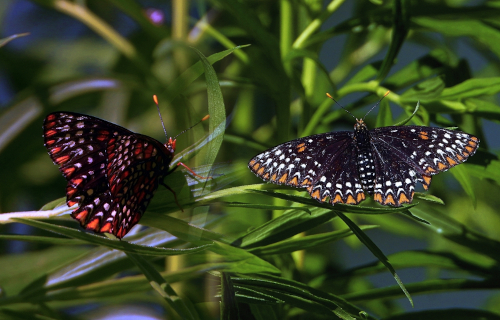
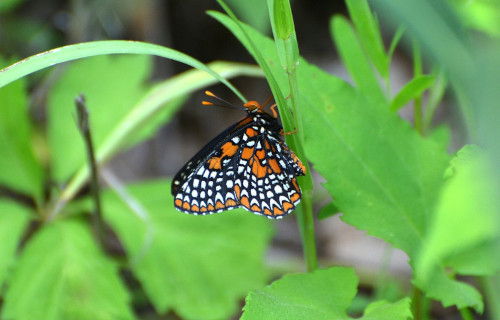
The body of the marvel of Nature and evolution developed to display as black in color, often with small orange or yellow markings showing. It also has clubbed antennae, typical of butterflies in general, which develop as dark with lighter tips, creating another eye-catching pattern of coloring.
Yet, it’s doubtless the astounding wings of the stunning Baltimore Checkerspot that create the greatest appeal among most of its fortunate viewers. It’s also here that the sex-based differences manifest themselves again. Both genders have the same patterns, but males are brighter.
The upper wings have a dark black base, giving a strong contrast to the colorful spots. A band of small white spots lines the outer edges of both forewings and hindwings. Near the base of the wings, there are several orange or red-orange spots arranged in rows, adding bright highlights.
Appearances differ somewhat on the underside, or ventral side of the wings of the butterfly, however. That’s because, although the basic pattern remains the same, the colors present as somewhat more subdued. This includes the black appearing as more of a somewhat brown hue.
- Kingdom: Animalia
- Phylum: Arthropoda
- Class: Insecta
- Order: Lepidoptera
- Family: Nymphalidae
- Genus: Euphydryas
- Species: E. phaeton
Baltimore Checkerspot Distribution, Habitat, and Ecology
The eye-catching Baltimore Checkerspot evolved as native to a moderate expanse of the earth’s surface. That zone of habitation’s location, however, likely won’t surprise anyone, given that part of it’s implied by the name itself. It’s indigenous to a portion of the continent of North America.
Within that greater landmass, however, it lives within the national boundaries of the countries of Canada and the United States. The more northern portion of its territory extends into northern range extends into southern Ontario. Yet, occasional sightings of it do occur in southern Quebec.
Meanwhile, the majority of its presence occurs inside the United States. In both the Northeastern and Midwestern States, the species frequently appears from Maine down through the Appalachian Mountains, including states such as New York, Pennsylvania, New Jersey, Maryland, and Virginia.
It also has a Midwestern Range. Here, populations are also present in states like Ohio, Indiana, Illinois, Michigan, Wisconsin, and Iowa. And, in the Southeastern part of the country, it lives in some parts of Tennessee and North Carolina, though it’s less common in more southern regions.
Much like many of its relatives, it displays extremely clear and specific preferences regarding its choice of habitat types. Regrettably, this creates the net result of it having a patchy distribution across its range due to its habitat specialization and fragmentation of suitable environments.
This remarkable creation of Nature and natural evolution principally inhabits regions composed of various wetlands. These locations most typically consist of areas of marshes and wet meadows. The marvel of the invertebrate world also strongly prefers the presence of its primary host plant, as well.
Despite this strong general preference, however, smaller concentrations of the butterfly do sometimes appear in another type of habitat. That consists of the edges of deciduous forests or wooded areas. This holds especially true where these habitats border wetlands or moist meadows.
The larvae of the Baltimore Checkerspot feed almost exclusively on the white turtlehead, a wetland plant. Only if its’s scarece do they feed on others, such as the English plantain. Adults, meanwhile, feed on nectar from a variety of flowering plants, such as milkweed, dogbane, and thistles.
Females lay their eggs in clusters, usually on the undersides of the leaves of their host plants, primarily the same white turtlehead. After hatching, the larvae feed gregariously on the host plant. As they mature, the larvae become solitary in nature, often overwintering in the larval stage.
Fully mature adults emerge in early summer. This typically occurs between the period of late May and July, depending on the region in which the individual lives. Unfortunately, the adults remain relatively short-lived, with their primary focus being on mating and reproduction of the species.
Dogbane Beetle

CCL: https://tinyurl.com/56xey2at
Dogbane Beetle Facts
- Next up in this compilation of 5 Wonderful West Virginia Insects comes the dazzling creature named the Dogbane Beetle.
- This eye-catching invertebrate most frequently goes by the intriguing common name that we’re using across its native range. The marvel does have a few alternate titles that it’s known by, though. These include the terms Metallic Tortoise Beetle and Iridescent Leaf Beetle.
- Inside the halls of science, however, it’s possibly much better known by its purely technical tag. That one, though, like many such, is somewhat hard for the layperson to pronounce. That’s because this amazing product of Nature and evolution bears the moniker Chrysochus auratus.
- The stunning insect received that epithet due to the efforts of Johann Christian Fabricius, a student of Carl Linnaeus. This researcher accomplished the first official recognition of it as a separate and distinct species. He achieved that scientifically noteworthy deed in the year 1775.
- This fascinating Arthropod’s quite well-known among entomologists for a variety of reasons. High on this list stands its unusual reproductive behavior. The insect lives a highly polygamous lifestyle. The mating process itself lasts for many hours, sometimes more than a day!
- Fortunately, the gorgeous Dogbane Beetle appears to be thrive, and maintain a population that’s both stable and sufficient. That most pleasant state also seems to hold true throughout its entire range. The IUCN therefore does not presently have a place for it on the Red List.
- Nonetheless, this natural marvel still faces many potential threats to its continued existence as a species, at least. In this regard, it faces the same dangers as all forms of life on earth today. Most of these derive from the acts of man, including habitat loss and climate change.
CCL: https://tinyurl.com/3zv9v6vh
Dogbane Beetle Physical Description
The magnificent Dogbane Beetle rarely if ever fails to mesmerize those individuals fortunate enough to notice it in its native environment. That principally occurs, however, due more to its obvious visual appeal than any factor of size. In that respect, it’s a small-to-medium member of its Order.
It does differ from many other creatures around the world, including many of its kindred, in one respect, though. That’s the fact that it displays only the tiniest degree of the physiological characteristic known as sexual dimorphism. This makes distinguishing the genders visibly difficult.
Females do attain a greater average size than their male counterparts, it’s true. Yet, that difference remains so small as to be undetectable with the naked eye. They’re also very slightly more robust in shape. Obviously the genitalia are different, but remain wholly invisible without magnification.
Otherwise the two genders present the same outward appearance to the casual observer. The body reaches a mean length equaling roughly 0.3 – 0.4 in (8 – 11 mm). In width, it also averages about 0.16 – 0.24 in (4 – 6 mm). This makes the wonder roughly the size of a standard pencil eraser.
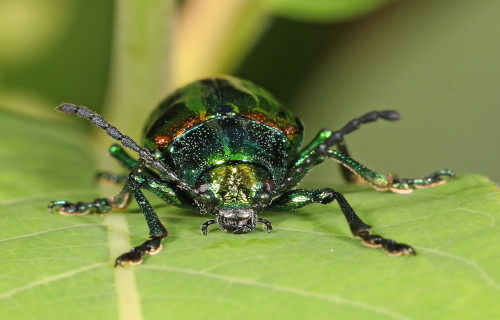
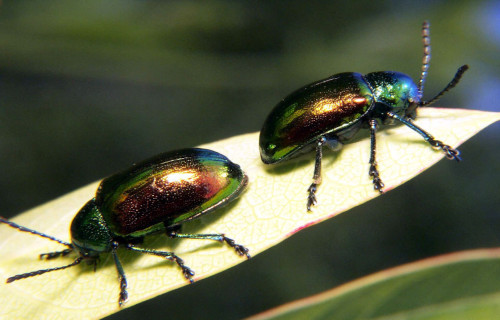
The shape of the body develops as dome-like and compact, possessing a smooth, rounded back. Like most of its countless relatives, it also evolved wing cases. These develop as shiny and hard, covering the hindwings and abdomen. They display no clear markings, just a shimmering surface.
Other physical features of the breathtaking Dogbane Beetle also catch the eye. It has medium-length, thread-like antennae, often dark or black in color. Its legs, mwawhile, appear thin and dark-colored, sometimes with a slight metallic sheen. The surface’s consistently smooth and glossy.
Yet, it’s unquestionably the dazzling array of colors that most stands out about this species. This consists of brilliant, metallic green or blue, often with gold, copper, or red highlights depending on the angle of the light. This iridescence occurs due to its structural coloration, not pigment.
- Kingdom: Animalia
- Phylum: Arthropoda
- Class: Insecta
- Order: Coleoptera
- Family: Chrysomelidae
- Genus: Chrysochus
- Species: C. auratus
CCL: https://tinyurl.com/3ptdyfa9
Dogbane Beetle Distribution, Habitat, and Ecology
The beautiful Dogbane Beetle evolved as indigenous to a moderately broad expanse of the surface of the globe. Precisely where that expansive zone of habitation lies probably won’t surprise a great multitude of people. That’s because the remarkable beetle developed as native to North America.
Within the boundaries of that continent, the intrepid insect appears to be native solely to the general eastern and central portions of the landmass. Part of that range includes sections of the nation of Canada. There, it’s only known to occur in southern Ontario, Quebec, and Manitoba.
The majority of its native territory resides within the confines of the United States. There, in the east, its range extends as far north as Maine, and as far south as Florida. Spreading westward, the insect inhabits sections of the Great Plains, including states like Texas, Nebraska, and Minnesota.
Nature provided this enthralling beetle with a distinct evolutionary advantage over many other competing creatures. That’s the developement of an impressive degree of flexibility regarding its choice of habitat. The beautiful invertebrate’s therefore found in a wide variety of ecosystems.
Man of its numbers populate areas of meadows and open fields. Forest edges and clearings also serve as a common home to the insect. Prairies and old fields represent another location where it’s often seen. Displaying its versatility, it also commonly frequents roadsides and ditches of all sizes.
The ecology of this delightful Arthropod remains closely tied to its host plant, its chemical defenses, and its role in the food web. This serves as one of the limiting factors of its habitation range. Due to its dependency on a specific food source, it only lives where it finds this in sufficient quantity.
The animal feeds almost exclusively on varieties of dogbane plants, hence the name. These plants contain toxic compounds which the beetles ingest and sequester as a defense mechanism. The larvae feed on the roots, while adults of the species feed on the leaves and stems, both voraciously.
This dietary preference serves a pivotal role in its survival. After consuming these, it becomes not only unpalatable, but potentially lethal to would-be predators. Its bright, metallic iridescence also sends notice to those, since, in Nature such colors commonly represent a warning signal of toxicity.
The female of the Dogbane Beetle lays large numbers of eggs. These she typically places on or near the host plant. Larvae feed on roots underground, pupate in the soil, and emerge as adults in mid to late summer. Adults live for several weeks, during which they feed, mate, and lay their eggs.
This natural wonder plays an important role in the native plant-insect ecosystems it inhabits. Among other factors, its feeding habits help to regulate dogbane populations. Though only a few specialized predators feed on it, the insect nonetheless plays a role in the food chain in that regard.
Spring Azure
CCL: https://tinyurl.com/hp6b93c7
Spring Azure Facts
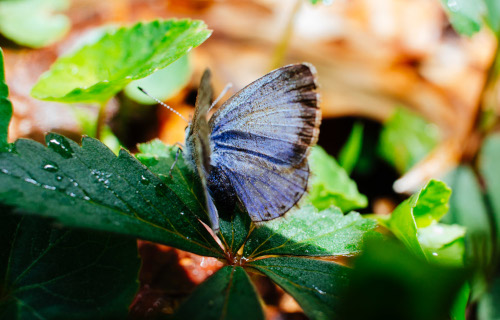
- Our next choice for inclusion in this gathering of these 5 Wonderful West Virginia Insects bears the colorful title of Spring Azure.
- This beautiful creation of Nature and evolution most frequently goes by the charming common name across its native range. Yet, the marvel does have a few other general titles that it’s also known by. These include such terms as Northern Azure, Spring Blue, and Echo Blue.
- Inside the hallowed halls of science, however, it’s perhaps much better known by its purely technical designation. Thankfully, that one’s simpler for the layperson to pronounce than most such tags. That’s because the stunning Lepiodtera bears the official moniker Celastrina ladon.
- The lovely insect received that particular epithet due to the efforts of Pieter Cramer. That highly respected Dutch entomologist recorded the first formal acknowledgement of it as a separate and distinct species. He achieved that scientifically noteworthy deed in the year 1780.
- Along with its undeniable appeal, the beautiful invertebrate also currently represents a source of some debate among taxonomic authorities. That’s due to a disagreement between members. Some consider it a subspecies of another insect, while others consider it a full species.
- Fortunately, the remarkable Spring Azure appears to be maintaining a population base that’s both stable and sufficient. That pleasant state also seems to hold true throughout the entirety of its known range. The IUCN therefore does not yet show it on its published Red List.
- It nevertheless should be considered as facing several potential threats to its continued existence as a species, at least. In this regard, it’s endangered by the same perils as all forms of life on earth. Most of these hazards stem from the actions of man, including climate change.
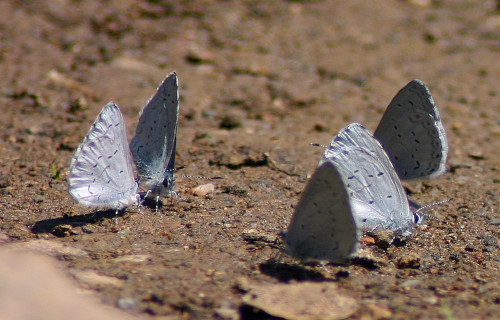
Photo: David A. Hofmann
CCL: https://tinyurl.com/4trju48p
Spring Azure Physical Description
The stunning Spring Azure generally captivates and enthralls those individuals fortunate enough to encounter one of these marvels. It typically does so, though, due more to its mesmerizing beauty than impressive physical stature. That’s because it’s a comparatively small type of butterfly.
Regarding this part of its nature, it also follows a natural pattern quite common among most fauna, including its many relatives. That’s the fact that it displays a certain amount of the physiological characteristic of sexual dimorphism. In its case, this trait manifests in terms of its coloring.
The lovely creatures reach a mean body length equaling approximately 0.3 – 0.5 in (0.8 – 1.2 cm). Overall, individuals of both genders also attain an average wingspan measuring between 0.75 – 1.25 in (1.9 – 3.2 cm). Although exceptional individuals naturally occur, they rarely exceed this by much.
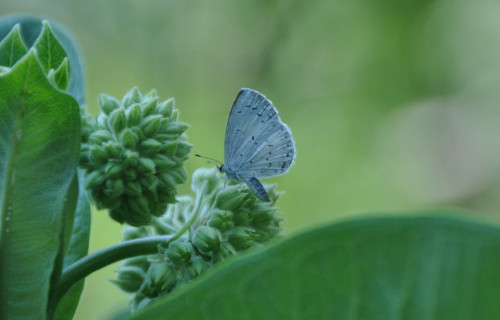
The body itself additionally develops a form similar to others of its kind. This evolved as relatively slender, and slightly blue-gray in color. It’s also covered in fine, short scales, providing it with a fuzzy appearance. The antennae evolved as black and white banded, with small clubs at the tips.
Without doubt, however, it’s the wings of the gorgeous Spring Azure that capture the most attention from its many admirers. This feature also forms the primary sex-based difference between males and females. The contrast, though, remains minimal, and easily overlooked by casual observers.
Among males of the species, the upper wing presents a very bright, uniform shade of blue. Yet, the underside displays a pale gray to whitish with fine black dots. Meanwhile, a dark margin frequently, though not always, appears on the upper wing. It’s also slightly smaller than the female.
Females, however, manifest a somewhat duller blue with dark borders, especially on the forewings. The underside of their wings evolved as similar, but sometimes slightly darker or more marked. And the margins on their upper wings, when present, at least, tend to be broader than in males.
- Kingdom: Animalia
- Phylum: Arthropoda
- Class: Insecta
- Order: Lepidoptera
- Family: Lycaenidae
- Genus: Celastrina
- Species: C. ladon
CCL: https://tinyurl.com/4dx9vfwf
Spring Azure Distribution, Habitat, and Ecology
The fabulous Spring Azure evolved as indigenous to a moderately broad expanse of the surface of the earth. Just exactly where that zone of habitation lies likely won’t surprise anyone, though. That’s because the remarkable insect developed as native to a specific portion of North America.
Within the borders of the United States, it primarily appears throughout the eastern and central portion of the country. In the northern part of the nation, that range extends from both the state of New England and the Great Lakes region, south to northern Florida, and west to the Great Plains.
It’s also common in the southern sections of Canada. There, the marvel remains especially prevalent in and around southern Ontario, Quebec, and parts of Manitoba and the Maritimes. Though it’s rarely spotted there, the southern part of its range extends into northern Mexico.
Much like many Lepidoptera, this work of Nature displays decidedly clear and strong preferences regarding its choice of habitat. Although the butterfly occupies a variety of habitats, it shows a strong preference for environments that support the flowering shrubs and trees its larvae feed on.
Its most common type of environment consists of combinations of deciduous woodlands and forest edges. The invertebrate prefers openings, trails, and sunny edges in or near mixed hardwood regions. It’s also frequently seen in riparian areas, such as along streams, rivers, and wetlands.
Other regions away from populated areas that it favors include open, sunny areas with scattered shrubs and early-flowering plants. Yet, it doesn’t shy away from man’s presence, either. It sometimes visits ornamental flowering shrubs, especially early in the spring, in human-altered landscapes.
The ecology of the breathtaking, and aptly-named, Spring Azure developed as shaped by its role in multiple facets of Nature. These include early spring ecosystems, its relationships with host plants and ants, and its various interactions with other Celastrina species within its native regions.
In its larval stage, it feeds as a herbivore. These principally, though not exclusively, consume flower buds and young fruits of woody plants and shrubs. Typical hosts consist of Dogwood, New Jersey Tea, Spirea, Viburnum, and Cherry. The adults, however, only feed on nectar, aiding in pollination.
Intriguingly, it displays the same mutualistic relationship with ants as other members of its Family. Larvae have nectary organs that secrete sugary substances. This sweet serves to rewards ants, which in turn protect the larvae from the numerous predators and parasitoids that threaten them.
Across the majority of its range, this wonder of evolution produces only a single generation per year. Adults emerge early in the Spring, thus the principal common name. This usually occurs between March and May, depending on latitude. Females lay their eggs on host plant flower buds.
Eastern Dobsonfly
CCL: https://tinyurl.com/459hsxvz
Eastern Dobsonfly Facts
- Now appearing in this compendium of 5 Wonderful West Virginia Insects we give you the unexpected natural wonder named the Eastern Dobsonfly.
- This imposing creation of Nature and evolution most frequently goes by the unassuming common name across it territory. It does have a few other general titles, though. These include such terms as Hellgrammite, Dobson, and Fishfly, among other, locally used names.
- Within the scientific community, however, it’s perhaps better known by its technical designation. This one, though, like many such tags, remains somewhat difficult for the layperson to pronounce. That’s because the insect bears the formal tag of Corydalus cornutus.
- The marvel of Nature received that moniker due to the efforts of Carl Linnaeus himself. The highly esteemed Swedish biologist recorded the first official recognition of it as a separate and distinct species. He achieved that scientifically noteworthy feat in the year 1758.
- Fortunately for it, the amazing Eastern Dobsonfly appears to be maintaining a population base that’s both stable and sufficient. That pleasant state also seems to hold true throughout the entirety of its native range. The IUCN therefore currently does not show it on its Red List.
- The species should nevertheless still be considered as facing multiple potential threats to its continued existence. In this, it’s dealing with the same perils as all forms of life on earth today, most of which stem from the actions of man. Chief among them stands climate change.
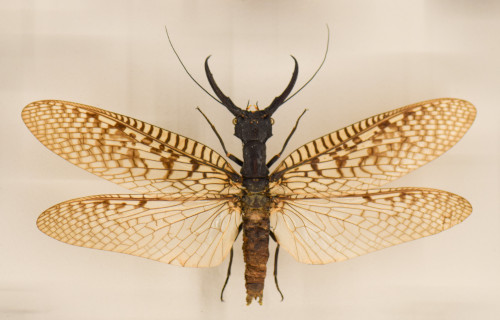
CCL: https://tinyurl.com/22y23f9m
Eastern Dobsonfly Physical Description
The astonishing Eastern Dobsonfly never fails to capture the attention of anyone who encounters an adult of the species. This occurs, though, due to a combination of factors, unlike with many insects. That’s true due to both its astounding appearance and surprising sheer physical dimenstions.
In the latter regard, though, it does follow a pattern of development common among many creatures. That’s the fact that it displays a certain degree of the physiological characteristic of sexual dimorphism. In its specific case, however, this attribute only manifests in a small, particular manner.
As a general principle, males of this wonder of evolution achieve a marginally greater length than their female counterparts. This specific gender itself reaches an incredible mean length equaling between 4 – 5.5 in (10 – 14 cm). The females, however, generally remain somewhat shorter than this.
The average wingspan for this attention-grabbing Arthropod also leaves most viewers astounded. Among fully mature specimens of either sex, this attribute measures as much as 7 in (18 cm)! Though rare, exceptional members of the species sometimes exceed this already amazing span.
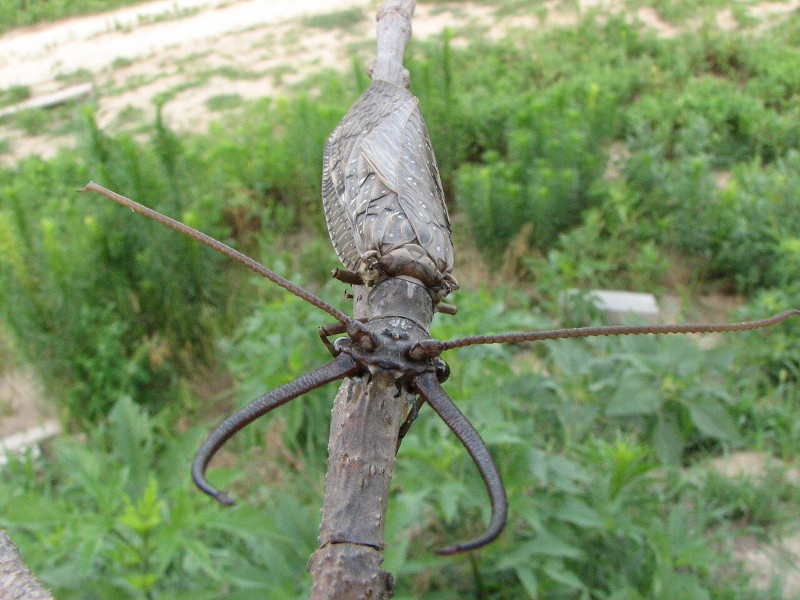
It also evolved a natural coloring that provides excellent camouflage in its native environment. The body usually presents a dark brown to gray shade. It also has a somewhat textured, almost leathery appearance. The wings develop as translucent, with dark veining mixed throughout.
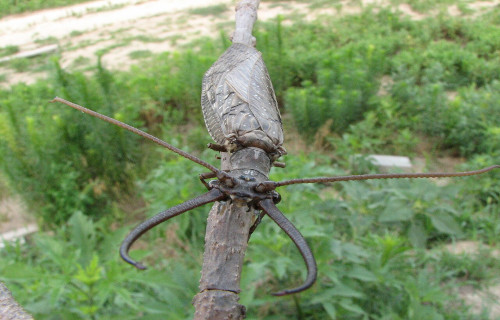
Yet, it’s the mandibles of the Eastern Dobsonfly that receive the most attention. This part of its physiology also represents the area in which the gender-based difference appears. In the male, these sometimes compose half the length of the body. Despite their size, though, they’re relatively weak.
Among females of the species, however, it’s a very different story. In this sex, these imposing features achieve much shorter mean sizes. Nevertheless, unlike the males, these develop as quite strong for their size. They’re capable of inflicting a painful bite if provoked, even unto a human.
The rest of the body follows a pattern common among its kind. It possesses two pair of the large, membranous wings. When at rest, the wings fold flat over the body, extending slightly beyond the abdomen. It also has two long, segmented antennae positioned atop the insect’s head.
- Kingdom: Animalia
- Phylum: Arthropoda
- Class: Insecta
- Order: Megaloptera
- Family: Corydalidae
- Genus: Corydalus
- Species: C. cornutus
CCL: https://tinyurl.com/459hsxvz
Eastern Dobsonfly Distribution, Habitat, and Ecology
The captivating Eastern Dobsonfly evolved as indigenous to a moderately broad expanse of the earth’s surface. The location of that native zone of habitation likely won’t surprise anyone, though. That’s because Nature created it as a resident of portions of the continent of North America.
The marvel’s found in the eastern United States, from southern Canada to the Gulf Coast and as far west as the Great Plains. Its range also extends from southeast Canada, around Ontario and Quebec, down through much of the eastern and southeast U.S. That region includes the Midwest.
In keeping with its nature, this creature displays decidedly clear and strong preferences regarding its choice of habitat. This remains quite closely tied to freshwater environments due to the aquatic nature of its larvae, intriguingly known as hellgrammites. These provide for its requirements.
The often frightening invertebrates require clean, oxygen-rich, fast-moving streams, rivers, and creeks for the larvae to thrive. These very specific water bodies often have rocky or sandy substrates within them. These characteristics provide hiding places and feeding grounds for the many larvae.
Adults frequently appear resting on nearby vegetation, rocks, or other surfaces during the day. Vegetative cover along the stream or riverbanks offers shade and protection. It’s also commonly found in riparian zones, where the proximity of water remains essential for mating and egg laying.
Adults of the species do not feed. This stage is quite brief, lasting only about a week, with the primary purpose being that of reproduction. Although adults have a brief lifespan, they serve a role in their ecosystems. That’s as a common prey for birds, bats, and other insectivores.
The larval stage of the Eastern Dobsonfly, however, lasts as long as 2 -3 years. During this time, they’re entirely aquatic. They function as voracious predators of other aquatic invertebrates, helping control populations of various insects, including mayflies, stoneflies, and small crustaceans.
These in turn, though, serve their own purpose. They represent an essential food source for fish like bass and trout, making them important in aquatic food webs. By regulating prey populations and serving as food for larger species, it supports the ecological structure of freshwater systems.
Aphrodite Fritillary
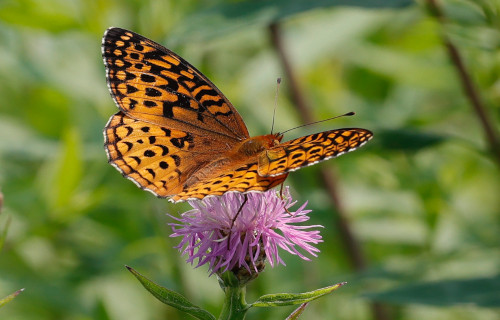
CCL: https://tinyurl.com/22y23f9m
Aphrodite Fritillary Facts
- Closing out this article about these 5 Wonderful West Virginia Insects comes the stunning creation of evolution named the Aphrodite Fritillary.
- The evocative term used herein serves as the most often employed common name for this beautiful species of Lepidoptera. It does have a few other general titles it’s known by, though. Those include Aphrodite Butterfly and Silver-spotted Fritillary, among others.
- Within the scientific world, however, it’s perhaps much better known by its purely technical designation. But, like many such epithets, that’s one that’s difficult for the layperson to pronounce. That’s because it invertebrate holds the official tag of Speyeria aphrodite.
- It received that distinctive moniker due to the efforts of Johan Christian Fabricius. The highly respected Danish zoologist accomplished the first formal recognition of it as a separate and distinct species. He achieved that scientifically noteworthy deed in the year 1787.
- For the moment, science knows of at least an astounding 12 confirmed subspecies of this remarkable creation of Nature and evolution. Each of these also shares the same general habitat range of the parent species. This frequently makes distinguishing them difficult.
- Fortunately, the beautiful Aphrodite Fritillary appears to be maintaining a population base that’s both stable and sufficient. That state also seems to hold true across the entirety of its range. The IUCN thus currently has no listing for it on the Red List of Threatened Species.
- The marvel of Nature and evolution nevertheless still faces multiple potential threats to its continued existence as a species. Like all forms of life on earth today, most of these stem from the actions of man. They include the closely related perils of habitat loss and climate change.
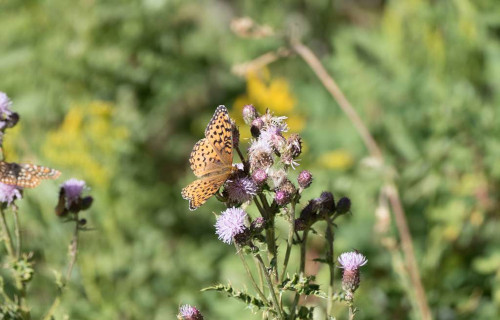
Aphrodite Fritillary Physical Description
The stunning Aphrodite Fritillary typically captivates those individuals fortunate to encounter one of these beauties in its natural environment. Unlike some species, though, it does so for several reasons. That’s due to the fact that it’s not only a lovely creature, but also boasts a respectable size.
The remarkable invertebrate also follows a pattern common to many of its relatives. That’s the fact that it displays a certain degree of the physiological characteristic of sexual dimorphism. In it specific case, however, that particular trait manifests itself in terms of both size and appearance.
Overall, though, the amazing Lepidoptera typically attains a wingspan averaging roughly between 2.5 – 4 in (6.4 – 10.2 cm). This ranks as the first of the gender-based differences. Females typically measure at the higher end of this range, while the males remain at the lower end of the same.
The body of both sexes of the creature presents approximtely the same general shape and proportions. Its thorax develops as fully robust and covered with fine, soft hairs, and typically brown or blackish. Yet, the abdomen remains slim and tapered, matching the color of the thorax.
The head, meanwhile, evolved as comparatively small and covered with fine hairs, with a pair of clubbed antennae that are black with orange tips. It has a long, coiled proboscis, used for feeding on nectar from various flowers. The legs also develop as slender and adapted for perching.
It’s the patterns of coloring in the breathtaking Aphrodite Fritillary that most often garner the greatest degree of attention, though. That’s also the other physical characteristic that separates the genders. Males generally manifest much more vivid and darker markings compared to the females.
The upperside of both the forewings and hindwings each primarily display as orange with black spots. This pattern includes several rows of black spots and lines, more concentrated near the margins. The spots vary in size, with those on the margins being smaller and densely packed.
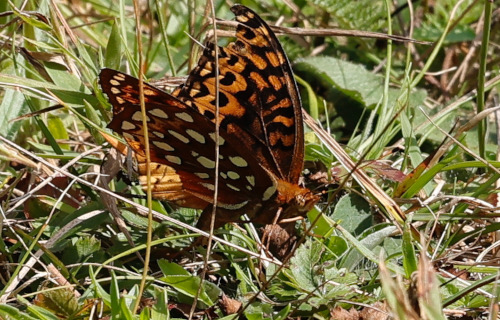
The underside of both sets of wings of this wonder of Nature, though, evolved a vastly different pattern. Its forewings typically show a remarkable shade of orange-brown, combined with a series of very pale spots. Some of these markings also present themselves outlined in shades of black.
Impressively, the hindwings of the wonder appear more even striking. These develop with a brownish or yellowish base color, accompanied by a series of large silvery or pearly white spots. These frequently vary greatly in both number and size, but typically remain distinct and reflective.
- Kingdom: Animalia
- Phylum: Arthropoda
- Class: Insecta
- Order: Lepidoptera
- Family: Nymphalidae
- Genus: Speyeria
- Species: S. aphrodite
CCL: https://tinyurl.com/22y23f9m
Aphrodite Fritillary Distribution, Habitat, and Ecology
The gorgeous Aphrodite Fritillary evolved as native to a moderately broad section of the surface of the earth. Precisely where that indigenous zone of habitation lies, however, probably won’t surprise many people. It’s a region already well known for its abundance of similar natural wonders.
The beautiful Arthropod developed as native to a certain range found within the confines of the continent of North America. There, the northern limits of its range reach southern Canada, including provinces like Alberta, Manitoba, Ontario, Quebec, and parts of the Maritime provinces.
To the south, however, it’s extensively widespread across the north-central parts of the United States. To the east, it ranges from New England and the Appalachian Mountains down to northern Georgia. In the Midwest, it is found in states such as Ohio, and across to the Great Plains.
In the west, its native range extends to the mighty Rocky Mountains and even includes states such as Montana, Wyoming, Colorado, and parts of New Mexico. The beautiful insect’s also commonly found in parts of the Pacific Northwest, including many regions in Washington and Oregon.
Across its broad range, this marvel of Nature and evolution clearly displays decidedly flexible preferences regarding its choice of habitat. It’s therefore found living within a wide range of local ecosystems. The insect nevertheless does display favoritism for several specific types of these.
It’s demonstrably quite fond of meadows and grasslands, or similar open areas with abundant herbaceous vegetation. Such settings remain rich in wildflowers, which provide nectar sources. These habitats often remain mostly sunny and have a various mix of grasses and flowering plants.
The butterfly’s additionally frequently seen in praries, and similar large, wide open, and either flat or gently rolling areas of native grasses. These settings serve similar purposes to meadows, but often measure significantly larger and with a particularly unique composition of grasses and forbs.
Many woodland edges and clearings also serve as common locations for the stunning small creature. These transitional zones between dense forests and open areas have their own appeal. They offer a mix of shade and sunlight, with diverse plant life, including flowers that it feeds on.
It’s even recorded as being present in areas of both alpine and sub-alpine meadows. It seems surprisingly fond of the high-altitude grasslands found in such mountainous regions. Here it also finds cool, moist environments with a short growing season and a diverse array of flowering plants.
The larvae of the amazing Aphrodite Fritillary feed primarily on the leaves of violets. They’re also almost exclusively nocturnal feeders, hiding during the day and emerging only to feed at night. The adults primarily feed on nectar from a variety of wildflowers, including many milkweeds.
After mating, the females lay eggs singly, typically either on or near host plants, usually the same violets the larvae later feed on. The eggs themselves are small, spherical, and pale in color. Both larvae and adults are preyed on by various predators, including birds, spiders, and other insects.
Photo: David A. Hofmann
CCL: https://tinyurl.com/4trju48p
5 Wonderful West Virginia Insects
We sincerely hope that each of you thoroughly enjoyed reading, and hopefully learning from, this article we’ve written about these 5 Wonderful West Virginia Insects. It’s also our hope that doing so has left you with either a new or renewed appreciation for such remarkable wonders of Nature.
Unfortunately, however, many of their kindred around the world now find themselves facing strong threats to their continued existence as a species. Many of those dangers, in fact, stem from the ongoing actions of mankind. We must do everything we can to protect and preserve them all.
Check out our other articles on 5 Incredible Pacific Ocean Rays, Africa’s Many Geological Masterpieces, 4 Fabulous Geological Features of Texas, Wonderful Wild Cats of the World










Leave a Reply