Anise Swallowtail Facts
- This beautiful Lepidoptera most frequently goes by the comparatively simple common name of the Anise Swallowtail across its entire range. The marvel of Nature does have at least one other general title by which it’s known, though. That’s the similar term of Western Swallowtail.
- Within the scientific community, however, it’s possibly much better known by its purely scientific designation. Thankfully, that’s a relatively easy one for the layperson to pronounce, compared to most such tags. That’s because it holds the official appellation of Papilio zelicaon.
- The gorgeous invertebrate received that particular moniker due to the efforts of Pierre-Hippolyte Lucas. That respected French entomologist recorded the first formal recognition of it as a separate and distinct species. This scientifically noteworthy deed occurred in 1852.
- In modern times, this marvel of evolution began playing a role of moderate importance in the educational system of the region in which it appears. School systems began frequently using it to teach the principle of metamorphosis, due to the striking appearance of its caterpillars.
- Thankfully, the eye-catching Anise Swallowtail seems to be maintaining a population base that’s both sufficient and stable. That pleasant state also appears to hold true throughout the entirety of its range. Accordingly, the IUCN now shows it as Least Concern on its Red List.
- The small beauty should nevertheless still be considered as facing several potential threats to its existence as a species. In this, it faces the same dangers as all forms of life on earth today. Most of these dangers stem from the actions of mankind, and include ongoing climate change.
Related Articles
Anise Swallowtail Physical Description
The magnificent Anise Swallowtail always captures the interest and attention of those individuals fortunate enough to spot one of these wonders. Unlike some of its relatives, it doesn’t rely solely on its beauty to do so, however. That’s true since it’s also an above-average sized butterfly.
In terms of physical appearance, it also follows a pattern of development shared by many species around the world. That’s the fact that it displays a certain degree of the physiological characteristic known to science as sexual dimorphism. In its case, this mainly appears in simple physical size.
The body of both sexes attains an average length that’s slightly shorter than another, very similar relative with which it shares a territorial range. This part of the lovely creature ranges in length from somewhere between 1 – 1.4 in (2.5 – 3.5 cm). In color, it’s mostly black, with yellow stripes or spots.
It’s the wings of this stunning creation of Nature that garner the most attention, though. It’s also the area in which it displays gender-based differrences. These reach a mean wingspan ranging from 2.5 – 3.5 in (6.5 – 9 cm). Those of females tend to be slightly larger and more rounded in their form.
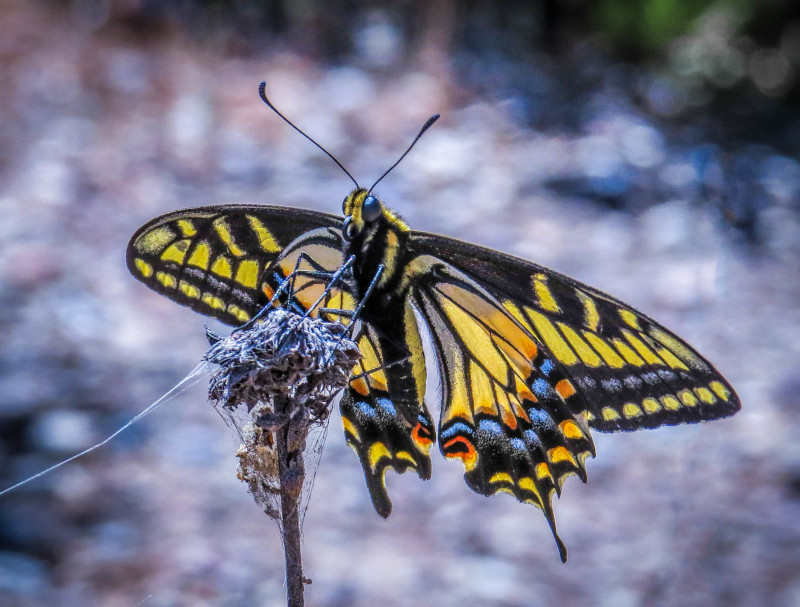
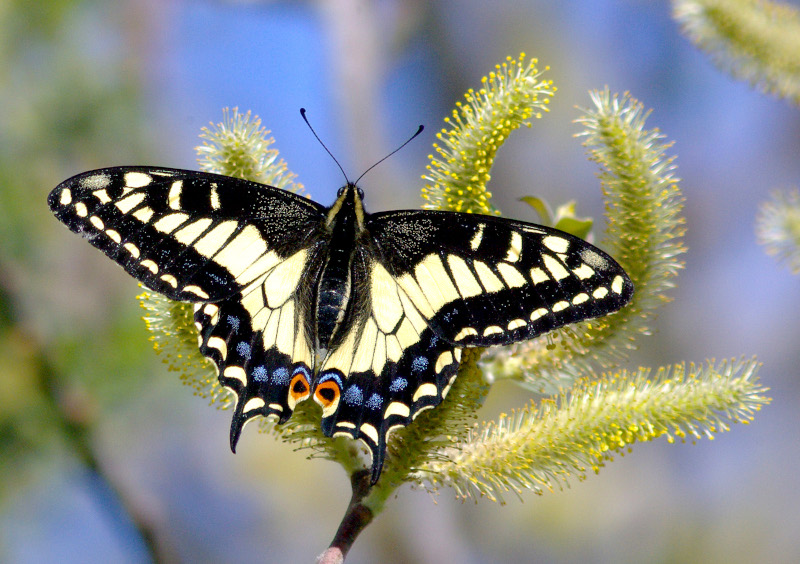
Yet, it’s the bewildering colors of these appendages of the Anise Swallowtail that most immediately draw the eye. The overall pattern consists of a bright yellow background marked by bold black vein markings. Each set of wings, however, present different patterns, creating a highly distinctive effect.
The forewings of this wonder of natural evolution evolved to be the physically larger of the two sets possessed by the colorful insect. They’re also broader in shape. These display a yellow base, with thick black borders. Each wing also has black stripes, or veins, extending across their length.
Though smaller, the hindwings remain the more striking of the set, though. These feature a prominent blue band near the rear edge. A bright orange eyespot also appears near the tail. Amazingly, each wing also manifests a short black tail-like extension, earning the name swallowtail.
- Kingdom: Animalia
- Phylum: Arthropoda
- Class: Insecta
- Order: Lepidoptera
- Family: Pailionidae
- Genus: Papilio
- Species: P. zelicaon
Anise Swallowtail Distribution, Habitat, and Ecology
The magnificent Anise Swallowtail developed as indigenous to a moderately broad swathe of the surface of the earth. Precisely where that zone of habitation occurs probably won’t surprise too many people. That’s true since it evolved as native to a portion of the continent of North America.
Within the greater area, however, it primarily resides along the western portions of the landmass. The majority of its numbers appear inside the the United States. From north to south, it lives in Washington, Oregon, and California. Inland, it’s found in parts of Idaho, Nevada, Utah, and Arizona.
Further to the north, though, the marvel also resides in one portion of the nation of Canada. There, the insect lives in parts of southern British Columbia. In the most southern parts of its range, meanwhile, it also appears in part of Mexico. There, it’s found in parts of northern Baja California.
This gorgeous Lepidoptera also displays an impressive level of versatility regarding its choice of habitat. It’s therefore found in a surprisingly wide variety of ecosystems. Nevertheless, each of these locales understandably shares certain basic environmental conditions to meet its specific needs.
Each of these represents a type of open, mainly sunny habitats. It’s additionally comparatively versatile in terms of the heights at which it chooses to make its home. Impressively, despite its seeming fragility, populations appear at altitudes ranging from about sea level to 6,500 ft (2,000 m).
All regions it lives in contain its host plants, upon which it depends. These areas include such diverse settings as grasslands, meadows, coastal scrublands, and foothills. Yet, it’s also not adverse to living along roadsides, in fields, and other such disturbed areas, even including backyard gardens.
The ecology of the mesmerizing Anise Swallowtail developed to be shaped by its interactions with host plants, predators, and even its role in pollination. Its caterpillars feed herbivorously, solely doing so with members of the Order Apiales, including such garden plants as celery and parsley.
Adults, though, feed on numerous plants, consuming their sweet nectar. In the process of doing so, their actions serve to contribute to the pollination of those same flora. Being stron, relatively fast fliers, these often appar in multiple open, sunny areas, feeding or seeking out prospective mates.
Females lay their eggs on the leaves of host plants, favoring carrots. After hatching, these progress through the stages of pupae to larvae, then finally to adults. This stage emerges in either late spring or early summer. Multiple broods per year sometimes occur, depending on local climate.
Species Sharing Its Range
Check out our other articles on 5 Lively North American Lizards, Humpback Whale, Nile River, Cucumber Tree, Rose’s Ghost Frog, Spotted Eagle Ray, Kentucky Cave Shrimp, Chinese Alligator

Leave a Reply