Calypso Orchid Facts
- This mesmerizing creation of Nature and botanical evolution most frequently goes by the distinctive common name of the Calypso Orchid. The delicate wonder does have a few other titles by which it’s known, though. Those include the tags fairy slipper and Venus’s slipper.
- Within the scientific community, however, it’s perhaps much better known by its technical designation. Thankfully, that’s an extremely simple one for the layperson to pronounce. That’s because the incredible flora holds the extremely similar formal tag of Calypso bulbosa.
- The esteemed Carl Linnaeus himself accomplished the first official recognition of it as a separate and distinct species. At that time, though, the respected Swedish biologist assigned it a different moniker. He originally labeled it as Cypripedium bulbosa. He did this in 1753.
- This astounding beauty stands out in the annals of science for one reason in particular. That’s true since it represents the sole member of its entire Genus. Though not unknown, that’s nonetheless somewhat uncommon. Science presently recognizes several extant subspecies.
- Fortunately, the stunning Calypso Orchid appears to be maintaining a population base that’s both stable and sufficient. This pleasant state also seems to hold true througout the entirety of its established range. Accordingly, the IUCN does not yet show it on the famous Red List.
- The plant nevertheless should still be considered as facing multiple potential threats to its continued existence as a species. In this respect, it faces the same dangers as all forms of life on earth today. Most of those stem from the actions of mankind, and include climate change.
Related Articles
Calypso Orchid Physical Description
Just like most of its relatives, the mesmerizing Calypso Orchid rarely fails to capture the attention and interest of those individuals who spot one. Unlike some of those kindred, however, it typically does so due to its beauty alone. That’s true because it remains a comparatively small plant.
Each of these beauties evolved to produce a slender stalk, called a stem. In terms of color, this aspect of the flora usually appears either reddish or purplish. As stated, though, this never attains a great height. Average vertical reach for this portion of the amazing flora equals 4 – 6 in (10 – 14 cm).
This itself grows from a small, underground corm-like bulb anchors the plant. Distinctively, each stem also produces a single leaf only, situated relatively close to the ground. This solo foliage usually develops as somewhat oval in shape, and presents as dark green, shiny, and slightly pleated in form.
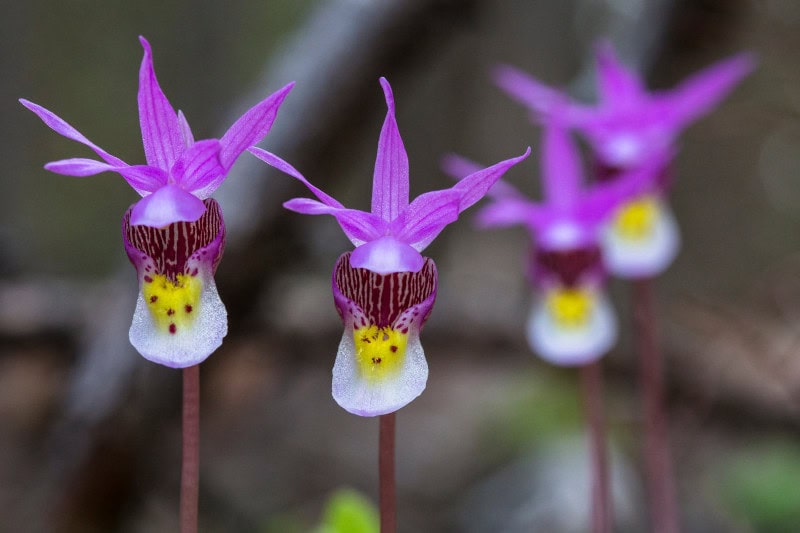
Yet, it’s doubtless the flowers of the breathtaking Calypso Orchid that generally garner the most attention form viewers. Each individual plant generally produces a single bloom. Nonetheless, exceptions occur. Even in these rare instances, however, it produces a maximum of two blossoms.
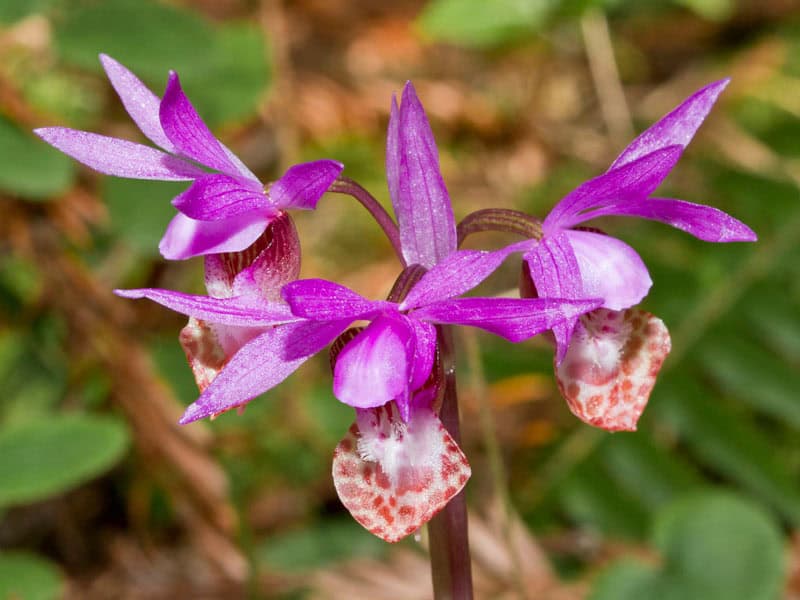
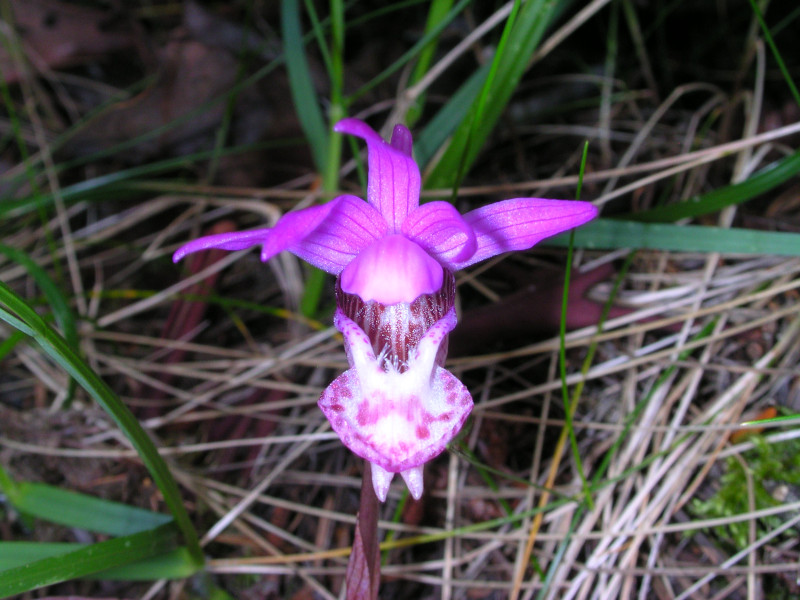
The stunning colors that this wonder of Nature and evolution most frequently displays run from very light pink to dark purple. Occasionally, though, these manifest with magenta tones. Meanwhile, the petals and sepals of the marvel both evolved as narrow in shape, spreading outward like wings.
The labellum, known colloquially as the lip of the flower, presents as white to pink, slipper-shaped, with yellow to reddish spots and hairs inside, giving it an appearance like a slipper or pouch. This same lip also often develops as notably ridged and hairy, typically creating a slightly textured look.
- Kingdom: Plantae
- Phylum: Tracheophyta
- Class: Liliopsida
- Order: Asparaglaes
- Family: Orchidaceae
- Genus: Calypso
- Species: C. bulbosa
Calypso Orchid Distribution, Habitat, and Ecology
The magical Calypso Orchid evolved as indigenous to a comparatively large portion of the surface of the earth. Yet, that natural zone of habitation qualifies as rather unusual. Nature created it as native to what science calls a circumboreal distribution. Explaining that therefore takes some doing.
The flora appears naturally across an area broad in expanse, but precise in location. It only grows natively around the northern regions of the globe. In doing so, it develops in the wild on a total of three separate continents. Those are the scattered locations of Europe, Asia, and North America.
In Europe, the Angiosperm mainly resides within Sweden, Norway, and Finland. It’s also present in the Baltic region, and parts of Russia. In its range inside Asia, though, the biological masterpiece makes itself known across Siberia, the Russian Far East, northern China, Korea, and even Japan.
In North America, it appears across all of Canada, except Nunavut. Its territory also extends further north, to Alaska. Southward, it extends that into the northern and western United States, including the Pacific Northwest, and northern Rockies, Great Lakes region, and parts of New England.
The remarkable Angiosperm displays habitat preferences that qualify as decidedly clear, specific, and delicate. This orchid variety principally appears in regions composed of cool, moist, shaded forests. It’s especially common in coniferous forests containing fir, spruce, hemlock, cedar, pine.
It does have some adaptability to differing elevations, however. Observers spot it from lowland forests to montane zones, depending on latitude. It favors humus-rich, well-drained soils with lots of decaying organic matter, often living on mossy forest floors or near decaying logs and stumps.
The fabulous Calypso Orchid achieves its pollination via a unique form of deceptive pollination strategy. Its bright colors, slipper-shaped lip, and yellow/reddish hairs mimic nectar-rich flowers, but it actually produces no nectar. This appearance tricks bumblebees into visiting, expecting a reward.
In its early stages, the flora depends on a symbiotic relationship with certain soil fungi. Even as an adult, it continues to rely on these to obtain nutrients, since its root system is very reduced. That dependence also makes it extremely sensitive to changes in soil conditions or forest composition.
Despite its size, though, it plays an important role in the eocsystems in which it appears. There, it acts as an indicator species of healthy, undisturbed old-growth forests, since it requires intact fungal networks and stable microclimates. The flower also provides seasonal forage for many insects.
Species Sharing Its Range


Check out our other articles on 5 Amazing African Herbaceous Plants, Northern Raccoon, Khone Phapheng Falls, Goldentail moray, Baltimore Checkerspot, Achiote Tree, Keeled slug-eating Snake










Leave a Reply