

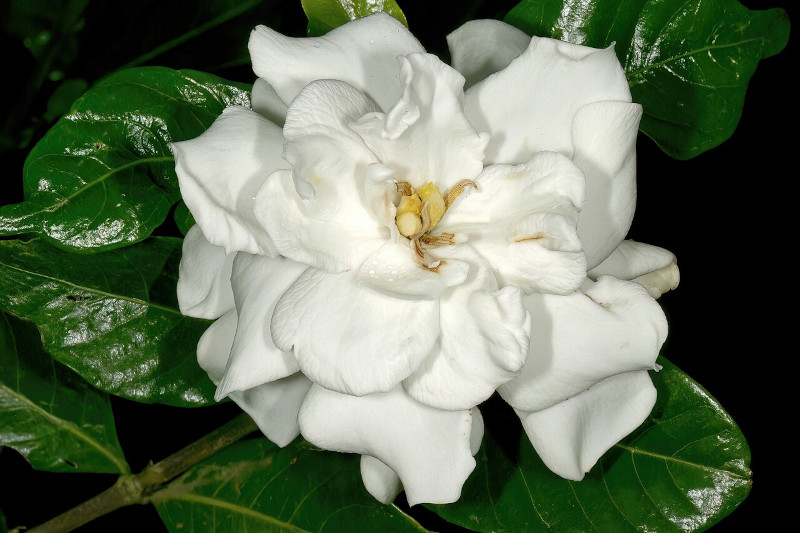
Cape Jasmine Facts
- The deceptively simple term of Cape Jasmine represents the most frequently used common name for this remarkably beautiful plant. Yet, it also has a few other titles by which it’s known. These options include Common gardenia, Cape jessamine, and Cape‐jasmine gardenia.
- Within the scientific community, however, it’s perhaps much more often referred to by its entirely technical designtation. Thankfully, that’s a comparatively simple one for the layperson to pronounce. That’s because the botanical wonder holds the official tag Gardenia jasminoides.
- The marvel of Nature and evolution received that particular epithet due to the efforts of John Ellis. That respected British naturalist accomplished the first formal acknowledgement of it as a separate and distinct species. He achieved that scientifically noteworthy deed in the year 1761.
- Today, due to the efforts of horticulturists, several cultivars of this remarkable Angiosperm exist. It’s deserving of special note, though, that no recognized natural subspecies of the flora exist. Though somewhat intriguing, this situation isn’t actually uncommon among plants.
- Fortunately, the stunning Cape Jasmine appears to still possess a population base that’s both sufficient and stable. That pleasing state also seems to hold true throughout the entirety of its native range. The IUCN thus presently shows it as Least Concern on its published Red List.
- Nevertheless, the captivating example of botanical beauty should still be considered as facing numerous potential threats to its continued existence as a species. Like all forms of life on earth today, most of these stem from the actions of man, including ongoing climate change.
Related Articles


Cape Jasmine Physical Description
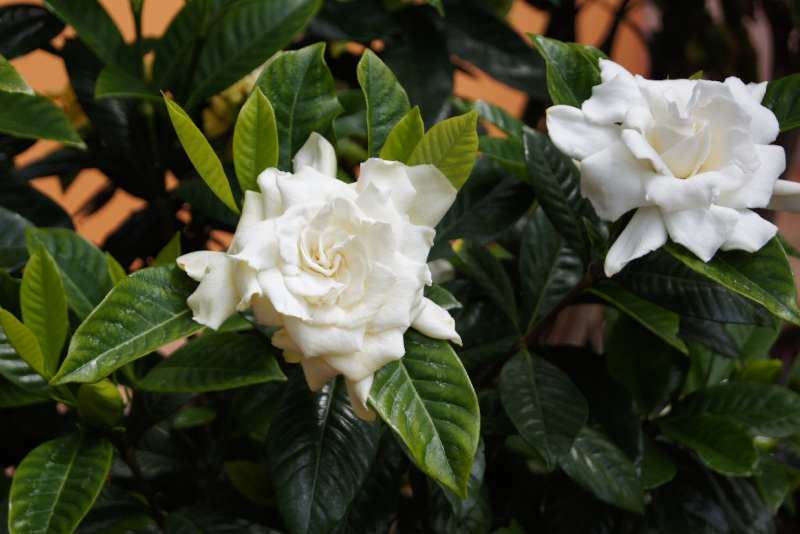
The gorgeous Cape Jasmine rarely if ever fails to immediately capture the attention of those individuals who encounter it for the first time. Unlike some of the amazing flora of the world, though, it does so for more than that beauty alone. It also impresses with respectable statistics.
This captivating Angiosperm develops as an what botanists call an evergreen shrub. Examples of the plant typically range in height from around 2 – 6 ft (0.6 – 1.8 m), though exceptional specimens do sometimes occur. Generally, it forms a dense, rounded, bushy shape replete with many branches.
Those same branches themselves also merit some note. These initially begin as green in color, and quite flexible in nature. As they age, however, these usually turn a grayish-brown shade, and become slightly more stiff. Each also becomes relatively stout and combine to form a compact framework.
The foliage stands out, catching the eye of the observer, as well. Its leaves evolved as opposite and whorled in arrangement. Averaging 2 – 4 in (5 – 10 cm) long, these present a dark green shade, with a thick, glossy, leathery texture. Each of the leaves also possesses a oval to lance-shaped design.
Indisputably, however, it’s the mesmerizing blooms of the Cape Jasmine that usually garner the most attention. These develop as large, averaging 2 – 5 in (5 – 12 cm) wide. Shapes vary from single to double blooms resembling roses. They also show a waxy, creamy white, aging to yellow with time.
Its fruit stands out as well, being a capsule measuring roughly 1 – 1.5 in (2.5 – 4 cm) in length, and with a mean width of about 0.8 – 1.0 in (2 – 2.5 cm). This also possesses an oval shape and smooth outer surface. As each of these bodies matures, it slowly turns to either orange or yellow in coloring.
- Kingdom: Plantae
- Phylum: Tracheophyta
- Class: Magnoliopsida
- Order: Gentianales
- Family: Rubiaceae
- Genus: Gardenia
- Species: G. jasminoides

Cape Jasmine Distribution, Habitat, and Ecology
The remarkable beauty of Nature known as the Cape Jasmine evolved as indigenous to a moderately broad swathe of the surface of the earth. Precisely where than native zone of habitation lies thus likely won’t surprise many people. It developed as endemic to the region now known as Asia.
Within that greater overall area, however, it only inhabits certain sections of the total. Those happen to fall within the national borders of four different countries. Those consist of Vietnam, Japan, Taiwan, and China. In the latter, it’s especially common in the southern and southeastern provinces.
Like many of its kindred fround across the globe, it displays decidedly clear and strong preferences regarding its choice of habitat. All of these, though, share certain environmental traits. This wonder of the botanical world naturally grows in comparatively warm, humid, subtropical environments.
Its favored climatic conditions range from tropical to subtropical settings, given that it’s sensitive to frost. The plant also prefers partial shade to bright indirect light, avoiding harsh, direct midday sun. It further likes its habitat to remain quite moist, with a favored humidity range between 60 – 80%.
Within these conditions, several types of ecosystems serve as host to the eye-catching species. These frequently include forest edges and understory, as well as shrublands and thickets. Still other regions it develops in consist of riverbanks, streamside slopes, and hills up to 4,921 ft (1,500 m) high.
Intriguingly, the lovely Cape Jasmine achieves its pollination through a method somewhat different from many similar varieties of flora. That’s because it primarily manages this at night, via the activities of a range of moth species. Bees and butterflies also aid in this somewhat, during the day.
In its native environment, it plays a role of relative importance in its local ecosystem. It provides a source of nectar to its nocturnal pollinators. The flora feeds local birds, who later spread its seeds via their droppings. It also creates microhabitats for insects and small Arthropods in its foliage.

Species Sharing Its Range

Check out our other articles on 4 Captivating Colorado Birds, Dwarf Sperm Whale, Dead Sea, Socotra Desert Rose, Lobster Moth, Blacktip reef shark, Long-nosed horned frog, Inland Taipan