
Lobster Moth Facts
- The surprising term of Lobster Moth represents the most frequently applied common name for this beautiful and intriguing Lepidoptera. Yet, the marvel of Natue and evolution has a few alternate titles, too. Those include Lobster caterpillar, Fagi moth, and Lobster prominent.
- Inside of the halls of science, however, the creature’s perhaps much better known by its technical designation. Fortunately, that’s a comparatively simple one for the layperson to pronounce. That’s because the delicate wonder holds the short official moniker Stauropus fagi.
- The invertebrate received that specific epithet due to the efforts of Carl Linnaeus. The highly esteemed Swedish zoologist recorded the first formal acknowledgement of it as a separate and distinct species. He achieved that scientifically noteworthy deed in the year 1758.
- Thankfully, the appealing Lobster Moth appears to be maintaining a population base that’s both stable and sufficient. That pleasant state further seems to hold true throughout the entirety of its known range. The IUCN therefore does not currently show it on its Red List.
- This wondrous Arthropod nevertheless should be considered as facing at least several potential threats to its continued existence as a species. In this, the insect finds itself dealing with the same perils as all other forms of life on earth today. Most of those dangers are related.
- In fact, the vast majority of problems the species faces stem from the actions of mankind, either directly or indirectly. These include such problems as habitat loss and deforestation. Pollution, pesticide use, light pollution, and of course, the ongoing effects of climate change.
Related Articles
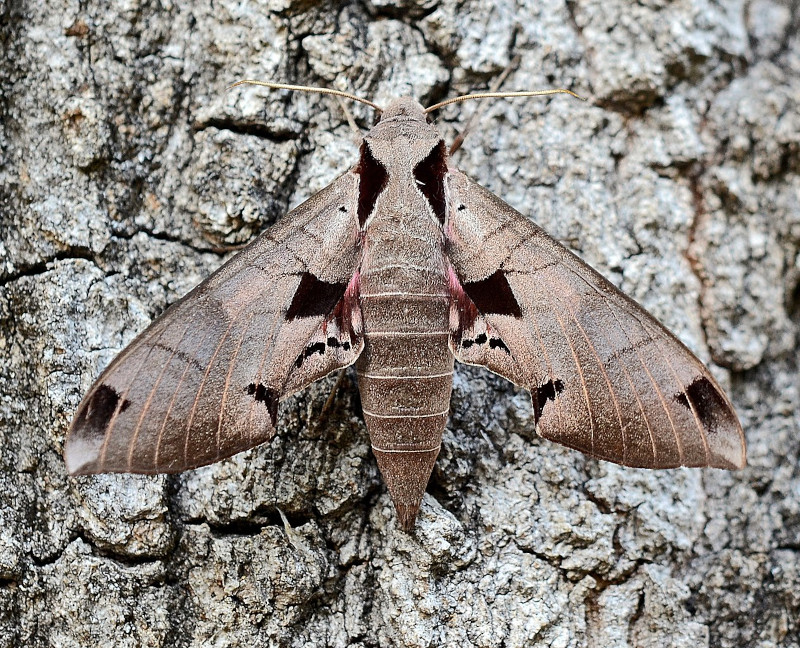
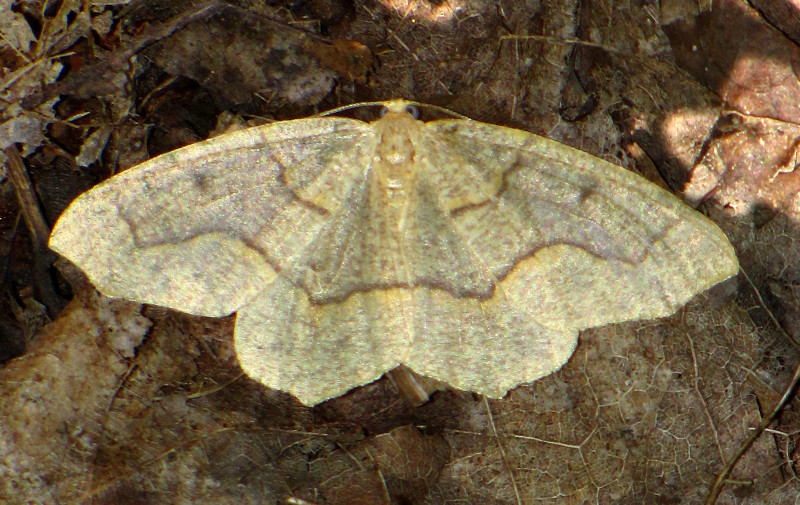
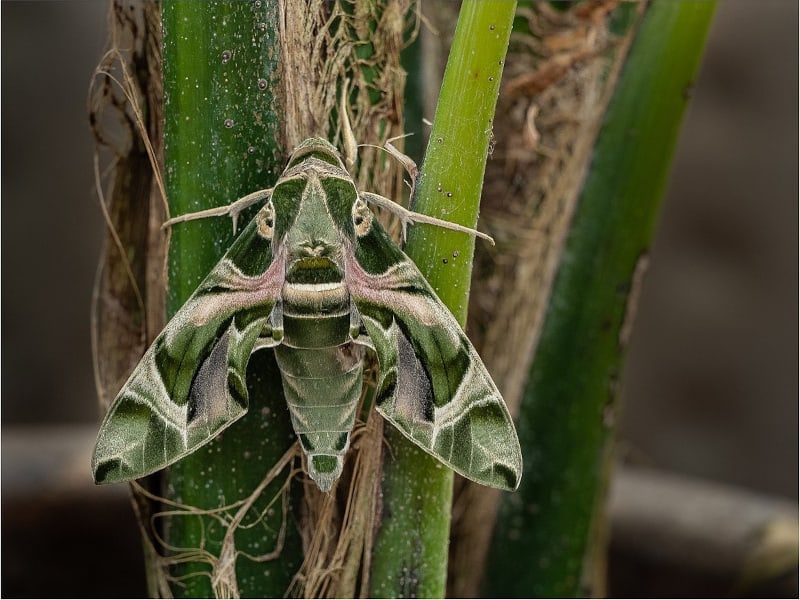
Lobster Moth Physical Description
The captivating Lobster Moth typically fascinates those individuals fortunate enough to spot one of these wonders of Nature. Yet, the intriguing Lepidoptera does so for a combination of several reasons, unlike some others. Let us detail a few of the insect’s most remarkable natural attributes.
Regarding its physical appearance, it follows the pattern of development common among most of its many kindred around the world. That’s due to the fact that it displays a certain amount of the physiological characteristic of sexual dimorphism. Indeed, it does so in multiple ways.
Adults of the species attain wingspans averaging between 1.6 – 2.75 in (40 – 70 cm). The males of the species, however, generally remain on the lower end of this scale, while their female counterparts usually reach the greater spans. Exceptional specimens occur, but rarely exceed this greatly.
The overall body shape also catches one’s attention, given that it differs moderately between the genders. Most of the males generally remain both shorter and slimmer in nature. Females of the invertebrate, though, tend to be both longer and in possession of stockier, more robust bodies.
Nature didn’t simply stop there, however. The two sexes additionally distinguish themselves via the nature of their respective antennae. Those of males evolved to be fluffier, significantly thicker, and somewhat longer than the female’s. In that gender, these appendages remain thin and thread-like.
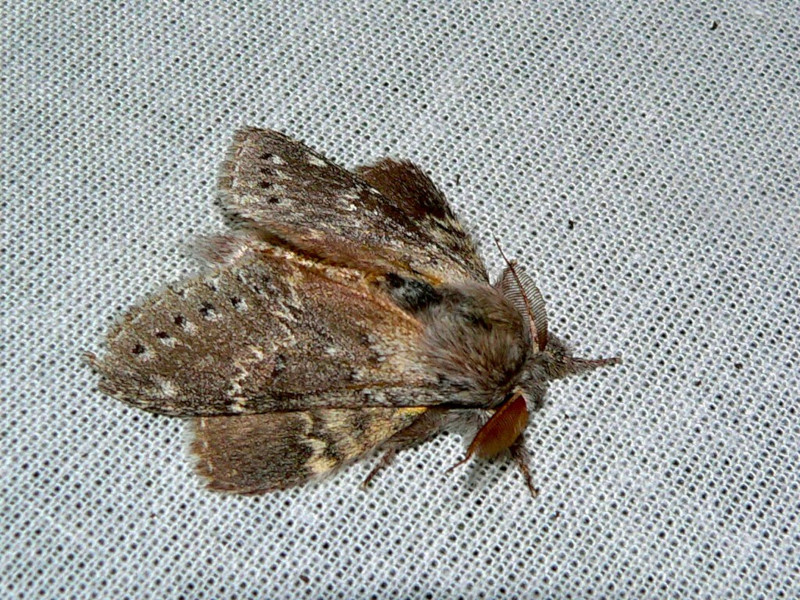
Yet, it’s the wings of the Lobster Moth that typically receive the most attention. The base color of the forewings consists of a mix of gray, brown, and sometimes reddish or ocher tones. These appear mottled and wavy, resembling tree bark. Dark streaks and subtle crosslines manifest, as well.
Meanwhile, its hindwings present a much lighter combination than the forewings. These often have a pale brown or grayish shade. Patterning appears significantly less, too. Nevertheless, markings similar to those on the other wings occasionally develop, though these usually remain fainter.
It’s the larval stage, however, that serves as the source of the most often used common name. This stage of the moth bears a striking resemblance to a lobster in the minds of many people. It has a wide body, legs that appear clawed, and even displays a pattern of color similar to the crustacean.
- Kingdom: Animalia
- Phylum: Arthropoda
- Class: Insecta
- Order: Lepidoptera
- Family: Notodontidae
- Genus: Stauropus
- Species: S. fagi
Lobster Moth Distribution, Habitat, and Ecology
The remarkable Lobster Moth evolved as indigenous to a unique portion of the surface of the earth. That true since its distribution simultaneously qualifies as both widespread yet specific. That slightly unusual zone of habitation covers a large section of Europe, and extends into parts of Asia.
Within the European part of its range, the stunning creature resides throughout much of Central and Western Europe. That habitation area mainly includes the nations of the UK, France, Germany, Spain, Italy, and Scandinavia. Smaller concentrations also live in other countries there, too.
Its numbers and groupings in Asia, though present, remains fewer, and more scattered. To date, the invertebrate’s known to be present in four countries. These include Russia, China, Japan, and Korea. It’s not currently known if this marvel of evolution lives in any other parts of the region.
Like many of its relatives, this species demonstrates a moderate degree of flexibility regarding its choice of habitat. It’s therefore found in a variety of different ecosystems. Each of these varying location nonetheless share certain basic environmental conditions that meet its specific needs.
The moth primarily prefers areas composed of deciduous woodlands. It’s most commonly found in beech woodlands but’s also occasionally spotted in forests with oak, birch, and other broadleaf trees. This intrepid Arthropod further thrives in similar forests, parks, and lightly wooded areas.
Since its larvae feed on the leaves of beech trees and other broadleaved trees, any type of forest where these exist in decent numbers suffices. Yet, it’s also frequently found in settings consisting of hedgerows and shrubby areas near forests, provided these are situated near its host plants.
Despite its relatively diminutive size, the fascinating Lobster Moth plays an interesting role in its local ecosystem. The larvae feed primarily on the leaves of deciduous trees, with a strong preference for beech, and sometimes oak and birch leaves. Adults, however, do not eat anything at all.
At that stage of their lives, these live only long enough to mate and lay eggs. These the female places on the underside of leaves, typically on beech or other broadleaved trees. Caterpillars hatch and begin feeding on the leaves. Adults emerge in late spring or early summer, and the cycle starts again.
Species Sharing Its Range
Check out our other articles on 5 Thrilling Animals of Thailand, Eurasian Red Squirrel, Namib Desert, Western Juneberry, Weedy Seadragon, Kamehameha Butterfly, American Alligator










Leave a Reply