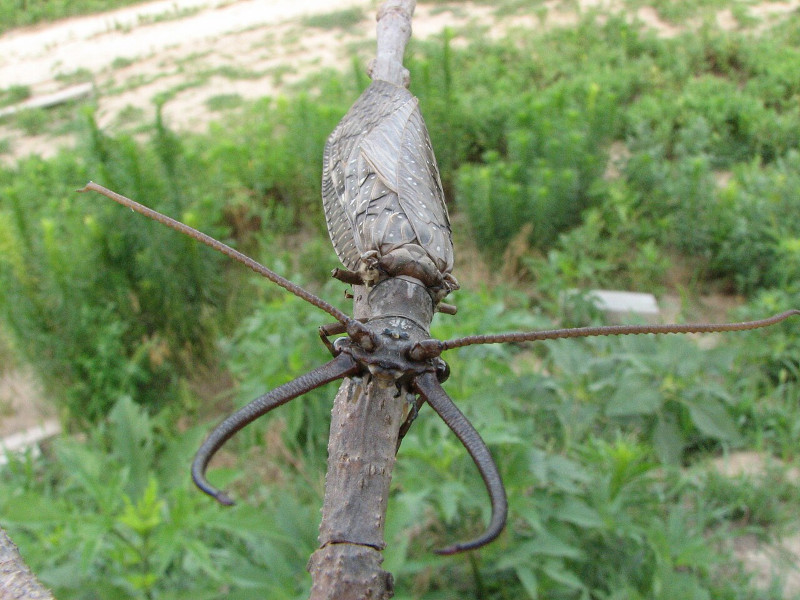
Eastern Dobsonfly Facts
- This imposing creation of Nature and evolution most frequently goes by the unassuming common name of the Eastern Dobsonfly. It does have a few other general titles, though. These include such terms as Hellgrammite, Dobson, and Fishfly, among other, locally used names.
- Within the scientific community, however, it’s perhaps better known by its technical designation. This one, though, like many such tags, remains somewhat difficult for the layperson to pronounce. That’s because the insect bears the formal tag of Corydalus cornutus.
- The marvel of Nature received that moniker due to the efforts of Carl Linnaeus himself. The highly esteemed Swedish biologist recorded the first official recognition of it as a separate and distinct species. He achieved that scientifically noteworthy feat in the year 1758.
- Fortunately for it, the amazing Eastern Dobsonfly appears to be maintaining a population base that’s both stable and sufficient. That pleasant state also seems to hold true throughout the entirety of its native range. The IUCN therefore currently does not show it on its Red List.
- The species should nevertheless still be considered as facing multiple potential threats to its continued existence. In this, it’s dealing with the same perils as all forms of life on earth today, most of which stem from the actions of man. Chief among them stands climate change.
Related Articles
Eastern Dobsonfly Physical Description
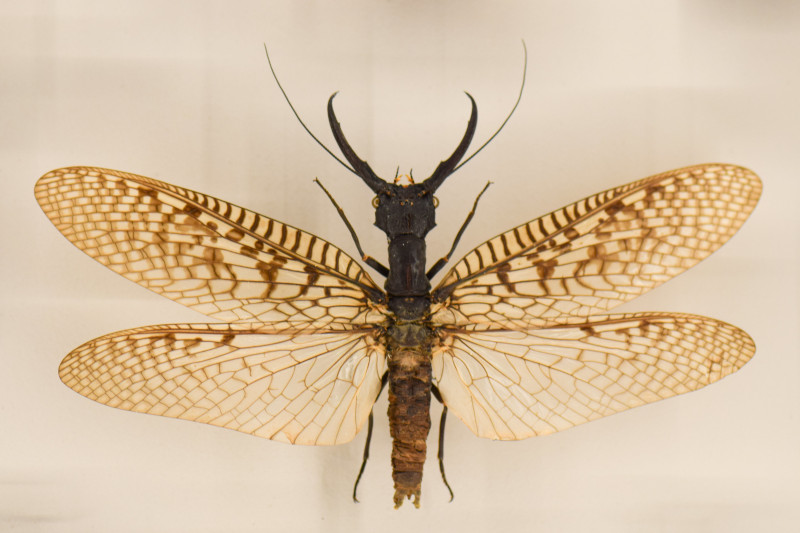
The astonishing Eastern Dobsonfly never fails to capture the attention of anyone who encounters an adult of the species. This occurs, though, due to a combination of factors, unlike with many insects. That’s true due to both its astounding appearance and surprising sheer physical dimenstions.
In the latter regard, though, it does follow a pattern of development common among many creatures. That’s the fact that it displays a certain degree of the physiological characteristic of sexual dimorphism. In its specific case, however, this attribute only manifests in a small, particular manner.
As a general principle, males of this wonder of evolution achieve a marginally greater length than their female counterparts. This specific gender itself reaches an incredible mean length equaling between 4 – 5.5 in (10 – 14 cm). The females, however, generally remain somewhat shorter than this.
The average wingspan for this attention-grabbing Arthropod also leaves most viewers astounded. Among fully mature specimens of either sex, this attribute measures as much as 7 in (18 cm)! Though rare, exceptional members of the species sometimes exceed this already amazing span.
It also evolved a natural coloring that provides excellent camouflage in its native environment. The body usually presents a dark brown to gray shade. It also has a somewhat textured, almost leathery appearance. The wings develop as translucent, with dark veining mixed throughout.
Yet, it’s the mandibles of the Eastern Dobsonfly that receive the most attention. This part of its physiology also represents the area in which the gender-based difference appears. In the male, these sometimes compose half the length of the body. Despite their size, though, they’re relatively weak.
Among females of the species, however, it’s a very different story. In this sex, these imposing features achieve much shorter mean sizes. Nevertheless, unlike the males, these develop as quite strong for their size. They’re capable of inflicting a painful bite if provoked, even unto a human.
The rest of the body follows a pattern common among its kind. It possesses two pair of the large, membranous wings. When at rest, the wings fold flat over the body, extending slightly beyond the abdomen. It also has two long, segmented antennae positioned atop the insect’s head.
- Kingdom: Animalia
- Phylum: Arthropoda
- Class: Insecta
- Order: Megaloptera
- Family: Corydalidae
- Genus: Corydalus
- Species: C. cornutus
Eastern Dobsonfly Distribution, Habitat, and Ecology
The captivating Eastern Dobsonfly evolved as indigenous to a moderately broad expanse of the earth’s surface. The location of that native zone of habitation likely won’t surprise anyone, though. That’s because Nature created it as a resident of portions of the continent of North America.
The marvel’s found in the eastern United States, from southern Canada to the Gulf Coast and as far west as the Great Plains. Its range also extends from southeast Canada, around Ontario and Quebec, down through much of the eastern and southeast U.S. That region includes the Midwest.
In keeping with its nature, this creature displays decidedly clear and strong preferences regarding its choice of habitat. This remains quite closely tied to freshwater environments due to the aquatic nature of its larvae, intriguingly known as hellgrammites. These provide for its requirements.
The often frightening invertebrates require clean, oxygen-rich, fast-moving streams, rivers, and creeks for the larvae to thrive. These very specific water bodies often have rocky or sandy substrates within them. These characteristics provide hiding places and feeding grounds for the many larvae.
Adults frequently appear resting on nearby vegetation, rocks, or other surfaces during the day. Vegetative cover along the stream or riverbanks offers shade and protection. It’s also commonly found in riparian zones, where the proximity of water remains essential for mating and egg laying.
Adults of the species do not feed. This stage is quite brief, lasting only about a week, with the primary purpose being that of reproduction. Although adults have a brief lifespan, they serve a role in their ecosystems. That’s as a common prey for birds, bats, and other insectivores.
The larval stage of the Eastern Dobsonfly, however, lasts as long as 2 -3 years. During this time, they’re entirely aquatic. They function as voracious predators of other aquatic invertebrates, helping control populations of various insects, including mayflies, stoneflies, and small crustaceans.
These in turn, though, serve their own purpose. They represent an essential food source for fish like bass and trout, making them important in aquatic food webs. By regulating prey populations and serving as food for larger species, it supports the ecological structure of freshwater systems.
Species Sharing Its Range
Check out our other articles on 5 Intriguing African Insects, Walrus, Lake Atitlan, Heartleaf Foamflower, California Mantis, Weedy Seadragon, Hellbender Salamander, Green Iguana










Leave a Reply