Galapagos Hawk Facts
- This mesmerizing winged wonder most frequently goes by the fully descriptive and informative common name of the Galapagos Hawk. The marvel does have a few other general title it’s known by, though. These include the similar terms Galapagos Buzzard and Galápagos Buteo.
- Within the halls of science, however, it’s possibly better known by some by its purely technical tag. Like most such designation, though, that one’s somewhat difficult for the layperson to pronounce. That’s because the bird holds the official appellation of Buteo galapagoensis.
- This remarkable product of Nature and evolution received that specific moniker due to the efforts of John Gould. The renowned English ornithologist accomplished the first formal recognition of it as a separate and distinct species. He achieved that noteworthy deed in 1837.
- Unfortunately, the magnificent Galapagos Hawk possesses a woefully small population. Estimates place this somewhere between 150 -300 individuals. Accordingly, the IUCN currently lists this gorgeous raptor as Vulnerable. That status appears on the organization’s Red List.
- It now faces multiple threats to its continued existence as a species, both active and potential. Like most forms of life on earth today, the majority of these stem from the actions of man in some way. These dangers include, among others, habitat loss and ongoing climate change.
Related Articles
Galapagos Hawk Physical Description
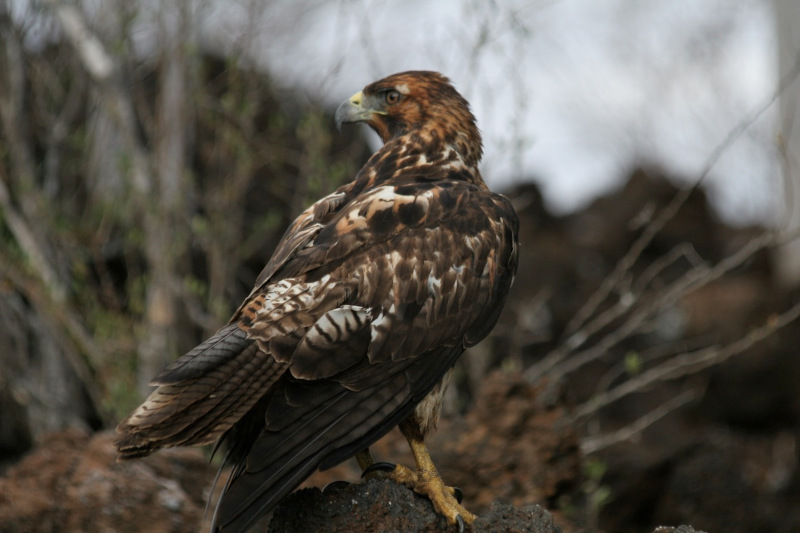
Despite being lesser-known, the stunning Galapagos Hawk typically captures the attention of those few fortunate enough to encounter it, and with ease. Unlike some of its kind, though, it does so for a combination of several factors. This marvel’s both beautiful and of quite considerable size.
The marvelous creature also follows a natural path common among avians. That’s the fact that it displays a certain degree of the physiological characteristic of sexual dimorphism. In its specific instance, however, this gender-based difference manifests itself primarily in regards to dimensions.
Males of this species attain an average total body length equaling roughly 17.7 in (45 cm). Their weight reaches a mean of between 1.77 – 2.2 lb (0.8 – 1.0 kg). Though exceptional specimens do sometimes occur, they rarely exceed this by much. A typical wingspan measures around 4 ft (1.2 m).
Females, however, evolved as significantly larger than their male counterparts in most of these categories. For them, an average length of body totals approximately 21.7 in (55 cm). They’re also stockier in build, averaging 2.6 – 3.3 lb (1.2 – 1.5 kg). Wingspans roughly equal that of males, however.
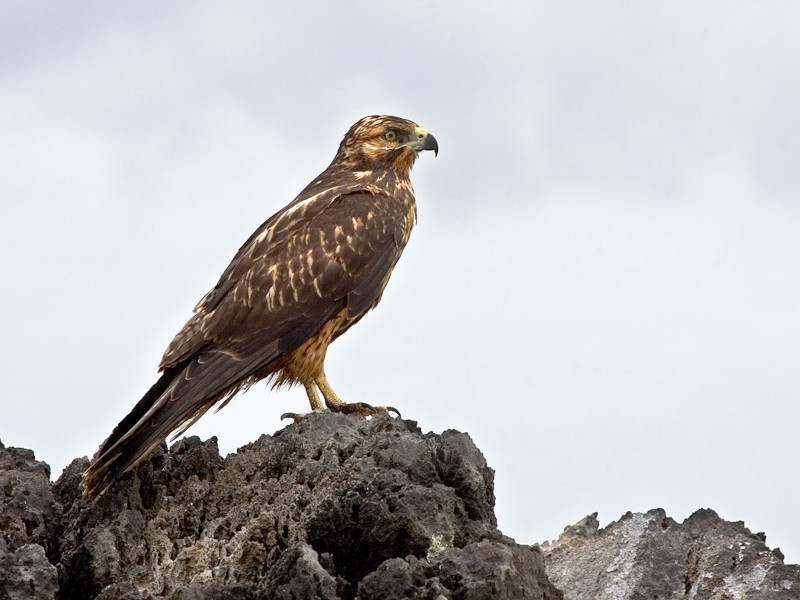
Meanwhile, the coloring of the amazing Galapagos Hawk remains the same among both sexes. Overall, this consists of a range that extends from dark brown to sooty black for the plumage. Exact patterns vary between individuals, regardless of gender. It also has a slightly mottled appearance.
The rest of the bird’s body also merits its share of attention. Its head evolved as uniformly dark, and presents a hooded presence. Its beak stands out as well, quickly capturing the eye of the viewer. This developed as short in length, hooked, and grayish-black, with a striking yellow base.
Still other aspects of the fabulous work of Nature grab one’s interest. Both the legs and feet are strong and sturdy, as well as being a bright yellow hue. It also has extremely sharp talons, like its relatives. The tail evolved as comparatively short and broad in nature, providing agility during flight.
- Kingdom: Animalia
- Phylum: Chordata
- Class: Aves
- Order: Accipitriformes
- Family: Accipitridae
- Genus: Buteo
- Species: B. galapagoensis
Galapagos Hawk Distribution, Habitat, and Ecology
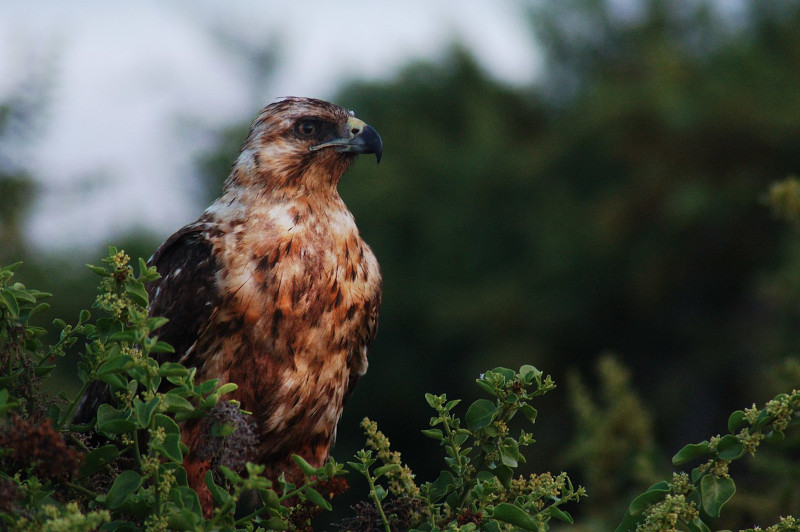
Lamentably, the gorgeous Galapagos Hawk developedas endemic to an extremely limited portion of the surface of the earth. The precise location of that orginal zone of habitation won’t come as any surprise, though. That’s true since, as the name implies, it’s native to the Galapagos Archipelago.
Historically, the breathtaking raptor inhabited the majority of the major islands of this expansive group. Genetic and morphological evidence suggests that its original ancestors arrived at their present location around 300,000 years ago. Over time, these evolved into an endemic species.
Today, it’s been extirpated from many of its native settings, likely due to habitat loss, human settlement, and introduced species. Now, it’s only known to be present on eight remaining islands. These are Fernandina, Isabela, Santiago, Santa Fé, Pinta, Española, Marchena, and Genovesa.
Although its range remains highly restricted, this wonder of evolution possesses a trait that enhances its chances of survival, at least somewhat. That’s because it displays a high degree of adaptability regarding its choice of habitat. It therefore inhabits a variety of natural environments.
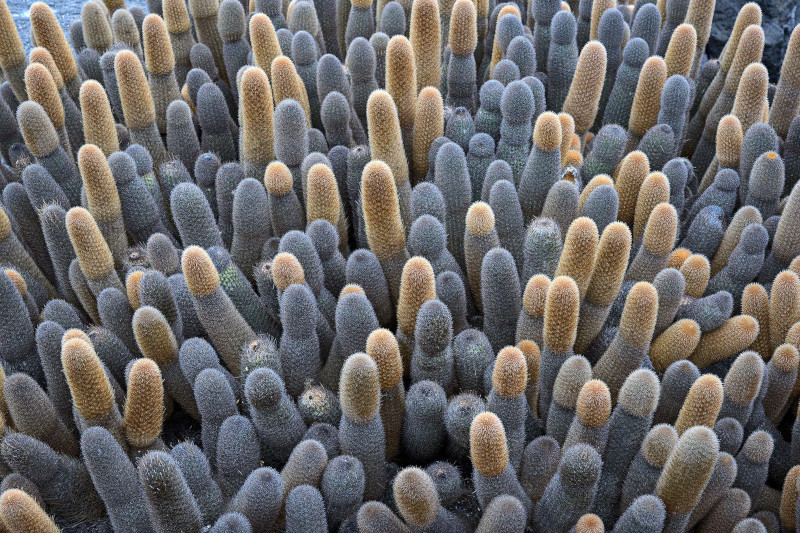
This powerful bird very commonly frequents arid lowland zones, for one. Such regions remain dominated by cacti, dry shrubs, and lava rock, especially on islands like Española and Fernandina. It also inhabits coastal areas, where it’s often seen soaring along shorelines, cliffs, and rocky coasts.
Other sections of the islands it lives on where observers note its presence include open woodlands and scrub. It favors open areas with scattered trees or shrubs, ideal for both perching and spotting prey on the ground. The animal’s even common in lava fields, where it utilizes the rugged terrain.
The phenomenal Galapagos Hawk plays a surprisngly pivotal role in the ecology of its remaining habitat, serving as an apex predator. In that position that Nature created it to fill so well, its activities serve to regulate the populations of numerous forms of life, helping to maintain ecosystem balance.
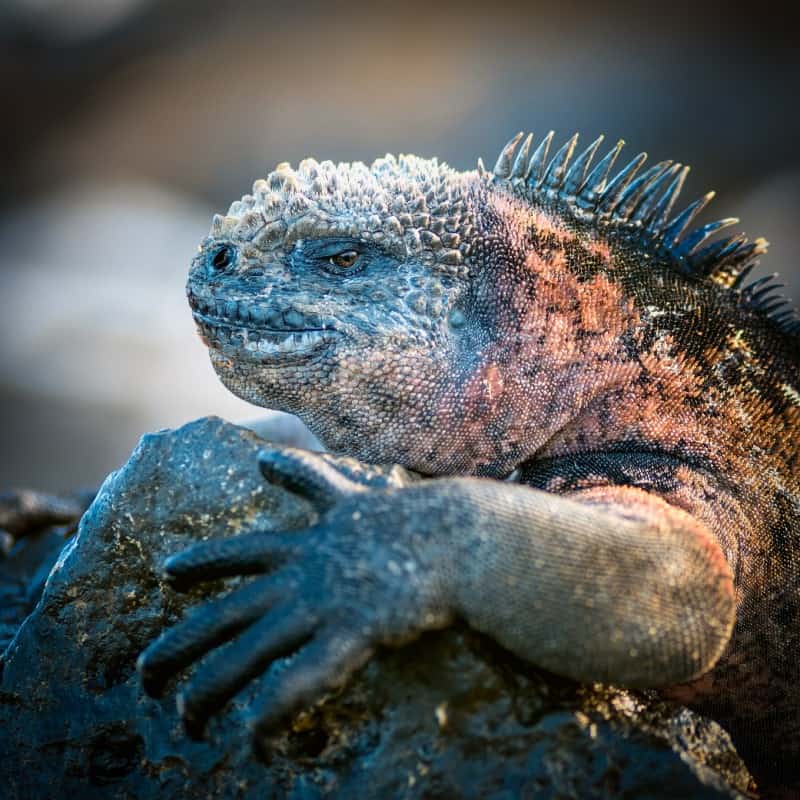
Intriguingly, it feeds as both a predator and an opportunistic scavenger. Its primary prey includes lava lizards, small snakes, Marine Iguana hatchlings, insects, and introduced rodents. Yet it also quite freely consumes various dead animals, including seabird chicks, fish, or sea lion placentas.
Mating strategies are quite unique, too. It has no specific mating season, thus engaging in this activity throughout the year. It’s also unique among raptors for exhibiting cooperative polyandry. One female mates with 2–7 males, who share numerous duties, such as helping raise the chicks.
Species Sharing Its Range
Check out our other articles on 5 Extremely Beautiful Epiphytes, Mountain Hare, Komodo Island, Douglas Iris, Fire Salamander, Fulvous Skimmer, Spotted Eagle Ray, Little Auk, Mugger Crocodile










Leave a Reply