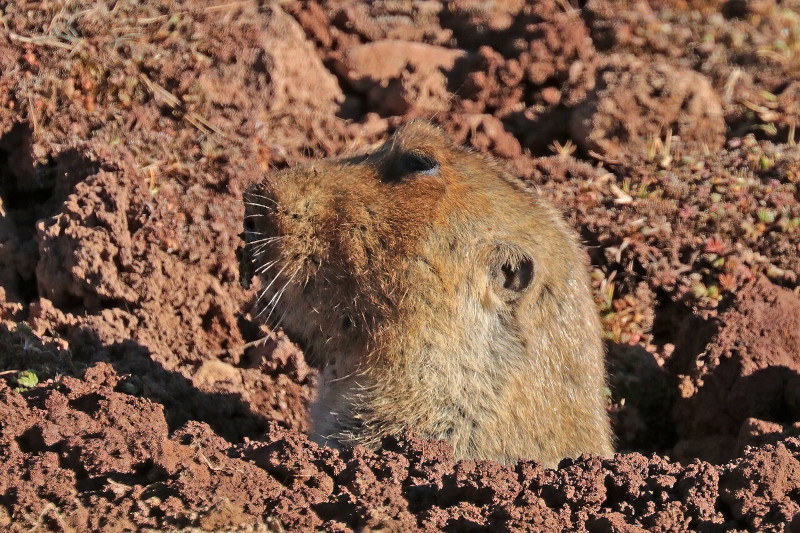
Giant Mole Rat Facts
- This fully descriptive term of Giant Mole Rat appropriately serves as the most frequently used common name for this remarkable creature. Yet, it does have several other general titles. These alternates include the intriguing terms giant root-rat and Ethiopian African mole rat.
- Inside the hallowed halls of science, however, it’s perhaps much better known by its purely technical designation. Unfortunately, like many such, that’s extremely hard for the layperson to pronounce. That’s because it holds the formal moniker Tachyoryctes macrocephalus.
- The incredible rodent received that epithet due to the efforts of Wilhelm Peter Eduard Simon Rüppell. That respected German naturalist recorded the first official recognition of it as a separate and distinct species. He achieved that scientifically noteworthy deed in 1842.
- This marvel of Nature and evolution distinguishes itself from all other known varieties of mole rate in terms of developed behavior. Its relatives all both live and feed underground. It, though, principally forages above ground, by digging a new tunnel to a nearby patch of appropriate flora
- Sadly, the Giant Mole Rat now finds itself in a serious and potentially untenable position. It has both a limited range and a currently declining population. Accordingly, the IUCN presently lists the fascinating creature as Endangered on its published Red List of Threatened Species.
- The distinctive animal faces numerous threats to its continued existence as a species. Like most forms of life on earth today, the majority of these dangers stem from the actions of mankind. They include the closely related perils of habitat loss and ongoing climate change.
Related Articles

Giant Mole Rat Physical Description
The surprising Giant Mole Rate typically captivates and amazes those individuals fortunate enough to encounter one of these natural wonders. This fascination usually occurs due more to its appearance than sheer size. Although larger than some rodents, it’s nevertheless a small creature.
It also follows a pattern of development that’s quite common among fauna, including rodents. That’s the fact that it displays a certain degree of the physiological characteristic of sexual dimorphism. In its specific case, however, this physical trait manifests itself to only a minor degree.
Overall, the body length of mature specimens varies from roughly 7.5 – 11 in (19 – 28 cm). Weights for these same examples also extend across a reasonably narrow range. That equals approximately 1.1 – 1.5 lb (0.5 – 0.7 kg). Males of the species tend to be on the higher end of both spectrums.
The fur of this animal also develops as comparatively dense, and extremely soft in texture. Both the upper and side parts of the body present shades of either dark brown or grayish. Meanwhile, the underside of the body of this remarkable rodent typically possesses a markedly lighter cast.
Like its many kindred, its forelegs evolved as relatively short, but nonetheless reasonably powerful. These appendages additionally appear with long claws, which it employs for digging. However, its hindlegs develop as somewhat weaker. Its tail also manifests as short, with a sparse covering of fur.
Yet, it’s doubtless the head of the stunning Giant Mole Rat that typically receives the most attention from its admirers. This develops as large and broad, and slightly more so in males. It’s also equipped with strong jaw muscles and large incisors that protrude outside the lips, adapted for digging.
The eyes and ears of the fascinating animal contrast this, though. These remain quite small, being consistent with its primarily subterranean lifestyle. Although it has poor eyesight, Nature provided it with other means to sense its world. It possesses both very strong tactile and olfactory senses.
- Kingdom: Animalia
- Phylum: Chordata
- Class: Mammalia
- Order: Rodentia
- Family: Spalacidae
- Genus: Tachyoryctes
- Species: T. macrocephalus
Giant Mole Rat Distribution, Habitat, and Ecology
Lamentably, the intriguing Giant Mole Rate evolved as indigenous to an extremely small section of the surface of the earth. Just where that limited zone of habitation lies might surprise some of our readers, however. That’s because it’s native to a very tiny section of the continent of Africa.
Within that larger area, its native territory lies in the eastern portion of the landmass. There, it’s found entirely within the borders of the nation of Ethiopia. Limiting its habitat zone even further, this wonder of evolution’s only known to appear in parts of the Bale Mountains, in the southeast.
The impressive rodent displays extraordinarily precise and restrictive preferences regarding its choice of habitat type. Even within the rugged mountain range it lives in, the creature primarily resides in either the Sanetti Plateau or surrounding areas within the Bale Mountains National Park.
Given these settings, altitude also understandably plays a factor. All observed examples reside at heights at or above 9,843 ft (3,000 m) above sea level. Within that range of heights, the intrepid animal prefers flat to gently sloping terrain with deep, easily crumbled soils, suitable for digging.
Yet, it’s additionally selective when it comes the nature of that soil. The regions of this that the rodent chooses are typically organically rich, and well-drained. These areas generally display an abundance of certain flora. Those mainly consist of afroalpine grasses, herbs, and giant lobelias.
The natural ecology of the Giant Mole Rat is naturally shaped by the combination of its highly specialized burrowing lifestyle and restricted high-altitude habitat in the surrounding mountain range. There, it plays a crucial ecological role in the immediate Afroalpine ecosystem it inhabits.
In its burrowing activities, it constructs tunnels that sometimes reach nearly 100 ft (31 m). These remain shallow, however, rarely going deeper than 15.7 in (40 cm). It situates its food chambers, though, somewhat deeper. These tunnels provide protection from both predators and temperatures.
In terms of its diet, again following a pattern common among its kindred, it also evolved as a complete herbivore. The creature principally consumes underground roots, tubers, bulbs, and rhizomes. Yet, it nevertheless also feeds on above-ground parts of Afroalpine plants when available.
Like most herbivores, however, the wonder also faces threats from its enemies. In its ecosystem, its hunters include several specialized predators. Standing atop such a list comes the Ethiopian Wolf. This wild canine, in fact, utilizes this remarkable small rodent for as much as 90% of its entire diet.
Species Sharing Its Range
Check out our other articles on 4 Fabulous North American Caves, Elk, Amazon River, Douglas Iris, Southern Darwin’s Frog, Spotted Eagle Ray, Epirus Dancing Grasshopper, Black Caiman










Leave a Reply