CCL: https://tinyurl.com/mvafnmn2
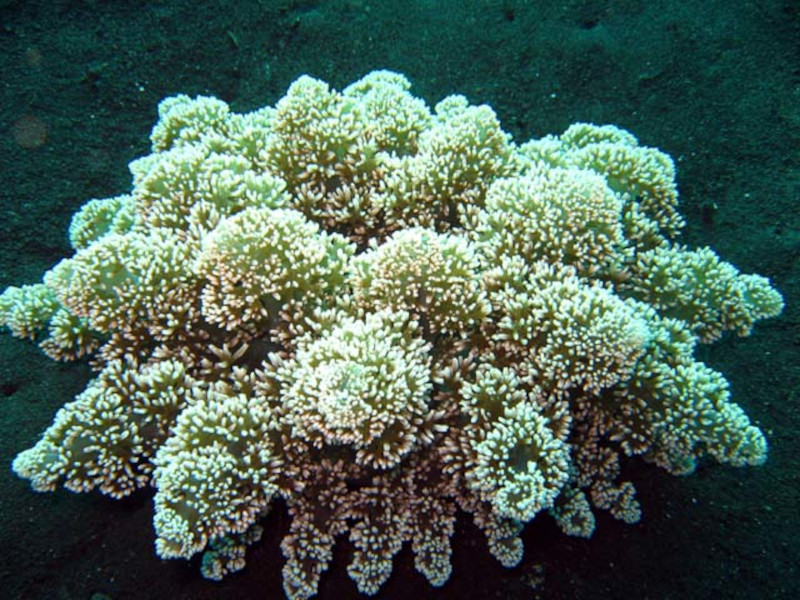
Hell’s Fire Anemone Facts
- This stunning creation of Nature and evolution most frequently goes by the attention-grabbing common name of the Hell’s Fire Anemone. Yet, it does have at least a few other general titles by which it’s known, though. Those options include the short term of Tree anemone.
- Within the scientific community, however, it’s pehaps much better known by its techical designation. Unfortunately, that’s an extremely difficult one for the layperson to pronounce. That’s because this marvel of the seas bears the lengthy moniker Actinodendron arboreum.
- It received that specific epithet due to the combined efforts of Jean René Constant Quoy and Joseph Paul Gaimard. Together, that duo of French researchers accomplished the first official recognition of it as a separate and distinct species. They achieved that noteworthy deed in 1833.
- This Cnidaria distinguishes itself from most of its relatives around the world with scientists and divers alike. That’s due to a unique trait of its biology. While most sea anemones remain harmless to humans, it’s highly venomous, with a sting capable of causing severe reactions.
- Fortunately, the remarkable Hell’s Fire Anemone appears to be maintaining a population base that’s both stable and sufficient. This agreeable state also seems to hold true throughout the entirety of its native range. The IUCN therefore does not currently place it on the Red List.
- The marvel nevertheless should still be considered as facing numerous potential threats to its continued existence as a species. Like all forms of life on earth today, the majority of these perils stem from the actions of mankind. They include habitat loss and climate change.
Related Articles
CCL: https://tinyurl.com/mrx5uknb
Hell’s Fire Anemone Physical Description
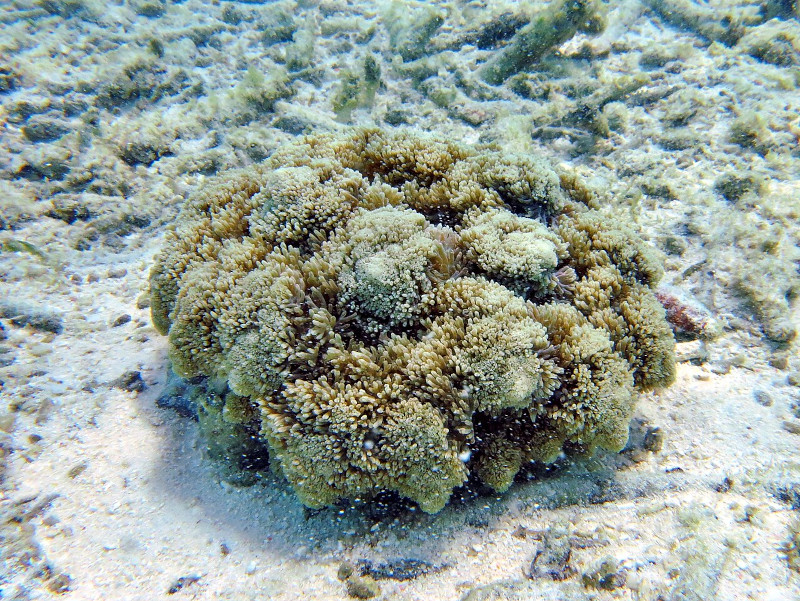
The mesmerizing Hell’s Fire Anemone rarely fails to capture the immediate and complete attention of those individuals who encounter one. Unlike most of its many kin around the world, however, it doesn’t do so just due to its appearance. It also ranks as one of the largest sea anemone’s.
Unlike many other creatures, both of the marine and land variety, it does not follow one certain pattern of development revolving around gender. That’s because, even though it has separate sexes, it does not show any evidence of the physiological characteristic known as sexual dimorphism.
Both genders thus display the same general outward physical traits. Individuals attain a body diameter that typically ranges from roughly 8 – 12 in (20 -30 cm). Though exceptional specimens occur, they rarely exceed this by much. The body of the animal also has a thick, columnar shape.
That same part of the anatomy, referred to as the column, usually presents as quite smooth, thick, and cylindrical. Its coloration further matches or slightly contrasts the tentacles. At the top of this structure also lies the oral disc, where the tentacles radiate outward from the central mouth.
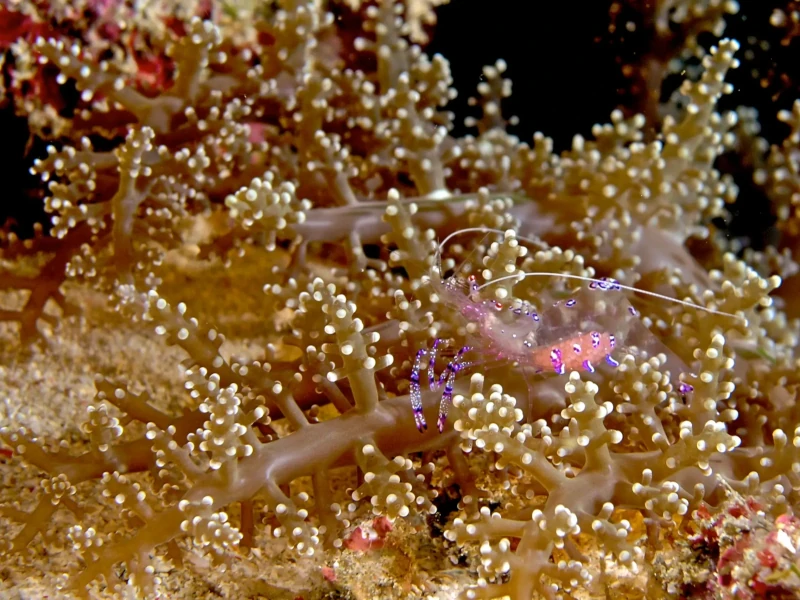
Those appendages also represent the aspect of the Hell’s Fire Anemone that typically garner the most attention from observers. These repeatedly branch, often resembling clusters of small tree branches. Each additionally has wart-like swellings containing potent stinging cells, or nematocysts.
The coloring of the creature, meanwhile, evolved as highly variable in nature. Principally, though, this consists of random combination of differing shades of brown, green, tan, or cream, sometimes with fluorescent hues under blue light. Other hues include greenish, yellowish, gray, or pink.
- Kingdom: Animalia
- Phylum: Cnidaria
- Class: Hexacorallia
- Order: Actiniaria
- Family: Actinodendridae
- Genus: Actinodendron
- Species: A. arboreum
Hell’s Fire Anemone Distribution, Habitat, and Ecology
The startling Hell’s Fire Anemone evolved as indigenous to a moderately broad expanse of the marine regions of the globe. Exactly what areas that native zone of habitation comprises therefore likely won’t surprise many people. That’s because it’s endemic to much of the Indo-Pacific region.
Within the confines of the Indian Ocean, reports of the presence of this wonder of the marine animal world cover such locations as the waters of Sri Lanka, the Maldives, and the Andaman Sea. In Southeast Asia, however, it appears around the Philippines, Indonesia, Malaysia, and Thailand.
Yet, this remarkable creature also commonly makes its presence known within the Pacific Ocean. There, the species appears around Papua New Guinea, the Solomon Islands, northern Australia, and Micronesia. In the waters of east Asia, though, it lives in locations around southern Japan.
This fascinating animal displays decidedly clear and strong preferences regarding its choice of habitat. Within its territory, it appears in warm, tropical coral reef ecosystems. It favors depths ranging from 3.3 – 98 ft (1 – 30 m). The species prefers sandy bottoms, rubble zones, and reef slopes.
It also quite frequently occurs in lagoons or sandy patches found within coral reefs. The anemone often buries part of its column in sediment for stability. In all of these regions, however, it follows the pattern of having its column firmly anchored, either into sand or between coral fragments.
Despite its burrowing nature, the amazing Hell’s Fire Anemone evolved as a highly efficient, predatory carnivore. In its feeding efforts, it utilizes its branched tentacles to capture its prey. This dietary fare primarily consists of various species of both small fish and crustaceans, and plankton.
Inside of the ecosystems in which it lives, this marvel also displays important symbiotic and ecological interactions. Unlike many of its kin, it doesn’t host clownfish or shrimp, due to the power of its sting. Yet, it often serves as camouflage for small species, as well as harboring symbiotic algae.
Species Sharing Its Range
Check out our other articles on 4 Herbaceous Plants of England, New Zealand Sea Lion, Mahé, Socotra Desert Rose, Goldentail moray, Epirus Dancing Grasshopper, Keeled slug-eating Snake










Leave a Reply