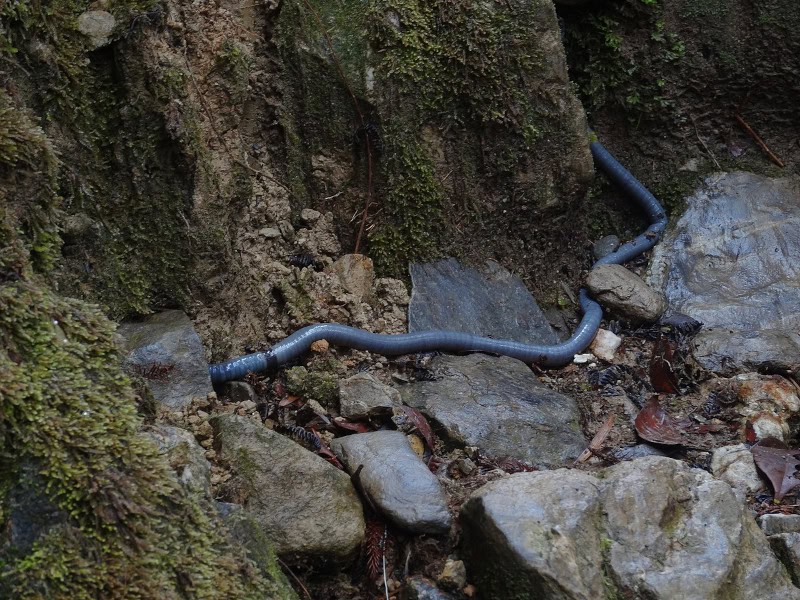
Kinabalu Giant Earthworm Facts
- This remarkable creature most frequently goes by the informative and highly descriptive common name of Kinabalu Giant Earthworm. Yet, it does have a few other titles by which it’s known. These include the similar Giant Kinabalu worm and Giant Bornean earthworm.
- Within scientific circles, however, it’s perhaps better known by its scientific honorific. Unfortunately, though, that’s an extremely difficult one for the layperson to pronounce, even when compared to most such terms. That’s because it holds the tag Pheretima darnleiensis.
- This marvel of Nature received that specific epithet due to the efforts of Joseph James Fletcher. That respected Australian biologist accomplished the first recorded recognition of it as a separate and distinct species. He achieved that scientifically noteworthy deed in the year 1886.
- Sadly, for the moment, no reliable data pertaining to the population numbers or trends of the amazing Kinabalu Giant Earthworm exist. The IUCN therefore does not yet assign it a rating. Any such listing would appear on the organization’s Red List of Threatened Species.
- It should nevertheless be considered as facing multiple potential threats to its continued existence as a species, at least. In this respect, it faces the same dangers as all forms of life on earth today. Most of these stem from the actions of mankind, and include climate change.
Related Articles
Kinabalu Giant Earthworm Physical Description
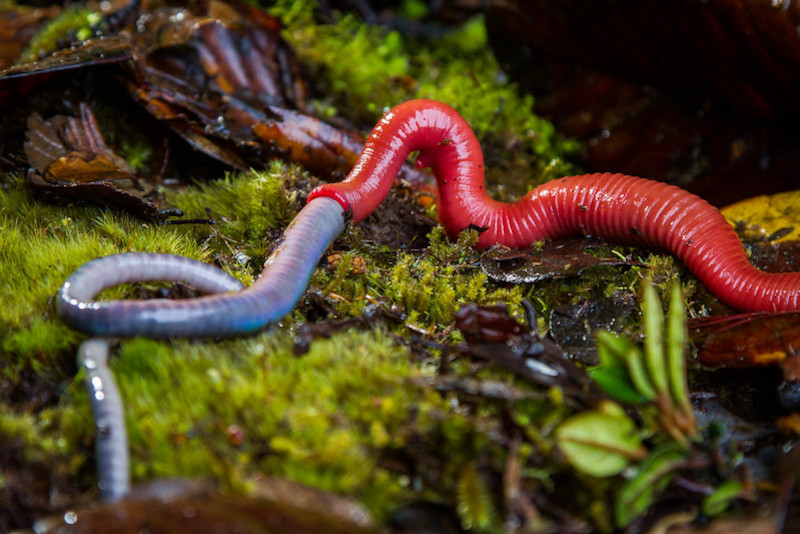
The mesmerizing Kinabalu Giant Earthworm virtually never fails to capture the immediate attention and interest of those inidividuals fortunate enough to encounter it. Unlike most of its kindred around the world, though, this worm does not do so solely due to its particular natural appearance.
In terms of that physical presentation, however, it follows a pattern of development typical of its kind. This differs from the majority of other fauna. That’s the fact that this wonder of Nature and evolution displays no sign of the physiological trait known to science as sexual dimorphism.
That’s true given the fact that the intriguing creature copies all other recognized species of earthworm known to human science. This amazing form of life evolved as fully hermaphroditic in nature. Each individual therefore possesses both male and female reproductive organs.
Like other earthworms, its body develops as segmented into numerous ring-like sections, called annuli. A thickened, glandular band used in reproduction, called the clitellum, also appears visible on mature individuals. It further possesses multiple tiny bristles on each segment, named setae.
Yet, it’s doubtless the extreme size of the aptly-named Kinabalu Giant Earthworm that garners the most attention, though. Individuals attain an average length equaling roughly 28 in (70 cm). Exceptional specimens of this Annelid marvel, however, occasionally exceed 3.3 ft (1 m) in length.
Its general pattern of coloring also serves to make it stand out in the minds of many who view it. While most earthworms present bland brown shades, this one evolved to display a bright bluish-gray to dark purplish-blue body. In moist conditions, this also manages to appear slightly iridescent.
- Kingdom: Animalia
- Phylum: Annelida
- Class: Clitellata
- Order: Haplotaxida
- Family: Megascolecidae
- Genus: Pheretima
- Species: P. darnleiensis
Kinabalu Giant Earthworm Distribution, Habitat, and Ecology
Despite the generally used common name, the awesome Kinabalu Giant Earthworm actually evolved as indigenous to a moderately broad expanse of the surface of the earth. Precisely where that native zone of habitation lies, however, probably won’t surprise many people who learn of it.
That’s because this marvel of evolution developed as endemic to much of Southeast Asia. That population region includes the countries of the Philippines, Indonesia, Borneo, and Malaysia. As its general title implies, though, it remains especially prevalent on the slopes of Mount Kinabalu.
Impressively, this specifically evolved work of Nature displays a relatively versatile behavioral pattern regarding its choice of habitat. It’s thus found in a moderate range of environments within its area. In each of these locations, however, certain basic requirements remain common to all.
It favors montane and submontane forests, often in mossy, cool, and humid environments. The worm also prefers moist soils with a high organic content. It’s often seen in areas with rich leaf litter and decaying plant material. It thrives at altitudes of around 8,200 – 9,800 ft (2,500 – 3,000 m).
The astonishing Kinabalu Giant Earthworm evolved as a detritivore, meaning it eats a combination of decaying leaves, organic matter, and soil microbes. In this manner, the remarkable creature plays a key role in its local ecosystem, breaking down organic material, thus enriching soil for plants.
To the knowledge of researchers, the Kinabalu Giant Red Leech, with which it shares part of its range, forms its principal predator. Yet, it likely has others, as well. Science believes it to additionally be preyed upon by various birds or small mammals present within the local montane ecosystem.
The intrepid animal also emerges above ground mainly during periods of either heavy rain or mist, thereby markedly reducing the risk of desiccation. Its hermaphroditic reproduction allows any two mature worms to mate. This amplifies the efficiency of the process among sparse populations.
Species Sharing Its Range

Check out our other articles on 7 Endemic Socotran Species, Northern Raccoon, Nile River, Rila Primrose, Sooty Gull, Hellbender Salamander, Empress Cicada, Tiger Shark, Keeled slug-eating Snake










Leave a Reply