
Least Weasel Facts
- This tantalizing creation of Nature and evolution most frequently goes by the fitting, if unflattering, common name of the Least Weasel. Yet, the mammal does have a few other general titles by which it’s known. These options common weasel, little weasel, among others.
- Within the scientific community, however, the marvel’s perhaps much better known by its technical designation. Thankfully, though, that’s a comparatively simple term for layperson to pronounce. That’s because the lovely creature holds the formal appellation of Mustela nivalis.
- It received that somewhat short epithet due to the efforts of Carl Linnaeus himself. That highly esteemed Swedish biologist accomplished the first official acknowledgement of it as a separate and distinct species. He achieved that scientifically noteworthy deed in the year 1766.
- The distinctive animal earns special note in some areas for several reasons. As its often-used tag implies, it ranks as the smallest member of its genus. In addition to this, researchers currently recognize an extraordinary total of 18 subspecies of the remarkable work of evolution.
- Fortunately, the beautiful Least Weasel seems to be maintaining both a thriving and stable population base. That pleasant state also appears to hold true throughout its entire known range. The IUCN therefore does not presently show it on the Red List of Threatened Species.
- It nevertheless should still be considered as facing multiple potential threats to its continued existence as a species. Like all forms of life on earth today, most of these derive from the actions of man. They include the related dangers of habitat loss and ongoing climate change.
Related Articles
Least Weasel Physical Description
The remarkable Least Weasel typically captivates those individuals fortunate enough to encounter one of the visually appealing creatures. It does not usually do so due to impressive physical stature, though. That’s due to the fact that, as its title implies, it’s a comparatively small mammal.
In regards to its physical description, this product of eons of evolution also follows a pattern of development shared by its numerous kindred around the world. That’s the fact that it displays a certain amount of the physiological characteristic known to science as sexual dimorphism.
Males of this species attain an average body length ranging from 6.3 – 10.2 in (16 – 26 cm). It also possesses a surprisingly short tail, stretching a mean of 0.5 – 2 in (1.3 – 5.2 cm) in both genders. Body mass varies notably as well, typically ranging from only about 1.3 – 8.8 oz (36 – 250 gms).
Females, meanwhile, remain even smaller than this in all respects except the tail. Among this sex, the body generally grows to around 5.1 – 7.9 in (13 – 20 cm) long. These also measure more diminutive in weight, as well. This usually varies from roughly between 1.0 – 4.1 oz (29 – 117 gms).
It shows a general structure typical of its kin, having a long, narrow body and highly flexible spine. The rest of the mammals also merits note by observers. The wonder manifests four short limbs with five toes on each foot and sharp claws, perfectly developed for gripping prey and climbing.
The rest of the form of the Least Weasel, however, deserves mention, too. Its head evolved as small, triangular, and with a pointed muzzle. The eyes remain dark and prominent, giving excellent binocular vision. It also has small, rounded ears which Nature placed relatively on the head.
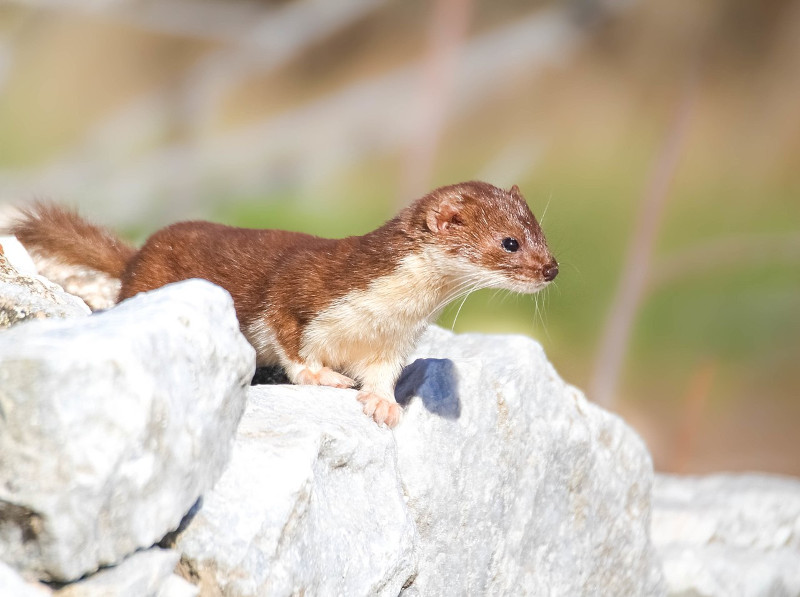
Yet, it’s perhaps the coloring that garners the most attention, especially given that it changes with the seasons. In summer, the upperparts display reddish-brown to chestnut-brown. The underparts, by contrast, show pure white or cream, with a sharp boundary between brown and white.
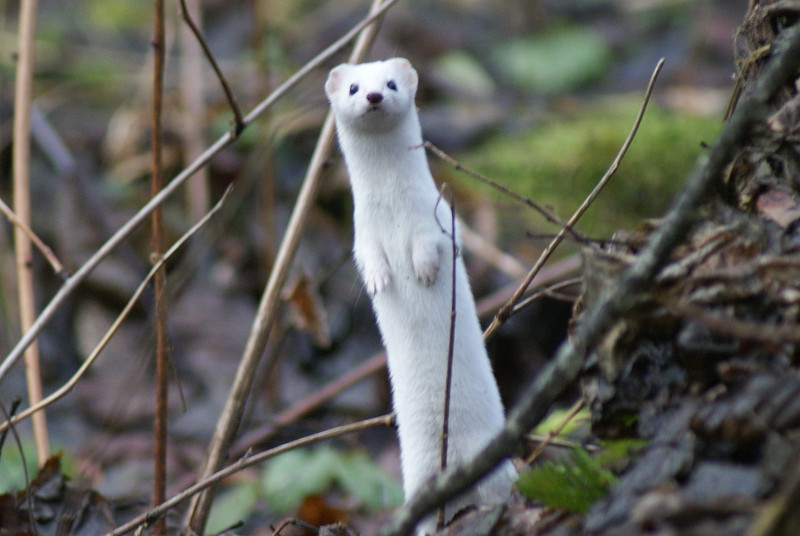
Its winter coat, though, presents perhaps the most striking image. At this time of the year, the animal typically turns completely white, especially in snowy regions, providing camouflage. Clearly distinguishing it from its relative, the stoat, even the tip of the tail displays this brilliant white shade.
- Kingdom: Animalia
- Phylum: Chordata
- Class: Mammalia
- Order: Carnivora
- Family: Mustelidae
- Genus: Mustela
- Species: M. nivalis
Least Weasel Distribution, Habitat, and Ecology
The attractive Least Weasel evolved as indigenous to an extraordinarily broad swathe of the surface of the earth. Incredibly, this small animal has one of the widest distributions of any carnivorous mammal. Its native zone of habitation actually covers the majority of the Northern Hemisphere.
It’s found in comparatively great abundance throughout most of Europe. In this region, it appears from the British Isles and Scandinavia in the north to the Mediterranean region in the south. The mammal does remain absent, however, from Ireland and Iceland, plus some Mediterranean islands.
Meanwhile, it’s also widely distributed across much of Asia, expanding from Turkey and the Middle East eastward through Central Asia, Siberia, China, Mongolia, Korea, and Japan. From there, its range extends north to the Arctic Circle and south into parts of India, Pakistan, and the Himalayas.
It also occurs in a few isolated regions of northern Africa, particularly Morocco, Algeria, and Egypt. Not content to stop there, though, Nature also spread the marvel across much of North America. In this part of the world, it lives abundantly in Canada, Alaska, and the northern United States.
This impressive biological marvel displays an extremely high degree of flexibility regarding its choice of habitat. It therefore thrives equally well in a wide range on environments. That serves to provide it with a strong advantage over many of the species with which it competes for food and territory.
As a general principle, it prefers open or semi-open areas that provide both cover for hunting and shelter for nesting. Areas frequented include such diverse settings as grasslands, meadows, farmland, and pastures. Yet, it also lives in scrublands, steppes, wetalnds, tundra, and alpine zones.
In terms of microhabitat, the animal likes the burrows of rodents, like voles, or hollow logs, crevices, and dense vegetation for shelter. There, it usually lines its nests with dry grass, moss, feathers, or rodent fur. In human-modified landscapes, it often shelters in barns, stone walls, or haystacks.
The small mammal actually plays a crucial ecological role as a small, highly efficient predator that helps regulate populations of rodents and other small vertebrates. Despite its tiny size, it remain an active carnivore with high energy demands and a dynamic relationship with its environment.
The diet of the Least Weasel consists of smaller mammals, such as voles, mice, and shrews. Nonetheless, it occasionally augments this with small birds and hatchlings, frogs, lizards, and insects. Though it rarely does so, if food is scarce, it sometimes consumes carrion opportunistically.
In turn, given its diminutive stature, it’s threatened by multiple natural predators. Among these, birds of prey, including owls, hawks, and buzzards prey upon it. Mammalian and reptilian threats, however, often consist of various foxes, stoats, cats, martens, and snakes, among numerous others.
Although primarily diurnal in nature, it’s potentially active at any time of the day or night. It hunts by scent and sight, often entering burrows to capture prey. The creature also has an extremely high metabolic rate, thereby requiring it to consume roughly half its body weight on a daily basis.
Breeding season typically lasts from spring through early autumn. Gestation normally requires 34 – 37 days. Litters range from 1 – 10 in number, with 4 -6 being the most common. Females generally produce between 1 – 2 litters per year. An average lifespan in the wild only equals 1 – 2 years.
Species Sharing Its Range

Check out our other articles on 5 Awesome Canines of Asia, New Zealand Sea Lion, Khone Phapheng Falls, Socotra Desert Rose, Great Barracuda, Blue Baboon Tarantula, Chinese Alligator










Leave a Reply