

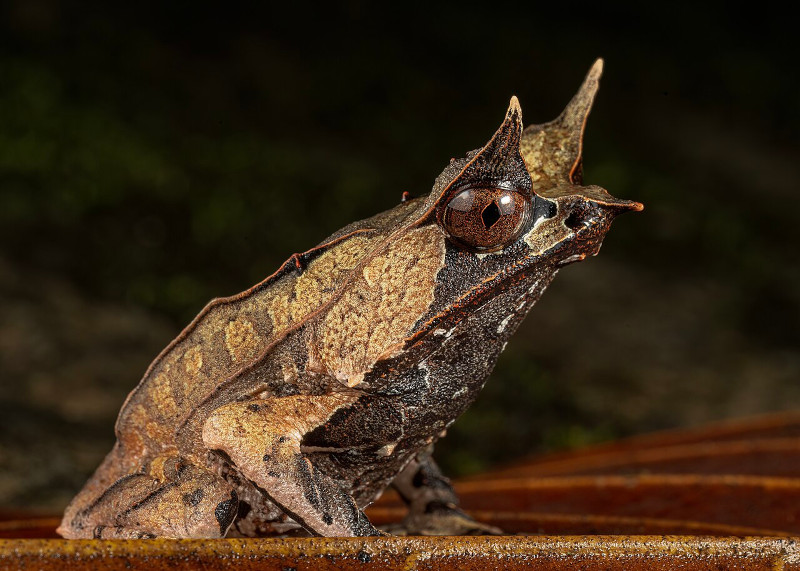
Long-nosed horned frog Facts
- This undeniably distinctive looking amphibian most often goes by the fully appropriate common name of Long-nosed horned frog. The animal does have several alternate titles it’s known by, though. Those choices include Horned frog, Leaf frog, and Long-nosed frog.
- Inside of scientific circles, however, it’s also referred to by yet another one, its technical designation. Unfortunately, that’s an extremely difficult one for the layperson to pronounce. That’s because this product of Nature bears the official tag of Pelobatrachus nasutus.
- The remarkable creature received that particularly tongue-twisting moniker due to the efforts of Hermann Schlegel. That respected German herpetologist accomplished the first formal recognition of it as a separate and distinct species. He achieved that noteworthy deed in 1858.
- Fortunately, the amazing Long-nosed horned frog appears to still be maintaining a fully thriving population base. This pleasant state further seems to hold true throughout the entirety of its known range. The IUCN therefore does not show it on the organization’s Red List.
- Nonetheless, this marvel of evolution should still be considered as facing numerous threats to its continued existence as a species. Like all forms of life on earth today, most of these perils stem from the actions of mankind. They include habitat loss and ongoing climate change.
- Though not considered endangered at this time overall, its population within individual portions of its range do seem to be diminishing. Accordingly, one nation in which it resides now lists it as Enangered on its National Red List. A captive breeding program now exists there.
Related Articles
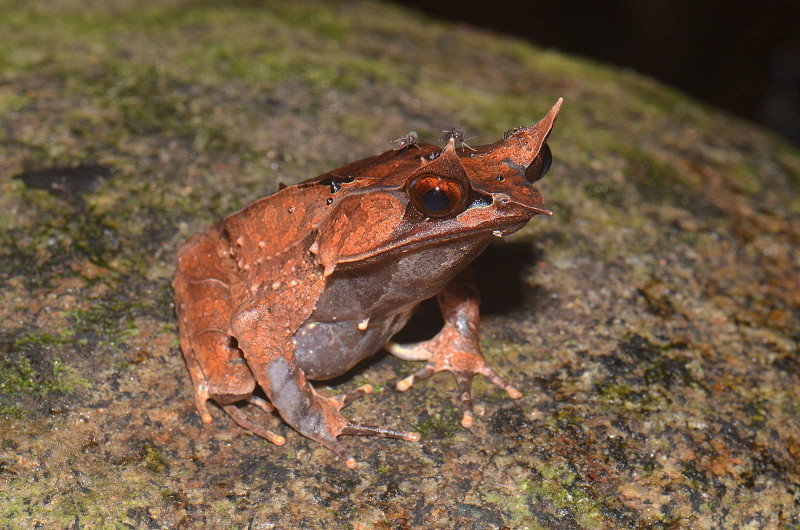
Long-nosed horned frog Physical Description
For those individuals fortunate enough to encounter one of these wonders in the wild, they rarely fail to capture one’s attention and interest. Surprisingly, however, that mesmeric effect doesn’t simply just occur due to its unique appearance. This amphibian also boasts impressive statistics.
In that regard, though, it does follow the evolutionary pattern common to most creatures, including its numerous relatives around the world. That’s the fact that it displays a certain degree of the physiological characteristic of sexual dimorphism. In it, this trait manifests itself in multiple ways.
In terms of sheer size, females attain greater average measurements than their male counterparts. For the former, a mean body length equals approximately 5 in (12.7 cm). Among the males of the species, though, this usually equals roughly 3 – 4 in (8 – 10 cm). Exceptional specimens do occur.
The females also typically develop a more robust and bulkier body shape than the males. That sex tends to remain somewhat slimmer in form. Males additionally have a vocal sac, which they use to produce mating calls. Females, however, completely lack this particular physical feature.
Otherwise, except for the undeerstandable reproductive-based differences, the two genders of the Long-nosed horned frog present the same general appearance to the viewer. With the two sexes taken together, the species demonstrates a flattened, broad body with rough, textured skin.
Its limbs also demonstrate notable features, similar in principle to most other frogs. The amphibian evolved strong hind limbs adapted for jumping, while the forelimbs remain relatively short but sturdy. It possesses extremely large eyes in relation to body size, as well, with vertically slit pupils.
But it’s undoubtedly the head of the Long-nosed horned frog that typically garners the most attention. This has sharp, triangular projections above the eyes that look like leaf veins or curled leaf edges. Its elongated snout, though, extends forward, resembling the tip of a leaf, thus the name.
The patterns of color this marvelous species presents to the observer remains the same for both genders. That principally consists of various shades of brown, tan, reddish-brown, or even gray. Most individuals also frequently combine this background with seemingly random dark markings.
- Kingdom: Animalia
- Phylum: Chordata
- Class: Amphibia
- Order: Aunura
- Family: Megophryidae
- Genus: Pelobatrachus
- Species: P. nasutus
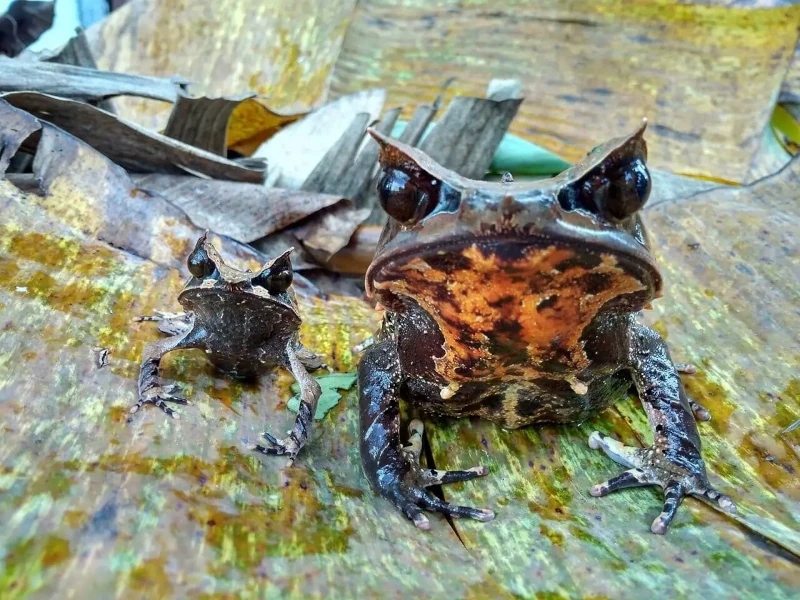
Long-nosed horned frog Distribution, Habitat, and Ecology
The eye-catching Long-nosed horned frog developed as indigenous to a moderately broad expanse of the surface of the earth. Exactly where that zone of habitation occurs, though, likely won’t surprise too many people. That’s because some of its alternate names provide a clear clue to this.
In general, that habitat range covers specific portions of Southeast Asia. For the moment, it’s only known to be present in four separate areas of this greater zone. Those consist of Malaysia, specifically Peninsular Malaysia and Borneo, Indonesia, Brunei, and southern sections of Thailand.
This remarkable creature also displays a unique blend of versatility and specificity regarding its choice of habitat. That’s true given the fact that it inhabits a number of different ecosystems. Each of these, however, shares the trait of existing within the boundaries of tropical rainforests.
It mainly resides inside either montane or lowland forests of this type. There, it most often appears in close proximity to both streams and forest floors covered in fallen leaves. It also prefers primary forests with dense vegetation, though it does sometimes make its home in secondary forests.
It’s additionally quite versatile where altitude’s concerned. Known populations appears at heights ranging from approximately sea level up to roughly 4,900 ft (1,500 m) above that. All of these locations provide a setting where it typically hides among dead leaves, under logs, or near tree roots.
The ecology of the amazing Long-nosed horned frog remains closely linked to its environment. There, it plays a role as both a predator and prey in the forest ecosystem. In both situations, its highly developed camouflage comes into play, providing it a degree of protection from detection.
It naturally evolved as carnivorous in nature. The fascinating amphibian primarily feeds as an ambush predator, at which it’s highly effective. Its principal prey consists of various insects, such as beetles, ants, and crickets. Other food sources include smaller frogs, lizards,and even small rodents.
In turn, it has it own share of natural predators. Snakes actively hunt it, both arboreal and terrestrial. Raptors sharing its range do so as well. These mainly include owls, hawks, and eagles. Mammals such as civets, rodents, and the mogoose also hunt it. Larger frogs and certain lizards do too.
Breeding typically occurs during the rainy season. Females lay eggs in slow-moving water, where tadpoles hatch and develop. These are adapted to life in flowing water, having suction-like mouths to cling to rocks. Metamorphosis into froglets takes anywhere from several weeks to months.

Species Sharing Its Range
Check out our other articles on 5 Terrific Texas Mammals, Humpback Whale, Salton Sea, Achiote Tree, Little Auk, Black and scarlet Cicada, West Indian Ocean Coelacanth, Mugger Crocodile