Mountain Huckleberry Facts
- This tantalizing creation of Nature and botanical evolution most frequently goes by the distinctive common name of the Mountain Huckleberry. The wonder also has multiple other general titles by which it’s known, though. All of these remain quite similar in nature, however.
- To some individuals, the flora’s known as the thinleaf huckleberry, tall huckleberry, or even big huckleberry. In some parts of its territory, though, the Angiosperm goes by the title of square-twig blueberry. Even more confusingly, a few people refer to it as black huckleberry.
- Within the scientific community, however, it’s perhaps more commonly referred to by its technical designation. Unfortunately, that’s a term that’s extremely difficult for the layperson to pronounce, and even a few botanists! It holds the formal tag Vaccinium membranaceum.
- This marvel of the plant world received that moniker due to the efforts of David Douglas. That highly respected Scottish botanist accomplished the first recorded recognition of it as a separate and distinct species. He achieved that scientifically noteworthy deed in the year 1874.
- Thankfully, the remarkable Mountain Huckleberry appears to be maintaining a population base that’s both sufficient and stable. This pleasant situation also seems to hold true throughout its entire range. Accordingly, the IUCN does not presently show it on the published Red List.
- The flora nevertheless should still be considered as facing multiple potential threats to its continued existence as a species. It deals with the same dangers as all forms of life on earth today. Most of those perils stem from the actions of mankind, and include climate change.
Related Articles
Mountain Huckleberry Physical Description
The beautiful Mountain Huckleberry rarely fails to capture the attention and interest of those individuals who view the botanical marvel. It does so, howeve, due to more than just its sheer visual appeal. That’s because this creation of eons of evolution also holds some surprises for observers.
It evolved as a variety of deciduous shrub. The plant possesses a rhyzomatic root system, which allows it to spread into dense patches. The form varies significantly between specimens, ranging from upright to spreading. This shrub also ranges in height from roughly 1.5 – 6 ft (0.5 – 2m) tall.
The numerous branches of the species develop as extremely thin in nature, and often widely branching. Its bark starts as thin and smooth on young growth, sometimes becoming slightly scaly with age. This also changes in color, showing a greenish when new, but darkening to reddish-brown.
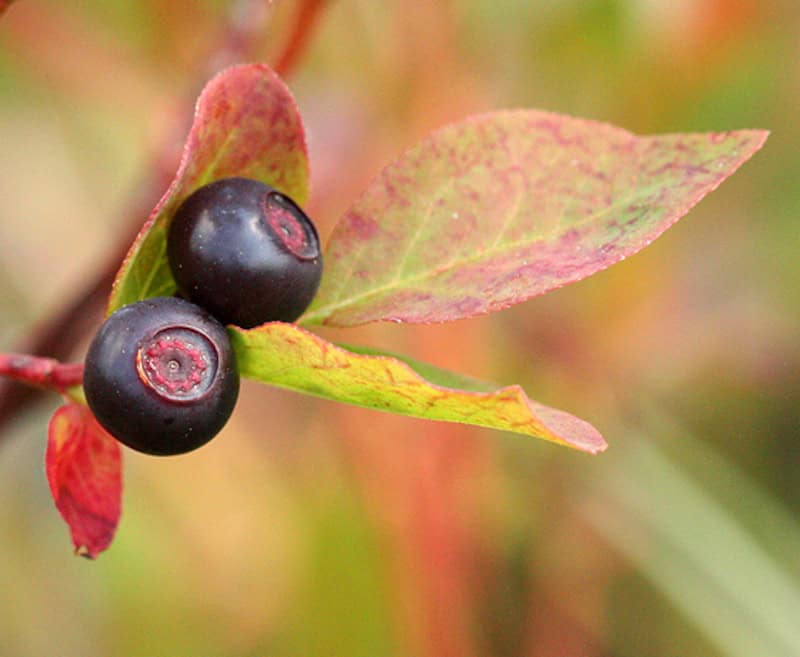
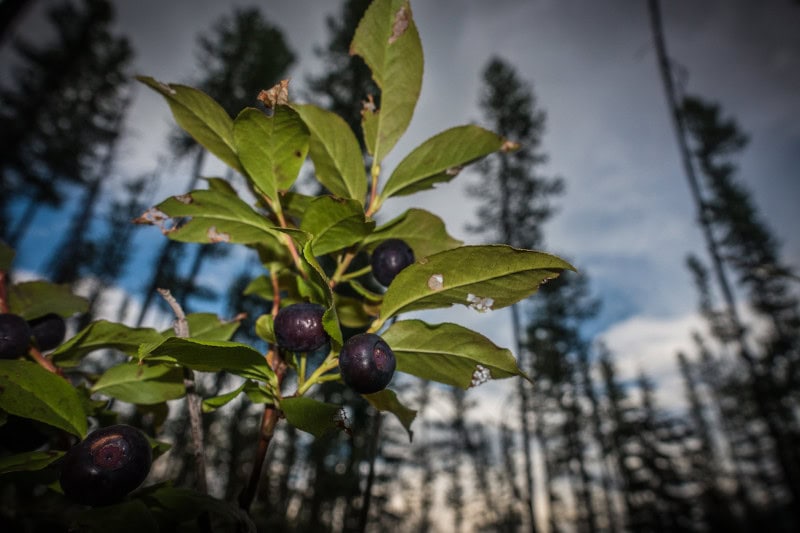
The leaves of this flora also merit attention. This foliage develops as alternate in pattern, and thin, oval-shaped to elliptical. Each leaf averages 0.8 – 2.4 in (2 – 6 cm) in length, with a finely serrated edge. In color, these appear as bright green on the upper surface, but somewhat paler underneath.
The flowers of the Mountain Huckleberry perhaps qualify as its greatest visual appeal, though. These remain quite small, averaging only about 0.2 in (5 mm) long, and display as urn to bell-shaped in form. Their colors also stand out, ranging from a lovely pinkish to a greenish-white shade.
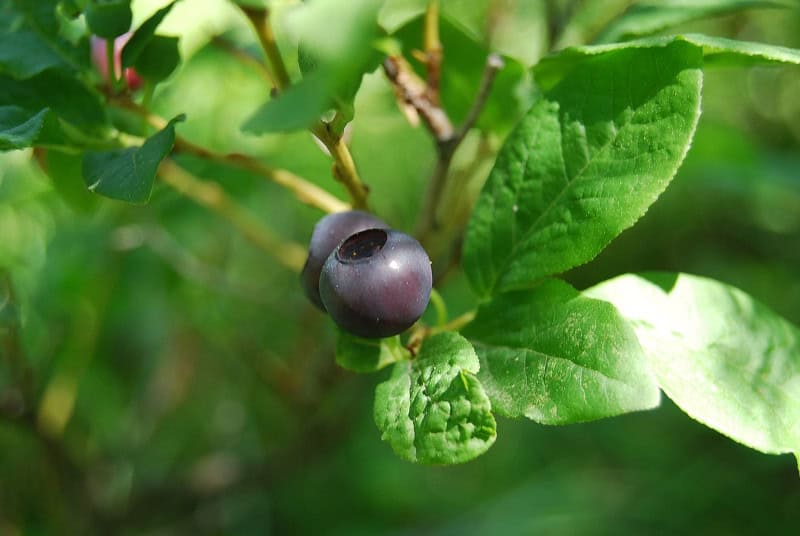
Its fruit also receives its own share of attention. This part of the plant develops as a small berry, usually reaching between 0.24 – 0.4 in (6 – 10 mm) in diameter. Typically, this appears dark purple when it first forms, slowly deepening to almost black in color. Some few, however, look reddish.
- Kingdom: Plantae
- Phylum: Tracheophyta
- Class: Magnoliopsida
- Order: Ericales
- Family: Ericaceae
- Genus: Vaccinium
- Species: V. membranaceum
Mountain Huckleberry Distribution, Habitat, and Ecology
The fascinating Mountain Huckleberry evolved as indigenous to a comparatively broad expanse of the surface of the earth. Exactly where that native zone of habitation lies, though, probably won’t surprise many who learn of it. That’s true since it developed as endemic to North America.
It primarily appears along the western portion of the continent. Within the confines of the United States, the wonder of Nature is common across the Pacific Northwest, including Washington and Oregon, northern California, Montana, and Idaho. It’s also in the Rocky Mountains in several states.
This botanical beauty also makes its home in the western parts of Canada. There, it’s widely distributed in British Columbia, Alberta, and the Yukon. It appears in parts of Saskatchewan, Manitoba, and the Northwest Territories, as well. Northward, the flora also lives in southeast Alaska.
Like most such plants, the Angiosperm displays decidedly clear and strong preferences regarding its choice of habitat. It thrives in montane to subalpine zones of the Rocky Mountains, Cascades, and Sierra Nevada. It’s common in openings, meadows, and burned areas where sunlight penetrates.
The shrub favors well-drained, acidic soils. It often occurs on volcanic or granitic substrates. The flora tolerates sandy, loamy, and rocky soils, but not alkaline conditions. It needs moderate to high moisture levels, but not waterlogged conditions, and also prefers either partial or direct sunlight.
The magnificent Mountain Huckleberry achieves its pollination principally via the actions of various bees. These mainly consist of locally prevalent bees and bumblebees. Interestingly, honeybees are less efficient at this for this plant, since the flowers evolved for what’s called buzz pollination.
It forms a keystone species in the understory of the forests in the regions it inhabits. Grizzly bears and black bears rely heavily on huckleberries for late-summer and fall fattening, while deer, elk, and moose browse the foliage. Grouse, thrushes, waxwings, and other songbirds eat the berries.
Smaller mammals, like chipmunks, squirrels, and rodents also feed on the berries and shoots. The shrub accomplishes its seed dispersal mainly through the droppings of these creatures, after they consume the berries. Its dense thickets also provide shelter and nesting for birds and small fauna.
Species Sharing Its Range
Check out our other articles on 5 Awesome Canines of Asia, New Zealand Sea Lion, Amazon River, Socotra Desert Rose, Great Barracuda, Fire Salamander, Veined rapa whelk, Chinese Alligator










Leave a Reply