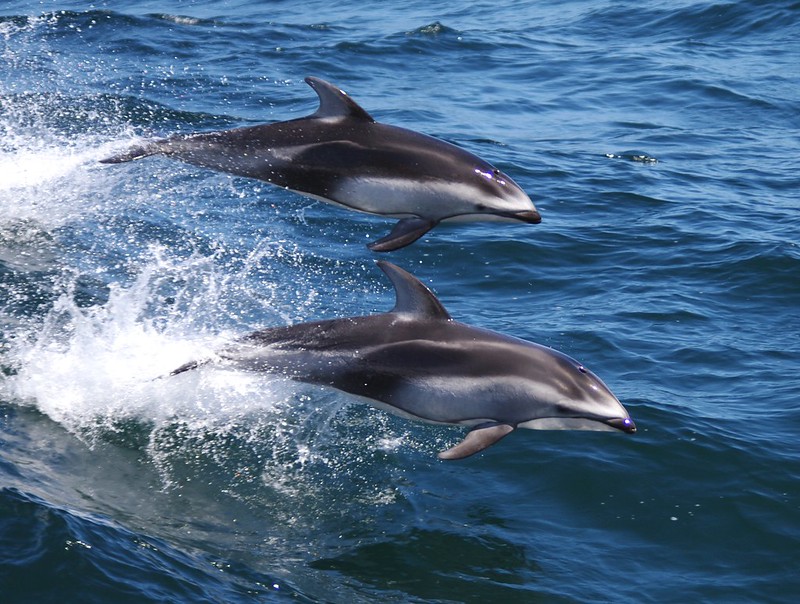
Pacific white-sided Dolphin Facts
- The descriptive term of Pacific white-sided Dolphin represents the most often used common name for this remarkable marine wonder. It does have a few other titles by which it’s known, though. Those include Hookfin porpoise and Pacific saddleback dolphin, to name a few.
- Within the scientific community, however, it’s perhaps much better known by its purely technical designation. Unfortunately, that’s one that remains particularly difficult for the layperson to pronounce. That’s because it holds the official tag Aethalodelphis obliquidens.
- It received that tongue-twisting epithet due to the efforts of Theodore Nicholas Gill. That highly respected American ichthyologist accomplished the first official recognition of it as a separate and distinct species. He achieved that scientifically noteworthy deed in the year 1865.
- This marvel of Nature and evolution earns a moderately special place in the annals of science. This occurs due to a special aspect of its territorial range. This beautiful marine creature currently represents the only member of its entire genus found exclusively in its native range.
- Fortunately, the stunning Pacific white-sided Dolphin seems to be maintaining a thriving and stable population base. That pleasant state also appears to hold true throughout its territory. Accordingly, the IUCN now ranks it as Least Concern on its Red List of Threatened Species.
- The animal nevertheless should still be considered as facing multiple potential threats to its continued existence as a species. Like all forms of life on earth today, most of these stem from the actions of man. They include the related perils of habitat loss and climate change.
Related Articles
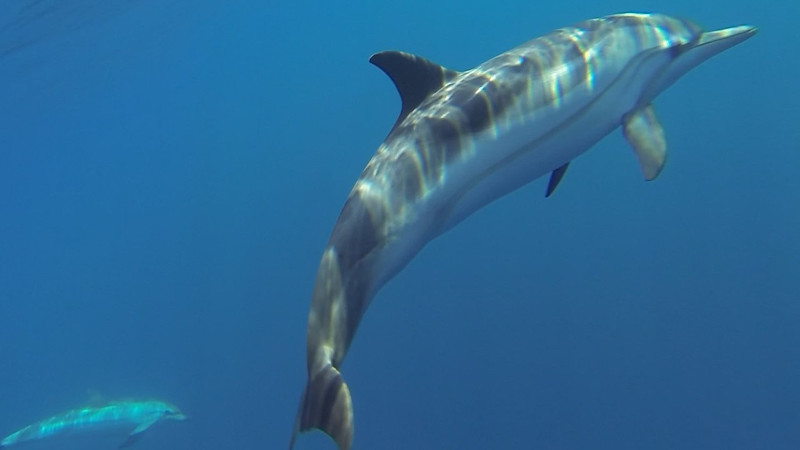
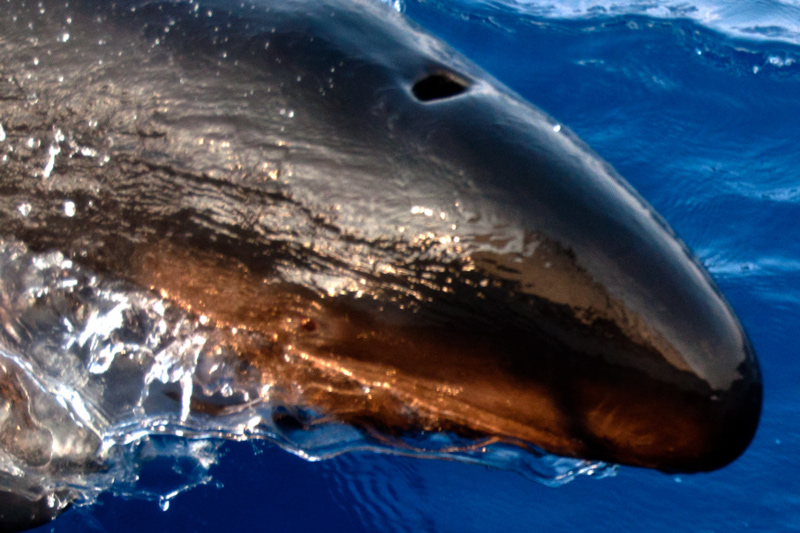
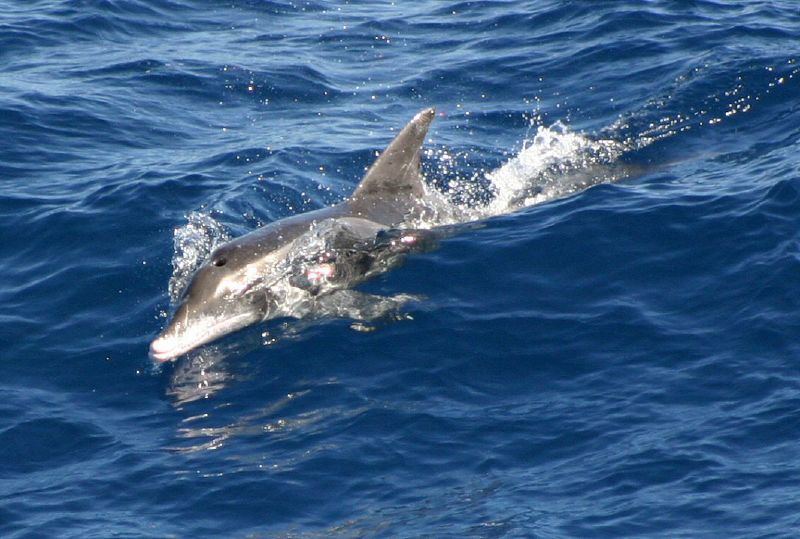
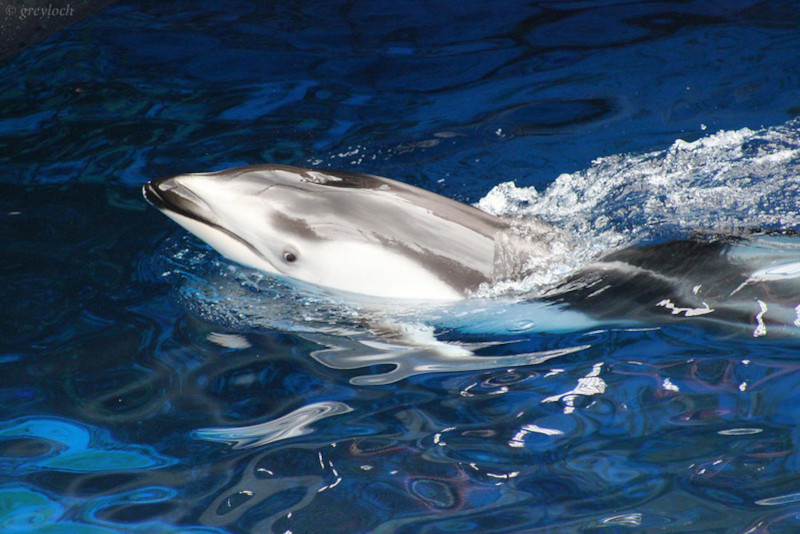
Pacific white-sided Dolphin Physical Description
The stunning Pacific white-sided Dolphin typically captivates and amazes those individuals fortunate enough to encounter it. The mammal does not do so due solely to its visual appeal, however appreciable that remains. That’s true since it also boasts fully respectable measurements.
Regarding its physical description, though, it follows a pattern of natural development shared by countless animals around the world. That’s the fact that it displays a certain degree of the physiological characteristic of sexual dimorphism. In its case, this only appears in a very minor way.
The general body shape usually develops as relatively streamlined and robust. Mature adults average between 5.5 – 8.2 ft (1.7 – 2.5 m) in length. In weight, the species achieves a mean of 300 – 440 lb (125 – 200 kg). Males tend to be on the higher end of both ranges than their female counterparts.
Its back, known as the dorsal side, presents as dark gray to black in color. Distinctive light gray or white stripes that sweep upward and backward from the eye to the dorsal fin additionally manifest on the lovely creature. This same pattern of coloration also appears from the belly toward the tail.
Still other aspects of the marvelous Pacific white-sided Dolphin also serve to catch the eye of the majority of observers. The belly, or ventral side, of the marine mammal shows a bright white shade. Its dorsal fin, meanwhile, displays as moderately dark on the front edge and light gray on the rear.
The beak, in the meantime, evolved to be short and clearly defined, with a dark stripe running from the eye to the beak. Its pectoral fins, called flippers, remain slightly long and pointed. The tail flukes of this particular dolphin also appear as broad in nature, with a very slight notch in the center.
- Kingdom: Animlia
- Phylum: Chordata
- Class: Mammalia
- Order: Artiodactyla
- Family: Delphinidae
- Genus: Aethalodelphus
- Species: A. obliquidens
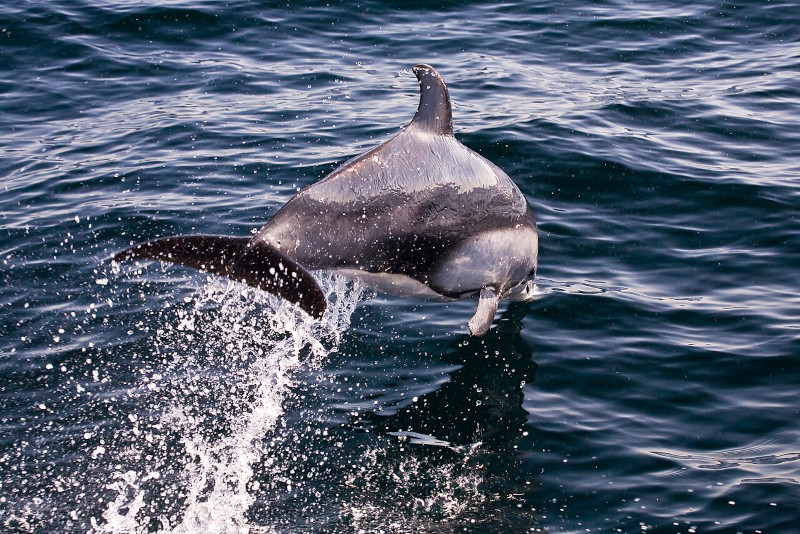
Pacific white-sided Dolphin Distribution, Habitat, and Ecology
The beautiful Pacific white-sided Dolphin evolved as indigenous to a moderately broad expanse of the marine regions of the globe. Precisely where that native zone of habitation lies, however, probably isn’t going to surprise anyone. Its very name serves to provide a clear indication of that.
This marvel of Nature and marine evolution currently inhabits a notably large portion of the Pacific Ocean. Inside the confines of the Western North Pacific, the wonder appears from the Sea of Japan, the Sea of Okhotsk, around southern Japan, up to the Kuril Islands, and into parts of the Bering Sea.
It also lives in the Eastern North Pacific. There, it appears from southern Gulf of California up through coastal waters of Baja California, along the United States West Coast, off the states of California, Oregon, Washington, and up to Alaska, including the Gulf of Alaska and Aleutian Islands.
Much like many of its numerous relatives found around the world, this mammal displays certain preferences regarding its choice of habitat. Fortunately, the gorgeous dolphin evolved to possess a comparatively high degree of flexibility in this specific aspect of its natural behavior patterns.
As a general principle, it favors areas of cool to temperate waters, often in areas influenced by upwellings or strong ocean currents. These settings vary significantly, though, in terms of location. That’s because the mammal thrives equally well in both offshore and nearshore environments.
It commonly appears over the continental shelf and slope of its area. In this setting, it mainly lives at depths betwenn 164 – 6,562 ft (50 – 2,000 m) deep. Scattered individuals do sometimes venture into deeper offshore waters, but it most often chooses to dwell in mid-depth coastal zones.
The Pacific white-sided dolphin evolved a social, fast-swimming, and highly intelligent cetacean. Where it thrives, it represents an apex mesopredator, playing an important role in controlling mid-trophic prey species, like small fish and squid, and also serving as prey for large marine predators.
Its diet varies greatly by region and season, tracking prey distribution and ocean productivity. Principal prey includes small schooling fish, such as anchovies, herring, sardines, saury, capelin, and smelts. Yet, it also consumes smaller quantities of cephalopods, including squid and octopus.
Nature created it as a highly intelligent and social animal. It usually lives in groups, called pods, typically of 10 – 100 individuals, though superpods occasionally number over 1,000. The dolphin engages in aerial displays, leaping, and bow riding, possibly for communication or social bonding.
Breeding season generally occurs between late spring to summer. Females typically give birth every 2 – 3 years, with gestation lasting approximately 12 months. Regardless of size, social groups often include mothers with calves, suggesting strong social bonds and possible cooperative care.
Species Sharing Its Range
Check out our other articles on 5 Astounding Asian Wild Cats, New Zealand Sea Lion, South Georgia Island, Scarlet Elf Cup, Vietnamese Mossy Frog, Empress Cicada, Chinese Alligator










Leave a Reply