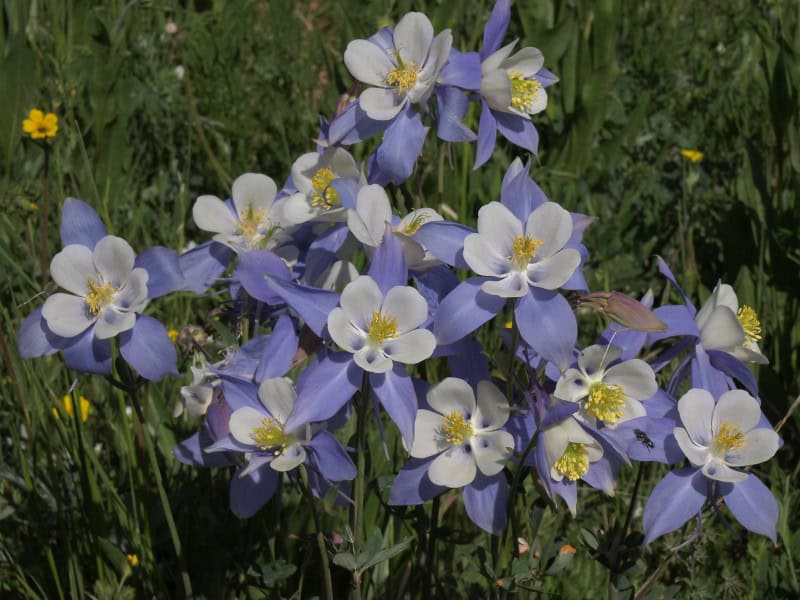
Rocky Mountain Columbine Facts
- This stunning beauty of botanical wonder most frequently goes by the informative common name of the Rocky Mountain Columbine. Yet, the gorgeous flora also holds several other titles by which it’s often known. These include Colorado Columbine and Colorado Blue Columbine.
- Inside of the scientific community, however, it’s possibly much better known by its entirely technical designation. Fortunately, that term remains comparatively simple for the layperson to pronounce. That’s because the stunning plant holds the formal moniker of Aquilegia coerulea.
- It received that relatively easy epithet due to the efforts of Edwin P. James. That highly regarded American botanist accomplished the first official acknowledgement of it as a separate and distinct species. The reseacher achieved that scientifically noteworthy deed in the year 1822.
- This delicate wonder of Nature and evolution also holds a certain measure of distinction within some circles. That’s due to the fact that several known varieties of the flora exist. For the moment, professional botanists recognize a total of four distinct varieties of the beautiful plant.
- Thankfully, the remarkable Rocky Mountain Columbine seems to be maintaining both a stable and sufficient population base. That pleasant state also appears to hold true across the entirety of its known native range. Accordingly, the IUCN does not yet show it on the Red List.
- The amazing Angiosperm nevertheless should be considered as facing multiple potential threats to its continued existence as a species. Like all forms of life on earth today, the majority of these dangers stem from the actions of man. These include the peril of climate change.
Related Articles
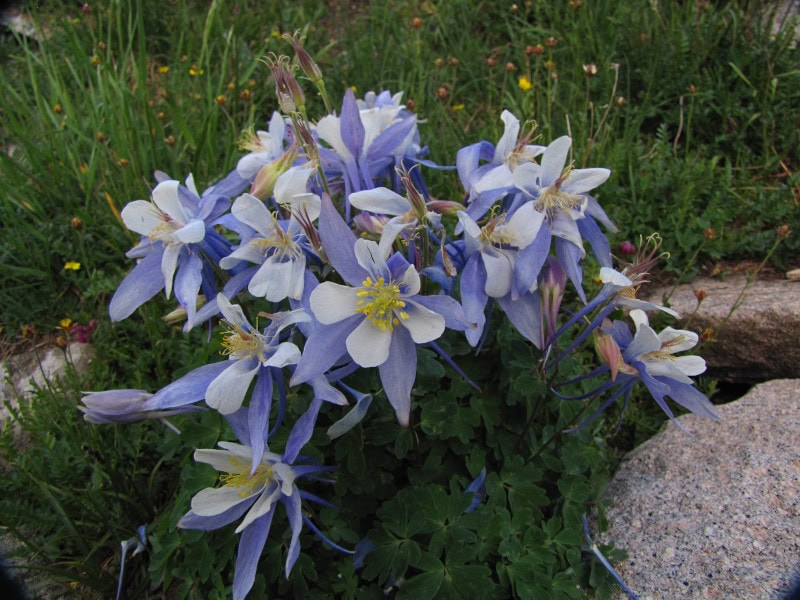
Rocky Mountain Columbine Physical Description
The captivating Rocky Mountain Columbine typically captures the full attention of those individuals who spot one of these beauties. Unlike some of its countless relatives around the world, though, it does so for more than just its sheer beauty. That’s true since it also boasts a fairly respectable size.
Mature examples of this marvel produce anywhere from one to ten flowering stems. These structures project strongly vertically, and display a dark green shade. Typically, these reach a height of 12 – 24 in (30 – 60 cm). Exceptional specimens, though, occasionally measure 28 in (70 cm).
The plant also produces two different types of foliage. Those appearing close to the ground, called basal leaves, develop divided into lobed, rounded segments. The ones on the stems, however, are smaller in size, and divided as 3 lobed. Overall, the foliage is delicate, fern-like, and bluish-green.
The fruit of this distinctive wonder evolved as a cluster of dry, pod-like structures called follicles. Each of these represents a dry fruit that splits open along one side at maturity. Usually, five of these develop on each bloom, appearing as narrow, elongated pods averaging 0.4 – 0.8 in (1–2 cm) long.
Without a doubt, though, it’s the mesmerizing flowers of the aptly-named Rocky Mountain Columbine that generally garner the most attention from observers. Each stem produces a single, star-shaped bloom. In size, these measure 2 – 3 in (5 – 8 cm) across, with spurs up to 2 in (5 cm).
Every blossom also has 5 petal-like sepals, often showing a blue shade. A total of 5 petals with long, backward-pointing spurs additionally manifest, showing white, blue, or lavender. The center, meanwhile, displays light blue to lavendar sepals, though color varies, sometimes pink or white.
- Kingdom: Plantae
- Phylum: Anthophyta
- Class: Magnoliopsida
- Order: Ranunculales
- Family: Ranunculaceae
- Genus: Aquilegia
- Species: A. caerulea
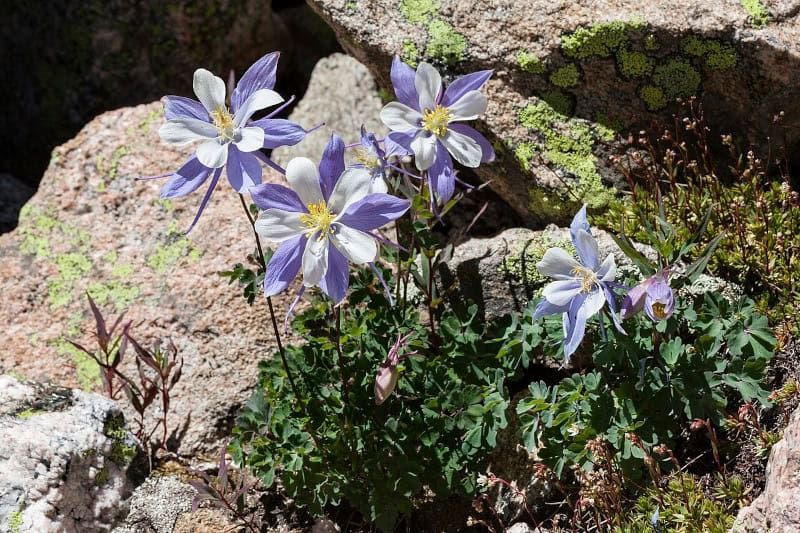
Rocky Mountain Columbine Distribution, Habitat, and Ecology
The breathtaking Rocky Mountian Columbine evolved as indigenous to a moderately restricted portion of the surface of the earth. Precisely where the majority of that zone of habitation lies, however, likely won’t surprise many people. That’s because its primary name provides a clear clue.
This remarkable beauty of botanical evolution developed as endemic to only the approximate western regions of the region of the world known as North America. Within the greater landmass of the amazing continent, it largely appears in portions of the Rocky Mountains, as the title implies.
Inside of that mountain range, though, this awesome flora mainly makes its home inside the borders of the United States. There, it’s known in Colorado, Wyoming, Montana, New Mexico, Utah, and Idaho. It also lives in mpountainous parts of southern Alberta and British Columbia, in Canada.
Given its area of habitation, this wonderful Angiosperm displays decidedly clear and strong preferences regarding its choice of habitat. These reflect the nature of its territory. It thrives best, and almost entirely, in surprisingly high-altitude, rugged mountainous regions of its native range.
It usually appears at heights ranging from between 7,000 – 12,000 ft (2,100 – 3,700 m) above sea level. There, it mostly lives in alpine and subalpine fields and meadows. Yet, the herbaceous plant also sometimes appears in open woodlands with scattered trees, and on rocky slopes and ledges.
Despite its seeming fragility and relative stature, the magnificent Rocky Mountain Columbine plays a key role in many of the local mountain meadow ecosystems. Its ecology naturally remains strongly shaped by its many interactions with pollinators, other plants, and the alpine environment.
The flowering plant primarily achieves its pollination via the actions of hummingbirds, especially the broad-tailed hummingbird, and various long-tongued bees. Its flowers typically bloom in late spring to early summer, coinciding with the pollinator activity present in high-altitude habitats.
The tiny seeds it produces accomplish most of their dispersal by wind, usually falling near the parent plant. Small mammals occasionally browse the leaves, though most find them toxic. Those that do feed on the foliage, however, sometimes aid in seed dispersal when these cling to their coats.
Species Sharing Its Range

Check out our other articles on 5 Awesome Canines of Asia, Northern Raccoon, Khone Phapheng Falls, Socotra Desert Rose, Sooty Gull, Goldentail moray, Empress Cicada, Earless Monitor Lizard










Leave a Reply