

Ruby Octopus Facts
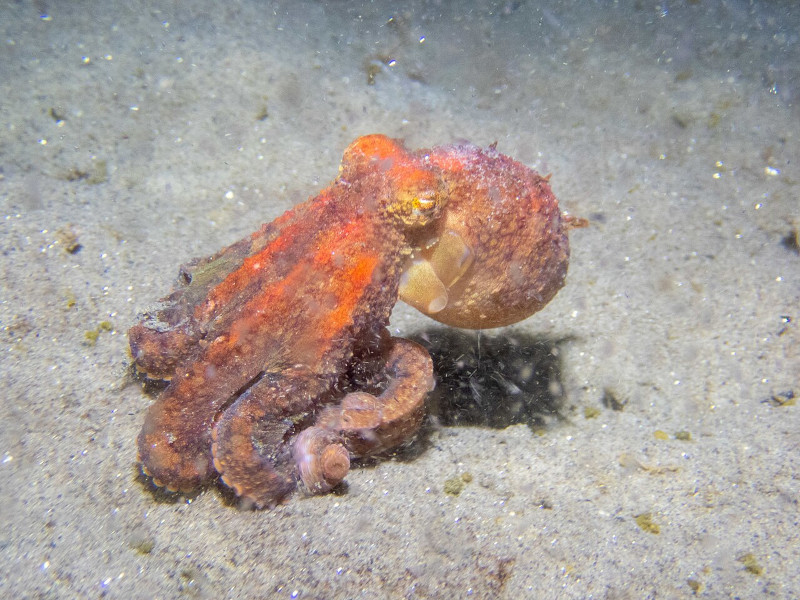
- This extraordinary denizen of the depths most typically goes by the descriptive common name of Ruby Octopus. It does, however, also possess a few other alternate titles by which it’s sometimes known. Those include Red octopus, Pacific red octopus, and Red Pacific octopus.
- Within the scientific community, though, the amazing creature’s perhaps better known by its entirely technical designation. That’s actually a relatively simple one for the layperson to pronounce. That’s because this marvel holds the official moniker of Octopus rubescens.
- The animal received that particular epithet due to the efforts of S. Stillman Berry. That highly respected American marine zoologist accomplished the first formal recognition of it as a separate and distinct species. He achieved that scientifically noteworthy deed in the year 1953.
- This remarkable ocean dweller distinguishes itself from its kindred found around the world due to a specific combination of factors. The impressive species demonstrates a surprising amount of genetic diversity, environmental adaptability, and strong behavioral flexibility.
- Fortunately, the Ruby Octopus appears to be maintaining a population base that’s both stable and sufficient. That pleasant state also seems to hold true throughout the entirety of its habitat range. The IUCN therefore currently shows it as Least Concern on its published Red List.
- These marvels of Nature and evolution nonetheless still face multiple potential threats to their continued existence as a species. Like all forms of life on earth today, most of these stem from the actions of mankind. They include the perils of habitat loss and ongoing climate change.
Related Articles


Ruby Octopus Physical Description
The visually stunning Ruby Octopus generally garners a great deal of appreciation from those individuals fortunate enough to encounter one. Unlike some of its relatives, however, it does not do so due to impressive size. That’s true since it’s actually a very small member of its specific Family.
Again diverging from the normal pattern among its kind, it displays only a very slight degree of the physiological characteristic of sexual dimorphism. Given that fact, distinguishing the gender of individuals by purely visual means often presents numerous challenges to even trained observers.
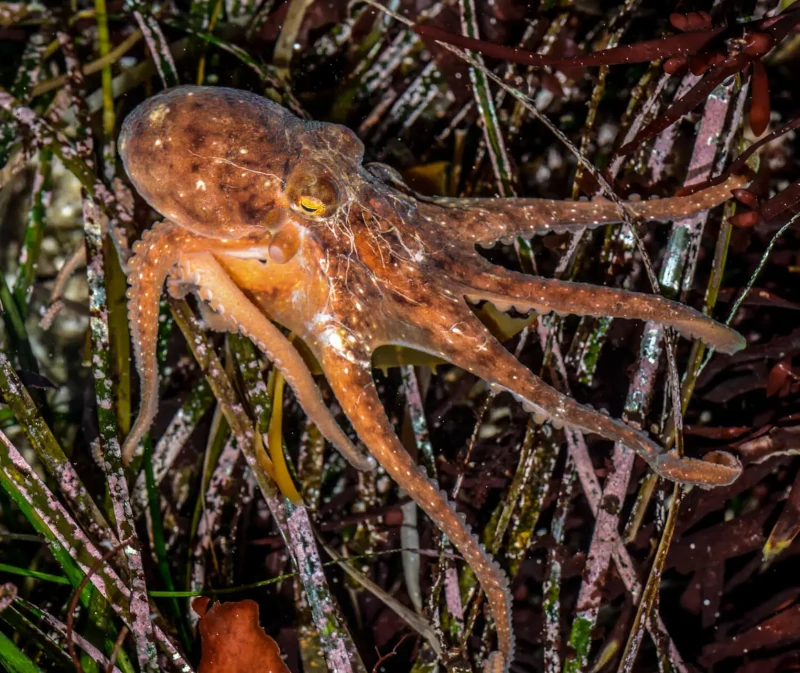
The mantle displays as small; being rounded to oval in shape. Its body in general shows a compact, low-profile build. Following the evolutionary pattern shared by its kindred, it also boasts eight relatively long tentacles. Thee typically average roughly two to three times the length of the mantle.
The body, the part known as the mantle, averages between 2 – 4 in (5 – 10 cm) in length. Its total combined arm span ranges from 15.8 – 23.6 in (40 – 60 cm). Its weight rarely exceeds 2.2 lbs (1 kg). Most individuals, in fact, remain under this. Exceptions to this do occur, but only quite rarely.
The sex-based difference presents itself in only slight ways in terms of size. females tend to be slightly larger, especially in the mantle. But the key distinction is the presence of a specialized arm called the hectocotylus. Used as an aid to reproduction, only the males of the species have this.
Sitting on the head itself, the distinctive creature evolved prominent, well-developed eyes with a notably horizontal slit pupil. Nature placed its eyes on either side of the mantle, giving wide field of view. This gives it the excellent vision so important for detecting motion and contrast, not just color.
Each of the eight arms of the captivating Ruby Octopus have two rows of small suckers, used for gripping either its prey or structures. The arms developed as highly flexible, and capable of exploring independently. At the tip of each of these appendages, it becomes extremely sensitive to touch.
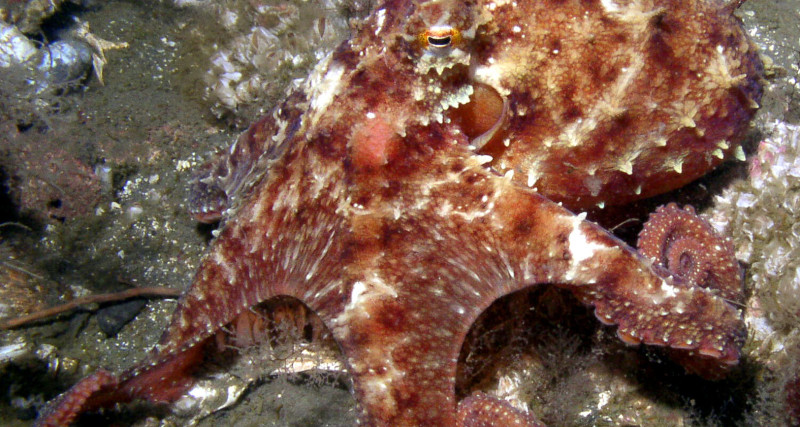
Though capable of camouflage, its skin does have several basic colors. Those include reddish-brown, rust, orange, or dark maroon. The animal fades these at will, usually to pale beige or gray. It also enhances this with mottled or speckled patterns, and darker patches along the arms or mantle.
- Kingdom: Animalia
- Phylum: Mollusca
- Class: Cephalopoda
- Order: Octopoda
- Family: Octopodidae
- Genus: Octopus
- Species: O. rubescens
Ruby Octopus Distribution, Habitat, and Ecology
Regrettably, the gorgeous Ruby Octopus seems to inhabit only a somewhat restricted portion of the marine regions of the globe. Its indigenous territory appears to be solely comprised of a specific portion of the Pacific Ocean. More specifically, it’s only known to live in the northeastern section.
There, the wonder primarily inhabits areas along the west coast if North America. The vast majority of its population dwells in a range that extends from California to Washington State, in the United States. Northward, however, it also appears in smaller numbers from British Columbia to Alaska.
Thankfully, evolution provided it with a high degree of adaptability in terms of where it chooses to live. It thus occupies a wide variety of marine environments. Those include rocky reefs, kelp forests, subtidal zones, tide pools, and even around artificial structures, such as piers, pylons, and jetties.
It also makes its home in an equally broad range of depths. Observers spot individuals and groups everywhere from shallow intertidal zones, down to deeper continental shelf waters. The animal’s typically most common in coastal shallows to mid-depths. It does favor cold to temperate waters.
Like others of its kind, the Ruby Octopus evolved as a carnivore. It most often hunts as a patient, mid-level ambush predator. The cephalopod generally feeds quite opportunistically, yet some prey predominate. Those consist of crabs, snails, shrimp and other crustaceans, and small fish.
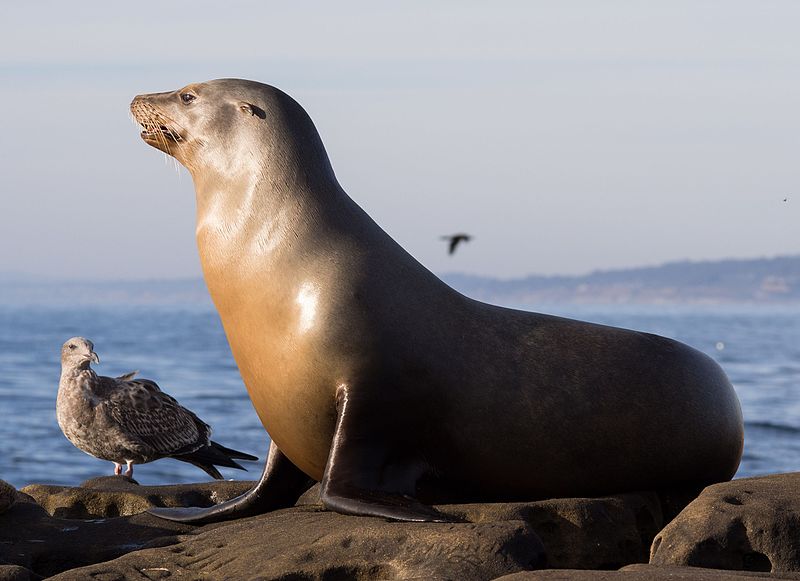
Like most fauna, in turn, it faces its own fair share of predators. Given its rather diminutive nature, many larger ocean species prey upon it, thus the active camouflage. Large fish, pinnipeds, such as seals and sea lions, and occasionally even other, much larger octopuses, all routinely feed upon it.
When mating, the male uses the specialized arm to transfer sperm packets, called spermatophores, directly into the female’s mantle cavity. This represents direct, internal fertilization, as opposed to the external spawning method displayed by the majority of other octopuses across the globe.
Females lay eggs in clusters, attached to rock crevices, sheltered hard surfaces, and protected cavities. They guard the eggs fiercely; never leaving them, even to feed. As a result, the females usually die shortly after the eggs hatch. Males die shortly after mating, though less dramatically.

Species Sharing Its Range
Check out our other articles on 5 Magnificent Mammals of the Himalayas, Ethiopian Highland Hare, South Georgia Island, Splendid Toadfish, Anise Swallowtail, Golden Eagle, Texas Alligator Lizard