Seven-Spotted Ladybird Facts
- The highly descriptive term of Seven-Spotted Ladybird serves as one of the most frequently used common names for this beautiful insect. Yet, it does possess several other general titles. These include Seven-Spotted Ladybug, Ladybird beetle, and Lady beetle, among others.
- Inside the hallowed halls of science, however, it’s possibly much better known by its technical designation. Unfortunately, like so often happens, that’s one that’s extremely difficult for the layperson to pronounce. It holds the official moniker of Coccinella septempunctata.
- This marvel of Nature received that particularly tongue-twisting epithet due to the efforts of Carl Linnaeus himself. The highly esteemed Swedish zoologist accomplished the first recorded acknowledgement of it as a separate and distinct species. He did so in the year 1758.
- Humans intentionally introduced it into regions of the world outside of its native range, beginning in the 1950’s. This occurred in an attempt to control aphid populations in farming areas. Since then, though, it’s spread and become considered invasive in some regions.
- For the moment, the beautiful Seven-Spotted Ladybird appears to be maintaining a population base that’s both stable and sufficient. That state also seems to hold true throughout the entirety of its range, both natural and artificial. Thus it does not show on the IUCN Red List.
- It nevertheless should be considered as facing multiple potential threats to its continued existence as a species, at least. In this respect, it faces the same dangers as all forms of life on earth today. Most of these perils stem from the actions of man, and include climate change.
Related Articles
Seven-Spotted Ladybird Physical Description
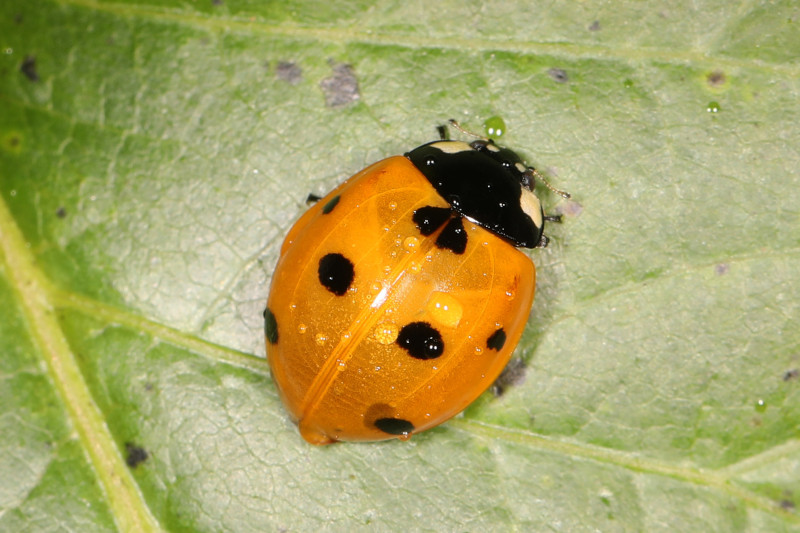
The captivating Seven-Spotted Ladybird generally appeals visually to those individuals fortunate enough to notice one of these insect wonders. However, this appreciation usually occurs due more to its appearance than dimensions. That’s true since, in that respect, it’s a very small creature.
It also follows a pattern of growth common among many fauna on earth. That’s the fact that it displays a certain amount of the physiological characteristic of sexual dimorphism. In its specific case, though, this natural trait manifests in size only, and even then to only a very minor degree.
Overall, specimens of this beautiful invertebrate achieve an average length equaling roughly 0.3 – 0.4 in (0.7 – 1 cm). Females of the species typically reach body sizes on the higher end of this range than their male counterparts. This minimal difference makes distinguishing the sexes visually difficult.
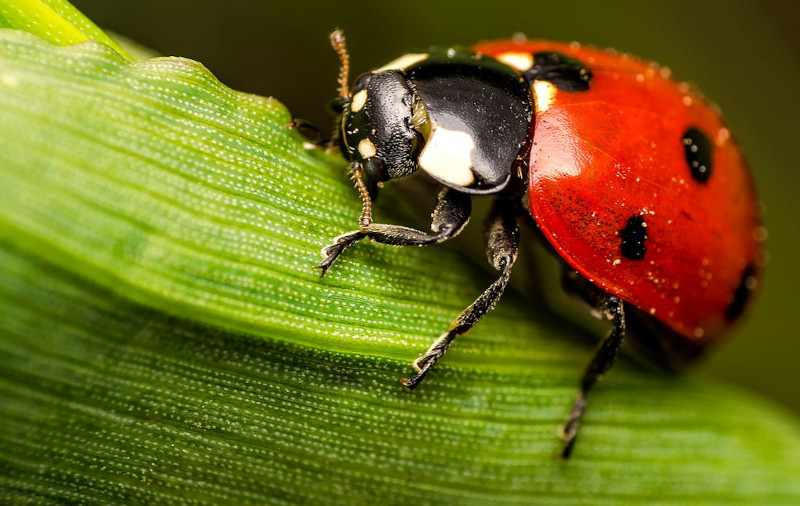
All individuals of this marvel of evolution present the same general body shape, though, regardless of gender. The beetle evolved a dome-shaped, conves body, much like many of its closest relatives around the world. This also presents an approximately oval and relatively compact structure.
The head, meanwhile, develops as comparatively small, and black in color. This additionally remains partially hidden under the pronotum. In color, it shows a deep black. The short legs also display a black hue. Its antennae are short and clubbed, with those of the male being more curved.
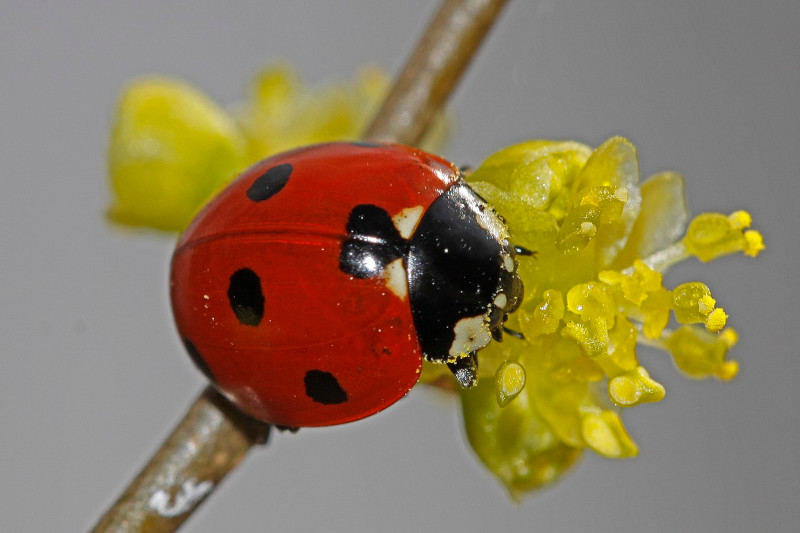
Undoubtedly, however, it’s the gorgeous pattern of coloring evolved by the Seven-Spotted Ladybird that usually garners the most attention. Being the same in both sexes, the wing covers, known as elytra, manifest either bright red or orange, with seven prominent black spots easily seen.
Each separate wingcase possesses three of these markings. The seventh appears centrally, straddling both elytra near the back. Intriguingly, two white or pale spots show near the head of the Arthropod. This feature creates an appearance that many viewers believe resembles a smiling human face.
- Kingdom: Animalia
- Phylum: Arthropoda
- Class: Insecta
- Order: Coleoptera
- Family: Coccinellidae
- Genus: Coccinella
- Species: C. septempunctata
Seven-Spotted Ladybird Distribution, Habitat, and Ecology
The stunning Seven-Spotted Ladybird evolved as indigenous to an extremely broad swathe of the surface of the earth. Just how far that native zone of habitation extended might surprise some of you, however. It evolved naturally to appear in parts, of Europe, Africa, Asia, and the Middle East.
In Europe, this creature holds a very widespread distribution, living in most sections. On the continent of Africa, it’s known to be present in the northern sections. Meanwhile, in Asia, the invertebrate lives in the central and northern areas, including Russia, China, and Japan.
As mentioned before, it’s now inhabiting non-native regions of the earth as well. In North America, it’s now present in both the United States and Canada. In New Zealand, humans introduced it for pest control, just as in North America. It’s also now been spread to both India and other areas.
This wonder of Nature and evolutionary processes evolved an impressive degree of flexibility regarding its choice of habitat. It’s therefore found thriving in a wide range of terrestrial ecosystems. All of these settings, though, share the condition of a high prevalence of its natural food sources.
It’s commonly found in meadows and grasslands, since these contain both a rich diversity of plants and insect prey. The insect’s additionally often seen in areas of forest edges and hedgerows. It considers these to be ideal for overwintering, as well as excellent sites for purposes of breeding.
Shrublands and even roadside vegetation also serve it well, given that these offer it both good cover and access to prey. Agricultural fields work perfectly for it, especially crops like wheat, barley, beans, and canola. It’s even common in urban and suburban regions, such as gardens and parks.
The ecology of the Seven-Spotted Ladybird centers around its role as a beneficial predator. That’s especially true in its role in controlling pest populations in its indigenous regions. Its interactions within various ecosystems make it a key player in natural and agricultural biological control.
The Arthropod evolved as primarily carnivorous in nature, mainly feeding on aphids and other small arthropods. Both the adult and larval stages feed voraciously, mainly on aphids. The tiny larvae consume hundreds of aphids during development, while adults continue feeding their entire lives.
Species Sharing Its Range
Check out our other articles on 4 Fabulous North American Caves, Mountain Hare, Deception Island, Douglas Iris, Spotted Eagle Ray, Epirus Dancing Grasshopper, Little Auk, Black Caiman










Leave a Reply