

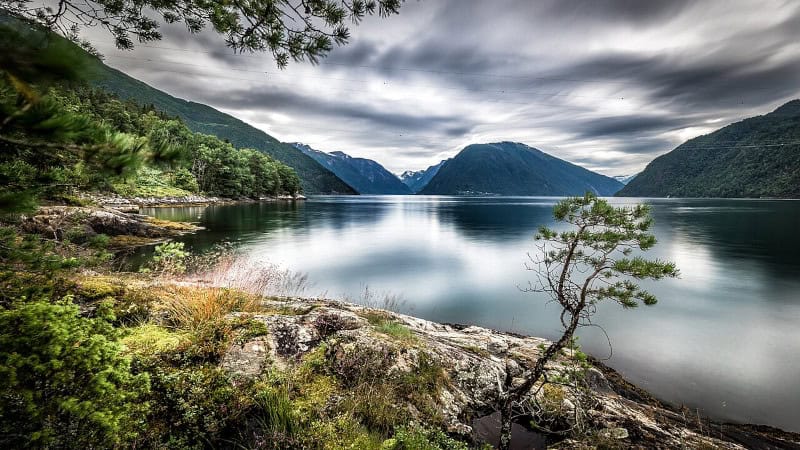
Sognefjord Facts
- This mind-boggling creation of time and natural forces most frequently goes by the title used here, that of the term Sognefjord. The wonder does, however, also have a few other names by which it’s sometimes known. Those include Sognefjorden, Sogn Ford, and King of the Fjords.
- It’s not presently known precisely when ancient man first sighted this majestic feature. The last Ice Age in its region, though, ended between roughly 12,000 – 10,000 years ago. Beginning during that period, prehistoric hunter-gatherers arriving in the area likely quickly spotted it.
- Archaeological evidence proves a human presence in its area around 9,000 – 8,000 BCE. These groups likely moved inland along fjords like this one, living on fishing, hunting, and gathering. Later, in the Neolithic period, around 4000 BCE, farming communities began to appear.
- The incredible beauty and majesty of Sognefjord understandably led to its receiving a certain amount of protection from the depredations of man. Parts of its vast extent enjoy legal protection from the local government. One branch now forms a UNESCO World Heritage Site.
- Lamentably, however, not all of this marvel is fully protected. The geological masterpiece faces threats from multiple dangers, many of which stem directly from human activities. These many perils include marine traffic emissions, agricultural runoff, and ongoing climate change.
Related Articles
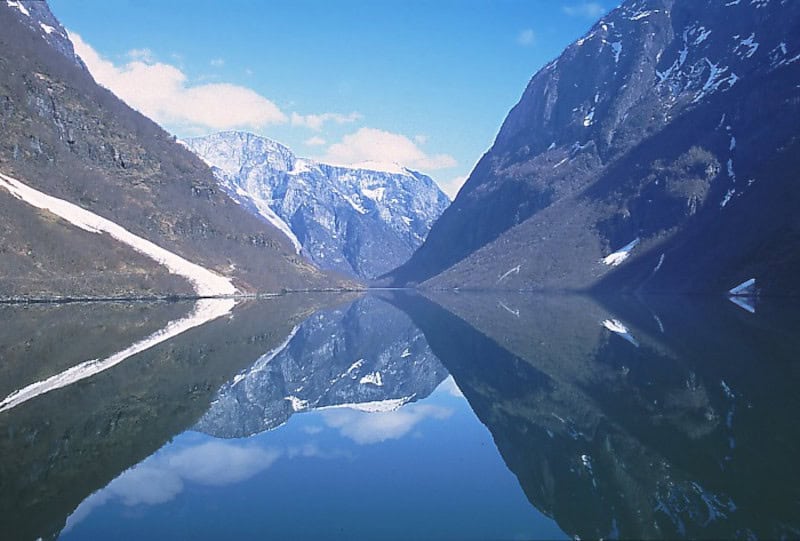
CCL: https://tinyurl.com/ppxymnf3
Sognefjord Physical Description
The breathtaking Sognefjord always captures the immediate attention and awe of those individuals fortunate enough to view it. As stunning as the view is, though, that’s not its only impressive attribute. That’s because this geological wonder also boasts some truly amazing measurements.
Not surprisingly, given this statement, the mesmerizing creation of natural forces ranks as both the longest and deepest of all such features in the country in which it sits. It additionally qualifies as one of the most impressive and awe-inspiring fjords to be found anywhere on the entire planet.
In length, it stretches for an astounding length of approximately 127 mi (205 km). It also naturally varies significantly in width across its extent. For the most part, however, this ranges from about 0.6 – 3.7 mi (1 – 6 km). Some of its side branches, though, have markedly narrower dimensions.
This intriguing site also possesses a remarkable depth. Currently, the maximum measured plunge reaches down an astounding 4,291 ft (1,308 m). The surrounding terrain serves to enhance the visual effect. Along its stretch, many cliffs and mountains rise to heights as great as 6,600 ft (1,000 m).
In general, it displays a roughly U-shaped form. Its inner sections remain narrow and steep-sided, with waterfalls cascading down from high plateaus. The outer fjord opens wider near the sea, with gentler slopes and small islands. Its bed, meanwhile, lies far below sea level, with a shallow mouth.
Even some of its branches boast their own notable attributes. Famous for their beauty and near-vertical walls, Aurlandsfjord and Nærøyfjord form World Heritage Sites in their own right. Much of the fjord, including the branches Arnafjord, Lærdalsfjord, and Finnafjord contain brackish water.

Sognefjord Location, Formation, and Ecology
The otherworldly majesty of Sognefjord formed in a region of the surface of the earth already well known for its extreme abundance of natural wonders. Precisely where that location lies, therefore, probably won’t surprise many of you. Nature crafted its splendor as part of the continent of Europe.
Within that greater landmass, it lies within the national borders of the country of Norway. The startlingly beautiful fjord starts near the coast at the islands of Solund, north of Bergen. There, it runs east to west, connecting the North Sea in the west to the mountainous interior in the east.
Before the Ice Ages, the area in which this wonder lies was a river valley. Rivers eroded the landscape over millions of years, cutting V-shaped valleys into the bedrock. The rocks here mostly contain Precambrian and Paleozoic gneisses and granites, which remain very resistant to erosion.
Between 2.6 million to 11,700 years ago, during multiple glaciations, thick ice sheets covered this region. Glaciers thus formed and flowed through existing river valleys. Moving ice, loaded with rock and debris, acted like sandpaper, further deepening and widening the valleys into U-shaped troughs.
However, when the ice melted at the end of the last Ice Age, sea levels rose. The over-deepened glacial valley was flooded by seawater, creating what we see today. Its mouth is shallower than its inner parts due to a ridge of sediment left by retreating glaciers, which partially blocks the entrance.
The ecology of Sognefjord is rich and varied, being shaped by its combination of deep marine waters, mountain environments, and influences from oceanic and alpine climates. It’s an ecosystem where marine, freshwater, and terrestrial biomes overlap in a narrow but dramatic landscape.
Its waters host an abundance of marine life. Fish present include cod, pollock, herring, saithe, ling, and occasionally salmon and sea trout. Deep-water species such as sea cucumbers, sponges, anemones, and cold-water corals also appear within its waters in comparatively copious quantities.
Mammals also abound inside its confines. Harbor porpoises, seals, and occasionally even orcas and dolphins make appearances in the more brackish sections. Seasonal blooms of phytoplankton, especially prevalent in the spring, fuel the captivating fjord’s surprisingly dynamic food web.
The terrestrial landscape around it also teems with life. Its coastal zone holds lush temperate rainforests with birch, alder, rowan, and mosses. Various parts of the mountains hold combinations of mixed forests, subalpine birch and willow scrub, along with alpine meadows and lichens.
Wildlife thrives here as well. Mammals include red deer, moose, mountain hare, foxes, and occasionally lynx. White-tailed eagles, oystercatchers, gulls, puffins, and migratory birds also live here. A rich diversity of insects live in forest and meadow zones, including bees and butterflies.

Features Sharing Its Region
Check out our other articles on 5 Amazing African Herbaceous Plants, Northern Raccoon, Nile River, Socotra Desert Rose, Hellbender Salamander, Empress Cicada, Earless Monitor Lizard