
Teddy Bear Bee Facts
- This colorful invertebrate most typically goes by a common name that conjures up numerous heartfelt images, that of the Teddy Bear Bee. It does, however, have several other general titles. These include the terms Fluffy Miner Bee, Honey Puff Bee, and golden haired mortar bee.
- Inside of scientific circles, though, it’s more frequently known by its technical designation. Like most such monikers, that’s one that’s somewhat difficult for the layperson to pronounce. That’s because the distinctive Arthropod bears the official epithet of Amegilla bombiformis.
- The remarkable creature received that tongue-twisting tag due to the efforts of Frederick Smith. The respected British entomologist recorded the first official acknowledgement of it as a separate and distinct species. He achieved this scientifically noteworthy deed in the year 1854.
- This marvel of Nature and evolution stands out in the minds of many for one most unusual reason. The name of the creature’s actually a deception. Despite the uncanny resemblance, it’s not a bumblebee at all. That’s the reason it’s placed in the Amegilla genus, not Bombus.
- Fortunately, the eye-catching Teddy Bear Bee seems to still possess a population base that’s both sufficient and stable. That pleasant state also appears to hold true throughout the entirety of its range. The IUCN therefore has no listing for it on the Red List of Threatened Species.
- This fascinating creature nevertheless does face potential threats to its continued existence as a species. Like all forms of life on earth today, the majority of these dangers stem from the actions of mankind. They include the closely related threats of habitat loss and climate change.
Related Articles

Teddy Bear Bee Physical Description
The intriguing Teddy Bear Bee rarely fails to grasp the attention of those who encounter one of these beautiful insects. In most instances, however, it’s the visual appeal of the animal that the viewer notices. That’s due to the fact that, like most related species, it’s not a large invertebrate.
Also following a pattern common among many insects, it displays a certain degree of the physiological characteristic of sexual dimorphism. In its specific case, though, this evolutionary trait manifests itself in multiple ways. This difference applies to both sheer size and general appearance.
Overall, the amazing species attains an average total length ranging from 0.6 – 0.71 in (1.5 – 1.8 cm). The body shape tends to be robust and hairy, similar to bumblebees, thus the confusion. Females of the invertebrate typically reach the upper portion of this range, while males attain the lower.
Other anatomical differences also appear, based on gender. Females have specialized pollen-collecting hairs on their hind legs, called scopa, which they use to help them gather pollen. The generally smaller males, however, do not have these features, since they do not collect pollen.
The individual sexes of the stunning Teddy Bear Bee also further distinguish themselves based on the color of the eyes. Males of the fascinating creature most often present either greenish or bluish shaded eyes. The females, meanwhile, typically have darker, blackish eyes. Exceptions rarely occur.
Yet one more gender-based variation exists to separate the sexes, though. This manifests itself in the markings on the faces of the Arthropod. Males have a distinctive white or pale marking on their face. Females, however, usually lack this pale marking, having a much more uniformly dark face.
- Kingdom: Animalia
- Phylum: Arthropoda
- Class: Insecta
- Order: Hymenoptera
- Family: Apidae
- Genus: Amegilla
- Species: A. bombiformis
Teddy Bear Bee Distribution, Habitat, and Ecology
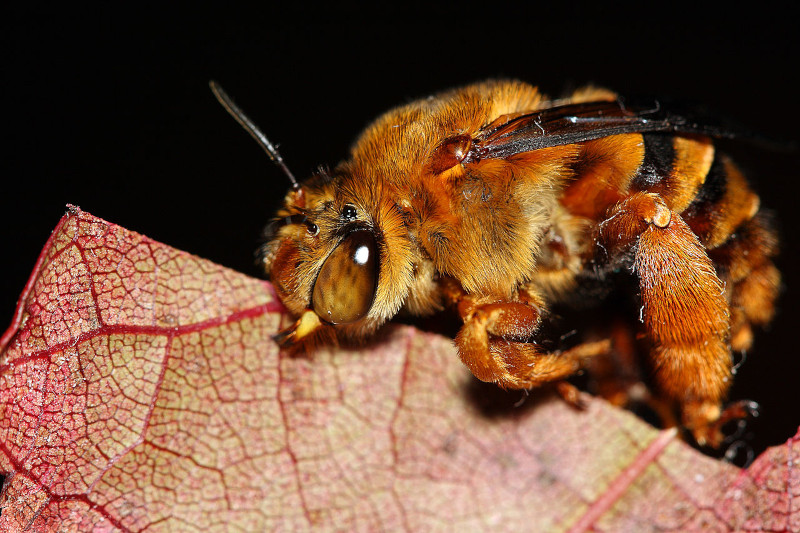
The fluffy, golden brown Teddy Bear Bee evolved as indigenous to a moderately broad swathe of the surface of the earth. Where that zone of habitation occurs, though, might surprise some individuals. That’s because this remarkable invertebrate developed as native to the continent of Australia.
Within that greater territory, however, it doesn’t inhabit the entirety of the continent. It’s primarily found in a total of five regions. Those consist of Queensland, New South Wales, Victoria, South Australia, and Western Australia. Scattered sightings nevertheless sometimes occur in other areas.
This gorgeous member of the Hymenoptera Order displays moderately exact preferences regarding its choice of habitat. Nature evolved it to display a clear preference for warm, open environments. Yet, that broad qualification allows for its presence in a range of ecosystems with these qualities.
One of these myriad settings includes various coastal and inland areas of the eastern and southern sections of the landmass. Another such, however, consists of gardens of all sizes and types, forests, and woodlands. In each of these instances, the intrepid animal requires plenty of flowering plants.
In every type of ecosystem in which it makes its home, one specific requirement stands out. The natural wonder typically only appears in one of these regions if it also has either a sufficient quantity of loose or sandy soil, or, failing that, a reasonable supply of rotting wood, such as fallen trees.
Once again keeping with a pattern common among its kindred, the Teddy Bear Bee evolved to feed on a combination of nectar and pollen. In this, it mainly prefers blue and purple flowers like lavender and bluebells. It vibrates flowers to release pollen, which additionally helps fertilize plants.
Unlike bumblebees, this distinctive species does not choose to live in any form of hive. Instead, this amazing creation of Nature nests in burrows that it constructs in either soft soil, sandy banks, or rotting wood. This naturally explains the need for these elements within its chosen habitat.
However, only the female digs one of these burrows for a nest. Each individual of this gender digs her own burrow and lays eggs inside. Males, meanwhile, take a different approach. They do not build nests, but generally sleep in groups. this they do while clinging tightly to plant stems at night.
Species Sharing Its Range

Check out our other articles on 6 Stunning North American Bees, Eurasian Red Squirrel, Table Mountain, Sturt’s Desert Pea, Spotted Seahorse, Black and scarlet Cicada, Blue-lipped sea krait










Leave a Reply