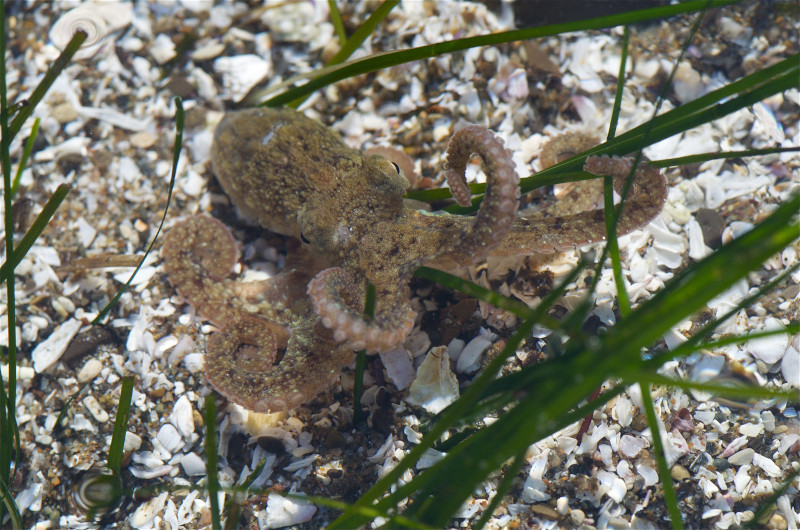
California Two-Spot Octopus Facts
- This intriguing cephalopod most frequently goes by the somewhat informative common name of the California Two-Spot Octopus for good reasons. However, it does have several other general titles. These include Bimac Octopus, Bimac, and California Octopus, among others.
- Within the scientific community, though, the creature’s perhaps better known by its technical designation. But, like many such terms, it’s rather difficult for the layperson to pronounce. That’s because this marine marvel holds the official moniker Octopus bimaculoides.
- The animal received that epithet due to the efforts of a duo of American researchers. Grace E. Pickford and Bayard H. McConnaughey first jointly recognized the cephalopod as a separate and distinct species. They accomplished this scientifically noteworthy deed in 1949.
- Thankfully, the fabulous California Two-Spot Octopus appears to be maintaining a population base that’s both stable and sufficient. This pleasant state also seems to hold true throughout the entirety of its native range. The IUCN therefore presently lists the animal as Least Concern.
- It nevertheless still faces multiple potential threats to its continued existence as a species. Like most forms of life on earth today, the majority of these dangers stem from the actions of mankind. These pitfalls include the related perils of habitat loss and ongoing climate change.
Related Articles
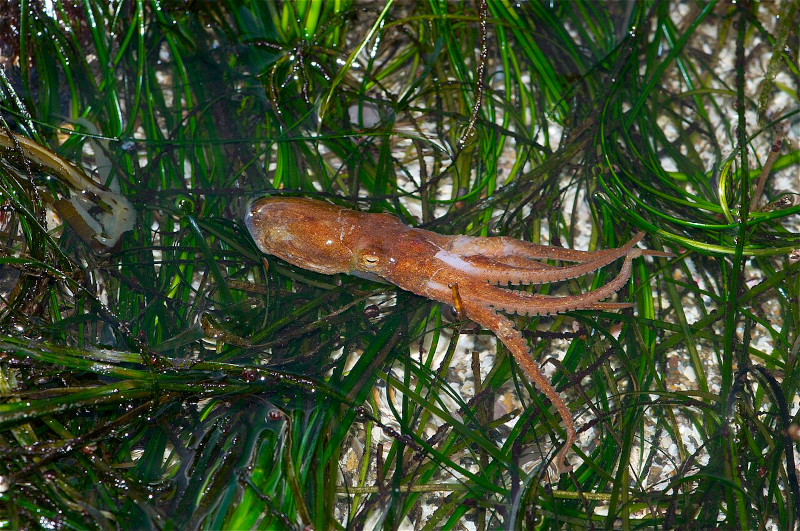
California Two-Spot Octopus Physical Description
The fascinating California Two-Spot Octopus certainly receives its due appreciation and admiration from those who encounter it. It does so, however, for reasons other than physical dimensions. That’s because this particular species represents a somewhat small variety of octopus.
In terms of characteristics, it follows the pattern common among its kind. That’s the fact that it displays a certain degree of the physiological trait of sexual dimorphism. In its specific case, though, this attribute manifests itself in extremely subtle ways. This makes identification difficult.
Overall, mature individuals achieve an average mantle length measuring approximately 2.8 – 3.1 in (7 – 8 cm). The arm span adds an additional mean extent equaling roughly 24 in (60 cm). Females sometimes grow moderately longer than males, though this isn’t always pronounced.
The body itself, meanwhile, remains quite soft and pliable. It’s also considered by many to have a sack-like form. While small, the mantle possesses a highly rounded shape. Like its kindred, the arms number eight in total. These versatile appendages radiate outward from the central body
Body masses vary between individuals of this marine marvel, regardless of gender in most situtations. Typical weights for the amazing species range from between 1.1 – 2.2 lb (0.5 – 1 kg). Gravid females, however, understandably generally temporarily exceed this measurement.
Like all its kind, the California Two-Spot Octopus has the ability to change its colors at will. The base appearance typically consists of grayish to brownish with a mottled pattern. The highly evolved creature achieves the startling changes via specialized skin cells called chromatophores.
All of its extremely flexible arms additionally comes equipped with a total of two rows of suction cups. Each of these suckers manifests a strong grip, aiding in manipulation, movement, and capturing prey. It also has large and prominent, with horizontal slit-shaped pupils.
The animal’s mouth sits positioned where the arms converge. A sharp, powerful beak also surrounds this, being used to crack open the shells of prey. Inside the mouth lies a toothed, tongue-like structure known as the radula. This helps the octopus to scrape and process its food.
- Kingdom: Animalia
- Phylum: Mollusca
- Class: Cephalopoda
- Order: Octopoda
- Family: Octopodidae
- Genus: Octopus
- Species: O. bimaculoides
California Two-Spot Octopus Distribution, Habitat, and Ecology
The tantalizing California Two-Spot Octopus evolved as indigenous to a fairly limited expanse of the earth’s marine regions. Its general range won’t come as any great surprise, however, given that the very name of the animal provides a clear indication of part of that greater area.
Overall, the remarkable cephalopod developed as endemic to the coastal waters of the eastern Pacific Ocean. The entire known concentration of its present population, though, as the name implies, lies within a restricted zone of habitation inside of this greater stretch of the region.
That concentration partly occurs along the coast of the state of California, in the United States. Yet, it’s not entirely limited to this portion of the coastal waters of North America. It’s range also includes Baja California, in Mexico, including both the mainland coast and offshore islands.
Compared to some of its many relatives around the globe, it holds a minor evolutionary advantage. The marvelous species displays a moderate degree of flexibility regarding its choice of habitat. This serves to compensate, at least somewhat, for the smaller extent of its natural range.
It’s typically found in shallower waters. This extends from the intertidal zone to depths of roughly 65 ft (20 m). Though it’s also occasionally spotted at slightly greater depths, such sightings remain scarce, and usually consists of only random individuals, rather than larger numbers.
In all areas it appears, however, the creature displays clear preferences for certain conditions. It seems to prefer habitats with rocky substrates, kelp forests, and sandy or muddy areas near rocks or crevices. It also utilizes crevices, abandoned burrows, and various man-made structures.
The California Two-Spot Octopus feeds as a highly generalized carnivore. It primarily preys on numerous local small crustaceans, mollusks, and fish. This includes crabs, snails, and clams. It also generally hunts at night, utilizing its natural camouflage and stealth to aid its efforts.
An average lifespan for the species consists of only 1 – 2 years. This amazing creation of Nature and evolution reproduces only once before dying. Females lay as many as several thousand eggs in a den, and guard them until they hatch, even sacrificing their own health in the process.
Species Sharing Its Range

Check out our other articles on 5 Magnificent Mammals of Greenland, Hellbender Salamander, Mount Olympus, Sturt’s Desert Pea, Orange-belted Bumblebee, Blue-lipped sea krait










Leave a Reply