CCL: https://tinyurl.com/btdm3sjj
Washington Ground Squirrel Facts
- The mostly informative term of Washington Ground Squirrel represents the most frequently used common name for this rodent. It does have a few other general titles by which it’s known, though. These include Columbia Plateau Ground Squirrel and Sagebrush Ground Squirrel.
- Inside of the hallowed halls of science, however, it’s possibly more often referred to by its technical designation. Unfortunately, that tag’s one that’s rather difficult for the layperson to pronounce. That’s because this mammal bears the cumbersome name Urocitellus washingtoni.
- The intriguing creation of Nature and evolution received that epithet due to the efforts of Arthur Holmes Howell. That respected American zoologist recorded the first recognition of it as a separate and distinct species. He achieved that scientifically noteworthy feat in 1938.
- This wonderful creature holds a certain amount of interest among many researchers, due to a unique evolutionary trait. That’s the fact that it hibernates for up to 7 – 8 months each year! That constitutes an exceptionally lengthy hibernation period for such a small mammal.
- Regrettably, the lovely Washington Ground Squirrel now possesses a greatly reduced population, compared to previous eras. Over half of all colonies have disappeared since the mid-1980s. Accordingly, the IUCN now shows it as Near Threatened on its published Red List.
- The remarkable animal currently faces multiple threats to its continued existence as a species. Like all forms of life on earth today, most of these stem from the actions of mankind. Those perils include habitat loss from agriculture and development, and ongoing climate change.
Related Articles
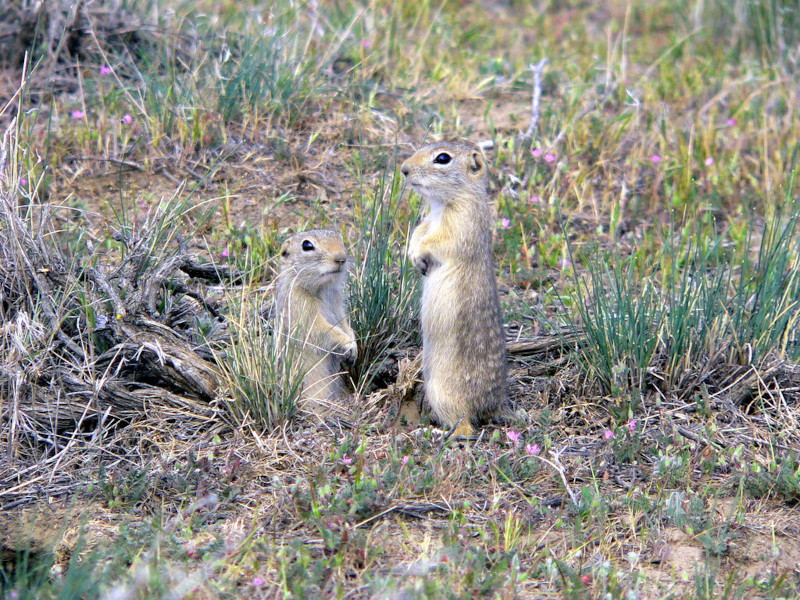
Washington Ground Squirrel Physical Description
The visually appealing Washinton Ground Squirrel typically enchants those individuals fortunate enough to encounter one. It generally does so, though, due more to that eye-catching appearance than any impressive physical statistic. That’s true since, like most of its kind, it’s relatively small.
The species also follows an evolutionary pattern common among its many relatives around the world. That’s the fact that it displays a certain degree of the physiological characteristic of sexual dimorphism. In its particular case, though, that trait only manifests to a comparatively minor extent.
As a general principle, mature individuals attain an average total length equaling between 8 – 11 in (20 – 28 cm). Of this total, however, the tail usually comprises approximately 2 – 3.5 in (5 – 9 cm). Although exceptional examples do occur, regardless of gender, few exceed this size by very much.
Also like the majority of its kindred, it remains a surprisingly light creature in body mass. Adults vary quite significantly in this respect, with an average ranging between 6 – 14 oz (180 – 400 gms). In terms of both length and weight, males of the species tend to be on the higher end of the spectrum.
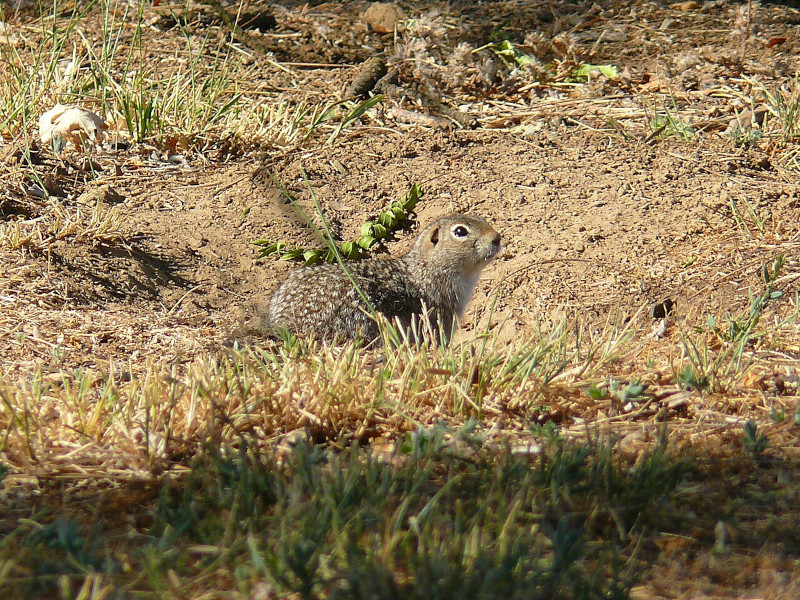
The coloring of the gorgeous Washington Ground Squirrel typically forms the aspect that most appeals to those who view them, however. On the animal’s back, this primarily consists of grayish to brownish shades. It’s also often speckled with either lighter buff or widely scattered white spots.
Other parts of its body manifest several contrasting patterns. Part of that trait includes the underparts, which most often present as a pale gray to off-white. The short, bushy tail, meanwhile, usually develops as edged with white or buff-colored hair. This combination creates a striking look.
Still other physical attributes deserve their own measure of appreciation, though. The legs of the creature evolved as short, yet comparatively strong. Its eyes developed as large, dark in hue, and set high on the head. In keeping with its nature, the rodent also possesses sharp, well-developed claws.
- Kingdom: Animalia
- Phylum: Chordata
- Class: Mammalia
- Order: Rodentia
- Family: Sciuridae
- Genus: Urocitellus
- Species: U. washingtoni
CCL: https://tinyurl.com/btdm3sjj
Washington Ground Squirrel Distribution, Habitat, and Ecology
Sadly, the fascinating Washington Ground Squirrel evolved as indigenous to a regrettably small portion of the surface of the earth. The generally applied common name, however, provides a clear indication of where that zone of habitation lies. Where it lives thus likely won’t surprise many.
This wonder of Nature inhabits a very small portion of the continent of North America. Presently, that habitat range only covers about half of what it once did, based on paleontological evidence. That current territorial range includes a highly limited section of the northwestern United States.
There, the marvel of the mammalian world’s only known to still be present in limited parts of two states. Eevn within that range, though, its concentrations remain highly scattered. In Washington, it only lives in the Columbia basin, in the east. Its Oregon population mainly appears in two counties.
Once again following patterns common among its kind, this beautiful creature displays decidedly precise, though restrictive, preferences regarding its choice of habitat. Lamentably, however, the very nature of the regions it favors serve to endanger it, due to their own highly vulnerable state.
The amazing rodent primarily chooses to reside in regions of shrub-steppe ecosystems. These are dominated by such flora as sagebrush, rabbitbrush, and bunchgrasses. It also appears in smaller numbers in patches of grassland and prairie where native grasses and forbs remain abundant.
The nature of the ground in these areas forms a further requirement for its presence. It prefers deep, well-drained soils. This usually consists of loam, sandy loam, or silty loam. Soils must be easy to dig but stable enough to maintain burrow structure, usually on flat or gently sloping terrain.
The Washington Ground Squirrel plays an important ecological role in the various ecosystems it inhabits. One of these occurs due to its burrowing nature. Its vast system of burrows coincidentally serves to aerate the soil, improve water filtration, and provide habitats for other animals.
The intrepid small rodent evolved as primarily herbivorous in nature. Its diet varies with the seasons, of course, but mainly consists of various species of grasses, broadleaf herbaceous plants, and seeds. Individuals occasionally supplement this fare with smaller quantities of smaller insects.
It’s typically only active sometime between the months of January to June, for roughly 3 – 4 months. Following this period, during which it mates, hibernation begins as early as late spring. This activity generally takes place in the deep burrows it engineered to maintain stable temperatures.
Though it forms colonies, it’s not highly social in general. This unfortunately leaves the individuals more vulnerable to its predators. While many carnivorous species prey upon it, several predominate in this. Those include Ferruginous hawks, Golden eagles, coyotes, badgers, and gopher snakes.
Species Sharing Its Range
Checkout our other articles on 5 Astounding Volcanoes of Africa, Australian Sea Lion, Alexander Island, Hairy Shadow Witch, Spotted Eagle Ray, Little Auk, Aphrodite Fritillary, Eyelash Viper










Leave a Reply