White-faced Cuckoo Bee Facts
- The descriptive term of White-faced Cuckoo Bee serves as the most frequently used common name for this remarkable invertebrate. Yet, the insect does have a few other general titles by which it’s known. Those alternates include Melecta Bee and White-fronted Melecta Bee.
- Within the scientific world, however, it’s perhaps better known by its technical designation. Thankfully, though, that name’s one that’s much simpler for the layperson to pronounce than most such tags. That’s because it bears the official appellation of Melecta albifrons.
- This wonder of Nature and evolution received that specific moniker due to the efforts of Johann Christian Fabricius. The highly respected Danish entomologist accomplished the first formal recognition of it as a separate and distinct species. He achieved that in the year 1775.
- Fortunately, the intriguing White-faced Cuckoo Bee appears to be maintaining a population base that’s both sufficient and stable. That pleasant state also seems to hold true throughout the entirety of its range. The IUCN thus presently shows it as Least Concern on its Red List.
- This amazing creature nevertheless still faces numerous potential threats to its continued existence as a species. Like all forms of life on earth today, most of these stem from the actions of manking. These perils include the related threats of habitat loss and ongoing climate change.
Related Articles
White-faced Cuckoo Bee Physical Description
The amazing White-faced Cuckoo Bee generally captures the attention of those individuals who happen to notice this wonder of Nature. Like most varieties of bees around the world, it doesn’t typically do so due to size, however. That’s because, like most of its relatives, it’s a small insect.
In terms of phsycial description, though, it also follows a pattern of natural development shared by many fauna. That’s the fact that it displays a certain degree of the physiological characteristic of sexual dimorphism. In its specific case, this natural trait actually manifests itself in several manners.
Overall, this remarkable creation of evolution typically attains a total length of approximately 1 – 1.4 cm (0.39 – 0.55 in). In general, males of the species tend to be on the lower end of this range than their female counterparts. Nevertheless, exceptional specimens do occur, regardless of gender.
The general shape of the body of this invertebrate also represents another manner in which the sexes distinguish themselves. Males usually develop a slimmer form than the females. Those individuals, meanwhile, typically possess bodies that evolved as both larger and robust in their form.
The antennae constitute yet another way the two genders separate themselves. In males, these thin appendages develop longer and more curved, especially the segments beyond the base, known as the flagellum. Among females, however, these usually remain both shorter and straighter.
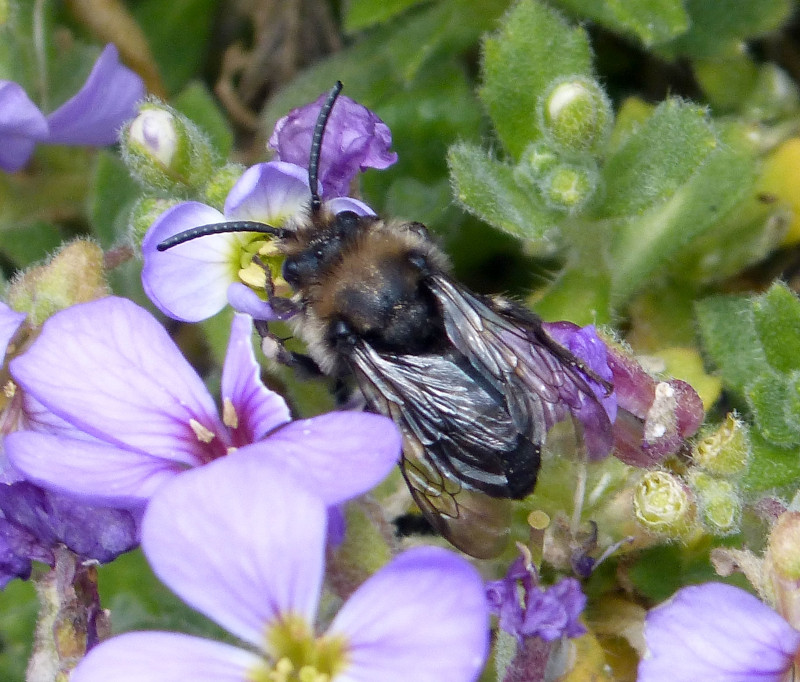
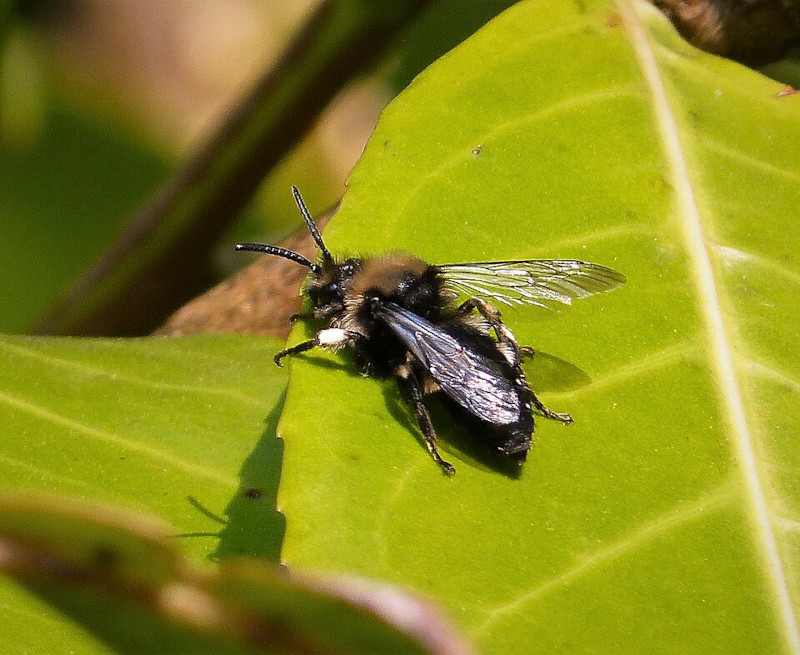
Yet, it’s the coloring of the mesmerizing White-faced Cuckoo Bee that generally garners the most attention. It’s also still another way in which the two sexes differ. In both, though, comparatively dense pale hairs appear on the face, thorax, and legs of this stunning product of Nature.
The basic background pattern of coloring consists of a deep black. Once again, males and females display differences here. Males often have denser and longer pale hairs, especially on the face and thorax. Females, however, typically have slightly less conspicuous banding and shorter facial hair.
The hair covering the head and tail usually present as primarily black, while that of the thorax generally shows a pale yellowish shade. White markings also often appear on one pair of legs. The abdomen of this creature also often has distinct pale bands formed by hair patches on the segments.
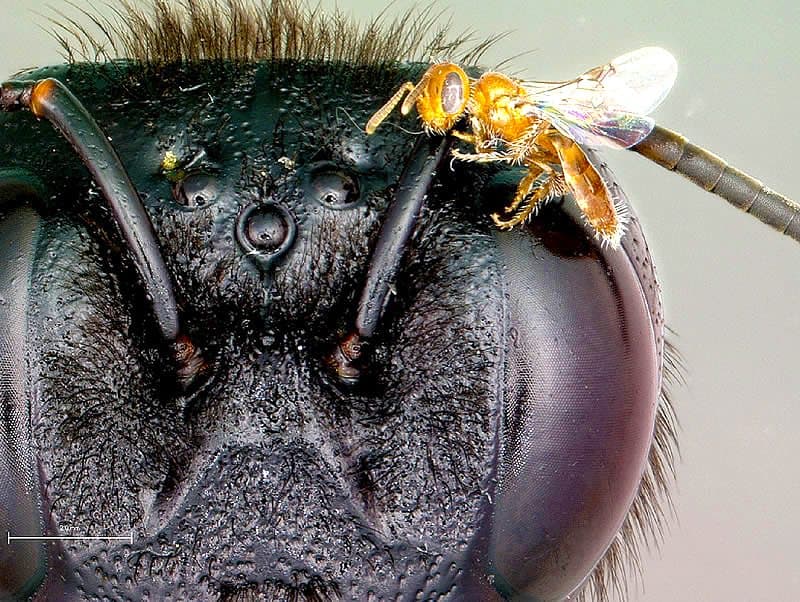
The wings and head of this marvelous species further serve to distinguish it from many of its numerous kindred. Its head evolved as relatively broad, covered in more black hairs, and possessed of large compound eyes. The wings, though, show as transparent to smoky brown with visible veins.
- Kingdom: Animalia
- Phylum: Arthropoda
- Class: Insecta
- Order: Hymenoptera
- Family: Apidae
- Genus: Melecta
- Species: M. albifrons
White-faced Cuckoo Bee Distribution, Habitat, and Ecology
The charming work of evolution named the White-faced Cuckoo Bee evolved as indigenous to an extremely broad swathe of the surface of the earth. In fact, the full extent of that native zone of habitation might surprise many people. It has what’s known to science as a Palearctic distribution.
Part of that territory consists of southern and central Europe. Within the UK, it’s primarily found within the southern borders of England, notably the southeast. Meanwhile, in France, it’s seen across the entire country, though in some areas, such as Manche, it’s considered fairly uncommon.
From there, though, it’s range extends into both the nations of Morocco and Egypt, situated in the northern portions of Africa. Not stoping there, however, it’s also present in parts of the Middle East. There, it’s known to be present in several countries, including Lebanon, Armenia, and Iran.
This remarkable insect evolved to follow the pattern established by its many relatives across the globe. Due to its distinctive nature, the small bee displays decidedly strong and precise preferences regarding its choice of habitat. Like them, its habitats remain strongly liked to those of its host.
Locations where it’s found include areas of sunny, vertical clay or sand banks. These frequently include quarries and cliffs. Urban gardens and parks also serve its purposes well. That’s especially true of older gardens with exposed bare earth or crumbling walls suitable for its specific needs.
Still other regions serving the natural marvel well include warm, sheltered sand or gravel pits. Outside urban areas, it also favors heathland edges and flower-rich grassland. Inside cities, however, the intrepid small Arthropod also often nests inside the cracks of south-facing stone or brick walls.
The fascinating White-faced Cuckoo Bee evolved as a cleptoparasitic bee species. This characteristic of its basic nature drives all aspects of its ecology. Given this underlying nature, this remarkable product of Nature and evolution is strongly dependent upon other bees for its reprodcutive process.
That’s due to the fact that it solely lays its eggs within the nests of other bees! Although this wonder of the animal kingdom sometimes relies on various species for this purpose, it primarily chooses one specific species of bee. That’s a creature given the common name of Hairy-footed Flower Bee.
Once the larvae hatch in the host nest, they foreign young kill the other larvae present, and proceed to consume the stored pollen. The adults, however, do not collect or feed on pollen. Instead, these feed on nectar, commonly from various spring-blooming flowers, such as nettles and comfreys.
Species Sharing Its Range
Check out our other articles on 5 Riveting Atlantic Ocean Rays, Mountain Hare, Amazon River, Hairy Shadow Witch, Hellbender Salamander, Goldentail moray, Aphrodite Fritillary, Eyelash Viper










Leave a Reply