

Witch-Hobble Facts
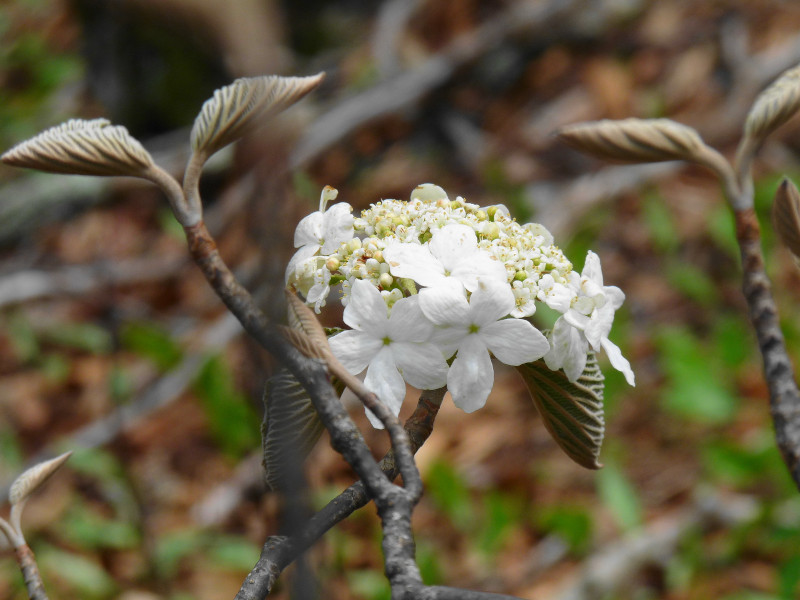
- This delicate, lesser-known botanical marvel most frequently goes by the deceptively uninspiring common name of the Witch-Hobble. Yet, it also has several other alternate titles. These include hobble-bush, alder-leaved viburnum, American wayfaring tree, and moosewood.
- Within the scientific community, however, it’s possibly better known by its technical designation. Like many such monikers, though, that’s somewhat difficult for the layperson to pronounce. That’s true because this marvel bears the cumbersome tag Viburnum lantanoides.
- This wonder of Nature received that specific epithet due to the efforts of André Michaux. That highly esteemed French botanist recorded the first formal acknowledgement of the plant as a separate and distinct species. He achieved that scientifically noteworthy deed in the year 1803.
- The primary honorific reflects old folklore, since some individuals believed the plant could trip or hobble witches or people traveling through the woods. The name hobblebush, meanwhile, refers to the way its branches frequently root at nodes and form a tangled understory.
- Thankfully, the intriguing Witch-Hobble appears to be continuing to maintain a thriving population base that’s both stable and sufficient. This most pleasant state of affairs further seems to hold true throughout its entire range. The IUCN thus does not place it on its Red List.
- Nevertheless, it still faces multiple potential threats to its continued existence as a species. Like all forms of life on earth today, most of those stem from the activities of mankind. These numerous perils include the closely intertwined dangers of habitat loss and climate change.
Related Articles
Witch-Hobble Physical Description
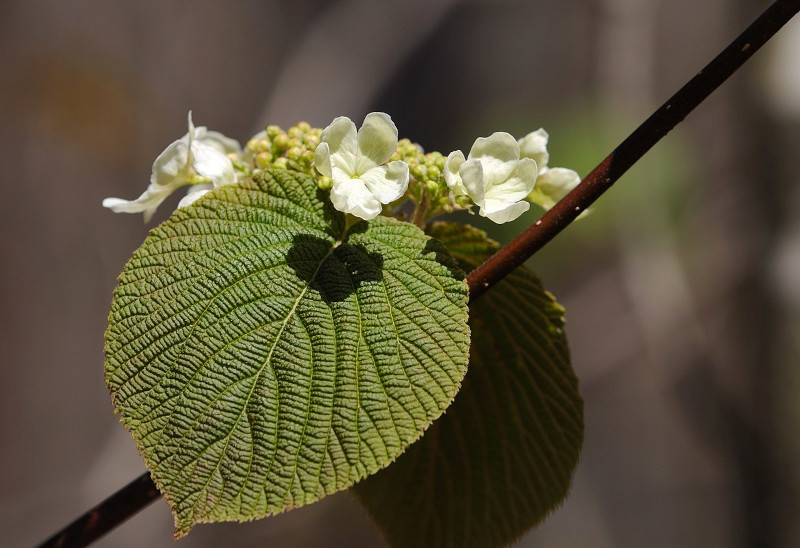
The Witch-Hobble is a distinctive woody shrub that often catches the attention of those fortunate enough to encounter in its native habitat. Unlike some of its relatives, however, it does so for a variety of reasons. That’s due to the fact that it’s both visually appealing and of impressive stature.
This remarkable product of botanical evolution develops as a deciduous, multi-stemmed species, often forming dense thickets. Mature specimens also vary significantly in dimensions due to local conditions. This typically ranges from between 3 – 10 ft (0.9 – 3.1 m) in both height and width.
The branches form sprawling, arching stems that commonly bend to the ground and root at their tips, forming new clones. On these, the bark appears smooth and gray-brown when young, yet becoming slightly rougher with age. The twigs remain slender, hairy, and brown to gray in color.
Its foliage also merits its own deserved measure of attention. The many leaves evolved as opposite in arrangement, and quite broadly ovate or heart-shaped with a pointed tip. These further reach comparatively large sizes, averaging 4 – 8 in (10 – 20 cm) in length, and 4 – 7 in (10 – 18 cm) wide.
Like some of its relatives around the world, this foliage also possesses coarsely serrated edges. Their texture, though, remains soft and velvety due to fine hairs on both surfaces. These present striking colors, too, consisting of bright green in summer, turning vibrant purple, red, or burgundy in fall.
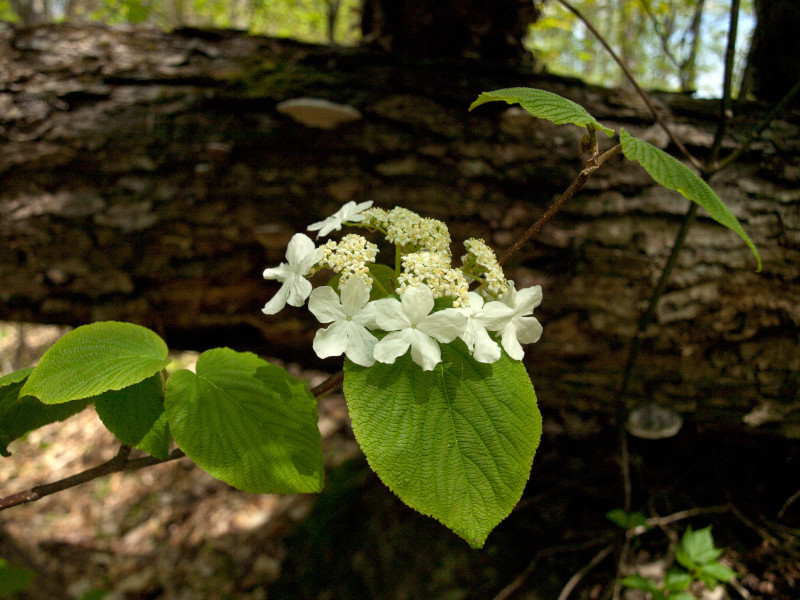
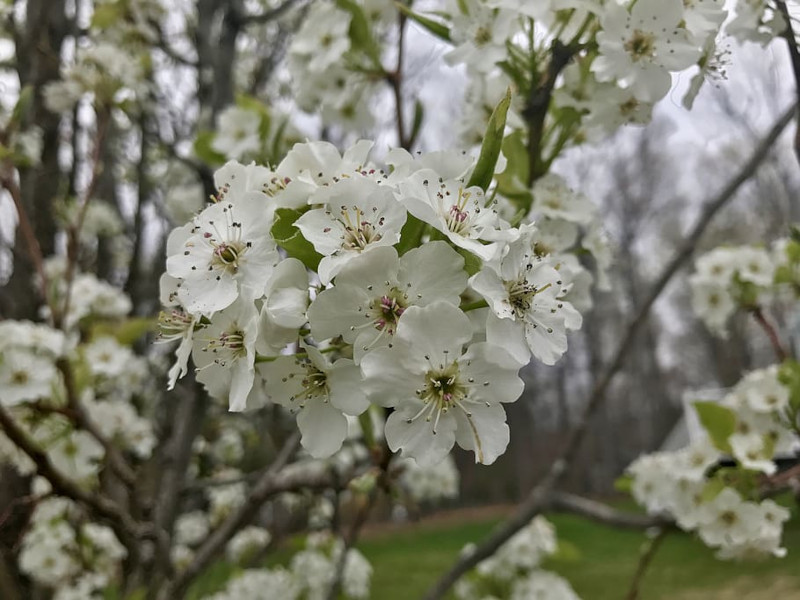
Yet, it’s doubtless the blooms of the Witch-Hobble that garner the most interest from the average viewer. Though individually small, they appear in large clusters 4 – 6 in (10 – 15 cm) wide. Large sterile, white or cream flowers ring the outer edge, surrounding small fertile flowers in the center.
Not to be outdone, the fruit of the plant contrasts with this wonderfully. Measuring only about 0.25 in (0.64 cm) in diameter, these ripen from green to red to dark blue-black in their hues. This constitutes a type known as a drupe, meaning that it’s fleshy and contains a small stone within it.
- Kingdom: Plantae
- Phylum: Tracheophyta
- Class: Magnoliopsida
- Order: Dipsacales
- Family: Adoxaceae
- Genus: Viburnum
- Species: V. lantanoides
Witch-Hobble Distribution, Habitat, and Ecology
The attractive Witch-Hobble evolved as indigenous to a moderately broad portion of the surface of the earth. Exactly where that native zone of habitation lies won’t surprise many of you, though. That’s true since this marvelous flora developed as native to a specific portion of North America.
There, gorgeous woody shrub’s found almost exclusively to the eastern portion of that continent. The majority of that greater range lies within the national borders of the United States. It’s common in the northeast, including Maine, New Hampshire, Vermont, Massachusetts, and New York.
From there, however, its territory extends southward, staying along the southeastern edge of the landmass. That area extends through the Appalachian Mountains. There, it lives in the states of Pennsylvania, West Virginia, Virginia, North Carolina, Northern Georgia, and northeastern Alabama.
Yet, the vibrant masterpiece of Nature also resides further northward of this region, too. That range extends into the southeastern parts of Canada. There, it’s principally found from southeastern Ontario through southern Quebec, New Brunswick, Nova Scotia, and into Newfoundland.
The amazing species displays moderate levels of adaptability in regards to its choice of habitat. It mostly thrives in cool, moist forest environments and forms a common shrub of hardwood ecosystems. These are often dominated by sugar maple, American beech, and yellow birch.
In these settings, it displays a preference for partial to full shade. It grows well in understory layers beneath tall canopy trees. The plant’s common on cool slopes, in ravines, and along streambanks. It also grows in mountainous terrain at higher elevations in the southern part of its range
This creation of evolution plays a valuable ecological role in the forests of eastern North America where it appears. It doesn’t merely represent just another variety of shrub in the understory. This species contributes greatly to forest structure, wildlife food webs, and plant community dynamics.
It generally forms surprisingly dense thickets in the shaded understory, especially in very moist, mature hardwood forests. Under those conditions, it helps to stabilize the soil on slopes and in ravines. Along the way, it also provides microhabitats for many insects, small mammals, and birds.
The Witch-Hobble also serves as a vital food source for numerous denizens of the woodlands. Its fruit ripens in late summer to early fall. These feed songbirds, ruffed grouse, chipmunks, foxes, and other small mammals. Deer and moose browse the foliage and twigs, especially in the winter season.
It achieves its pollination via the actions of a multitude of insect species. Those mainly include different species of bees, hoverflies, and butterflies. It reproduces by both seed propagation and layering. The latter method occurs when low-hanging branches touch the ground and take root.

Species Sharing Its Range
Check out our other articles on 7 Captivating United States Lakes, Red-legged Pademelon, Amazon River, Douglas Iris, Rose’s Ghost Frog, Fulvous Skimmer, Spotted Seahorse, Mugger Crocodile