How about some genetically modified salmon for dinner today?
Biotechnology has long modified living organisms according to human needs. Unfortunately, GMOs have found popularity in many developed countries already. Indeed, fruits and vegetables look at us from the shelf and boast with their impeccable appearance. Is this how it should be?
Most consumers in the US buy genetically modified organisms every single day, mostly unknowingly. The arguments over transgenic plants have gone on for years now and many people do expect certain crops to fall under that category. For example, what if one fine evening you went to a restaurant and found out that the fillet on your plate was a genetically modified salmon piece?

First Genetically Engineered Animal in History
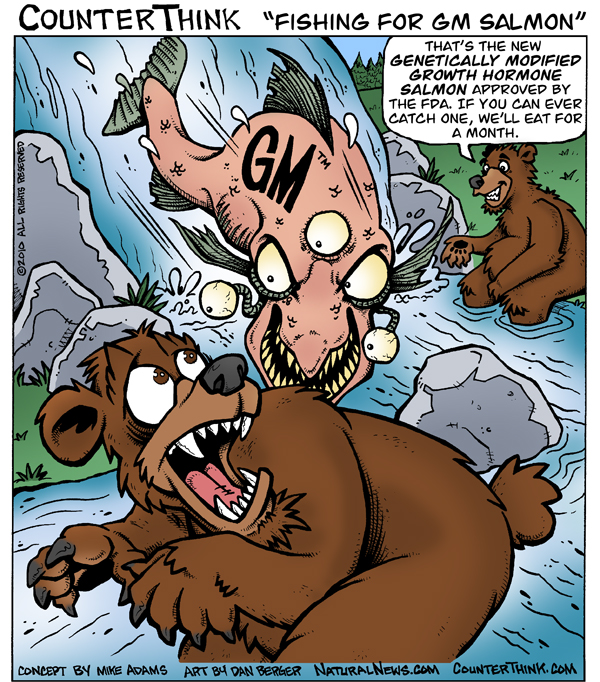
The genetically modified salmon is the first GE animal in the history of humanity. It’s artificially combined growth hormone genes from an unrelated Pacific salmon, (Oncorhynchus tshawytscha) with DNA from the anti-freeze genes of an eelpout (Zoarces americanus).
The genetically modified salmon is the first genetically engineered animal in the history of humanity.Click To TweetThe modification causes production of growth-hormone year-round, creating a fish the producer claims grows at twice the normal rate. This then allows factory fish farms to crowd fish into pens and still get high production rates.
Indeed, genetic modification always involves the deletion or insertion of genes in the DNA structure of an organism. Similarly, we know of or, even worse, tasted Monsanto’s triple-stack corn. Or Hawaii’s ringspot virus resistant papaya or the infamous grapple, an odd cross between a grape and an apple.
Genetically Modified Salmon: Where Does It Grow
In any case, each year millions of farmed salmon escape from open-water net pens, out-competing wild populations for resources and straining ecosystems.
“Approving genetically modified salmon is a sharp contradiction to the agreements the US has signed at NASCO, where transgenic salmonids present a serious threat to wild salmon” said Boyce Thorne Miller. Boyce is Science and Policy Coordinator for the Northwest Atlantic Marine Alliance and hold accreditation from the North Atlantic Salmon Conservation Organization.
“Genetically modified salmon that escapes can pose an additional threat. Genetic pollution resulting from what scientists call the “Trojan gene” effect.”
Further, research in the Proceedings of the National Academy of Sciences notes that a release of just sixty GE salmon into a wild population of 60,000 would lead to the extinction of the wild population in less than 40 generations. This is mind-boggling.
Interestingly, trying to circumvent analyses of those dangers, the producer AquaBounty claims that they would only raise their fish in land-based facilities. That would present new threats to America’s lakes, rivers, and estuaries. In fact, many of those are already under attack by invasive fish species like the Asian carp and Northern snakehead.
In fact, most salmon farmers in the real world ply their trade in low-lying coastal areas. Then, competing corporations will no doubt race to produce GM fish in crowded open ocean facilities already in use for fish production.
“FDA’s decision to go ahead with this approval process is misguided and dangerous, and is made worse by its complete lack of data to review” said Andrew Kimbrell, Executive Director for the Center for Food Safety.
What Can we do
“We all know there is a great appetite for salmon. In any case, the solution is not to ‘farm’ genetically engineered versions to put more on our dinner tables. The solution is to work to bring our wild salmon populations back”, said Jonathan Rosenfield, PhD, a Conservation Biologist and President of the SalmonAID Foundation. He represents a 28-member coalition of commercial, tribal, and sport-fishing interests, conservation organizations and chefs.
How about labeling? In short, tricky. Unfortunately, the US is the largest market with foods containing GE ingredients. Certainly, in 2016, the Senate passed a vague bill demanding GMO labeling. Whether the bill would really benefit the public is yet to establish.
Genetically modified organisms are illegal in many countries in the European Union. Also, increasingly more developing nations stand strong against it.
Genetically modified organisms are illegal in many countries in the European Union. Why not in the US yet? #gmo Click To TweetIn the end, each one of us is a drop but together we make up the ocean. Ask where your salmon comes from. With this in mind, remember that we all vote with our wallets.
Credit: Excerpts from “Coalition Demands FDA Deny Approval Of Controversial Genetically Engineered Fish“, Center for Food Safety
Check out our articles on Control the World through Genetically Modified Food, Amazing Conservation Photography










Leave a Reply