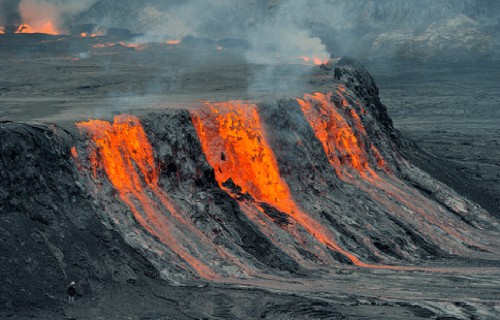
We sincerely hope that each of you, our readers, will thoroughly enjoy and appreciate this article we present about these 5 Astounding African Mountains. It was certainly our pleasure to gather the information for you. May it provide you with both education and increased awareness.
Certainly, amazing as they are, these few locations listed herein represent only a portion of the marvels found throughout this amazing region. It’s our belief, though, that they serve as excellent representations of the features found here. Check out some of our other articles, as well.
Table Mountain

CCL: https://rb.gy/9hl57
Table Mountain Facts
- Leading off this article about these 5 Astounding African Mountains we present the breathtaking wonder best known as Table Mountain.
- The simple yet perfectly apt term we’ve used herein serves as the english language name of this majestic creation of natural forces. Yet it also has other general titles by which it’s known. These include the relatively short moniker of Tafelberg.
- Populations of local Indigenous Peoples long knew of its existence, of course. Different groups held equally differing names for the remarkable feature. The closest approximation using the english alphabet for the most common one is Huriǂoaxa.
- Outsiders, however, did not discover it until comparatively modern times. The Portuguese sea captain, António de Saldanha, holds the distinction of being the first known non-native individual to spot the feature. He named it Taboa do Cabo.
- Today, Table Mountain comprises the central component of the namesake Table Mountain National Park. It represents one of the most frequently visited tourist destinations in the country in which it sits. This poses problems for preserving it.
- Originally named the Cape Peninsula National Park, the government of the country formed the park surrounding it in 1998. Due to its incredible nature, it was named one of the New Wonders of Nature in 2011. Sadly, though, it remains vulnerable.
CCL: https://rb.gy/b78k6
Table Mountain Physical Description
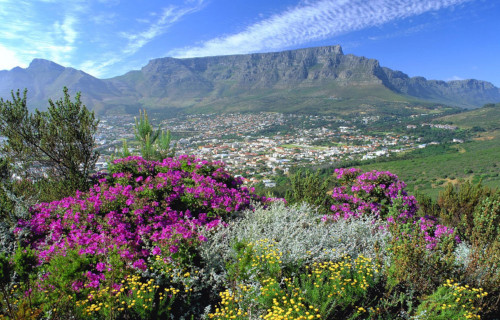
The magnificent Table Mountain receives fully justified appreciation for its natural splendor. Unlike some related features, however, it does so for more than one reason. That’s because it’s not only visually appealing, but also boasts impressive dimensions.
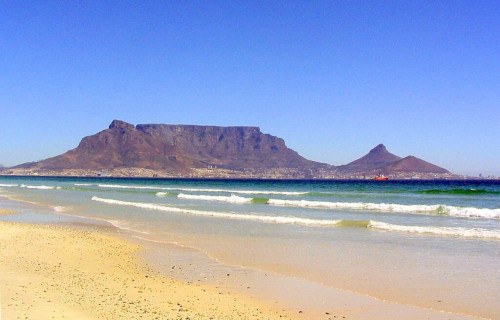
The geological processes that created it also gave the formation a highly elongated shape. It measures approximately 1.8 mi (2.9 km) in length. In contrast, though, its length equals roughly 30 mi (48 km), thus providing the sharply elongated shape it shows.
The upper surface of the wonder of nature further presents a roughly flattened shape. This characteristic easily creates a spectacular large plateau. Its highest point also impresses those fortunate enough to visit. This measures 3,563 ft (1,086 m) above sea level.
Yet the amazing nature of stunning Table Mountain doesn’t merely end there. The above-mentioned plateau lies surrounded by truly magnificent cliffs. These plunge the terrain below in dramatic fashion, being almost vertical along some portions of their length.
An intriguing gorge also appears in addition to its other gifts of beauty. Named Platteklip Gorge, this individual feature splits the cliffs of the primary plateau. Rounding out its breathtaking traits is the almost constant presence of clouds over the top of the mountain.
CCL: https://rb.gy/f615r
Table Mountain Location, Formation, and Ecology
The mesmerizing Table Mountain formed in a region of the globe already well known for its abundance of geological wonders. That location’s therefore not going to surprise many people. This remarkable feature lies on what’s now the beautiful continent of Africa.
There, the fabulous peak sits in the southernmost portion of that region. More precisely, it lies within the borders of the country of South Africa. Yet, its exact placement, in fact, directly overlooks the city of cape Town, forming an unbelievable backdrop for residents.
This impressive creation of natural processes also formed over a period that extended from roughly 510 – 450 million years ago. During that geological period, known as the Ordovician, two distinct layers were created due to the deposition of specific minerals.
The upper layer is understandably the younger of the two. It mainly consists of very hard quartzitic sandstone. It’s extremely resistant to erosion, too. Meanwhile, the lower and older section is composed of maroon-colored, fine-grained rock called mudstone.
Table Mountain boasts yet another impressive attribute. It hosts a veritable explosion of life! More than 8,200 plant species call it home. Various species of shrubs and heaths constitute the majority of these. Nearly 2,300 live only here or in the immediate area, though!
Numerous animals also live here, as well. This includes many mammals, with the dassie being the most abundant. Reptiles present include several types of tortoises, snakes, and lizards. Amphibians living here include a rare species of frog found nowhere else on earth.
Waw an Namus
CCL: https://bit.ly/3outSoq
Waw an namus Facts
- Next up in this compilation of 5 Astounding African Mountains we give you the remarkable feature named Waw an Namus.
- The astounding volcano known by the unusual title truly distinguishes itself from other, relatively ordinary volcanoes. The name of the magnificent site also has an alternate spelling, however. By either name, though, it’s a breathtaking sight to behold.
- Surprisingly, the English translation of the original name roughly equals Oasis of mosquitoes. The exact age of the formation also remains a point of controversy among scientists. Different pieces of evidence hint at varying ages for this work of Nature.
- The natives of the region knew of the existence of this masterpiece for centuries, prior to its discovery by outsiders. The first mention of it to the rest of the world occurred in 1862. The German explorer Karl Moritz von Beurmann made that report.
- The first known outsider to reach it, however, only did so in 1920. The French explorer Laurent Lapierre had that singular honor. The first known scientist to reach the volcano, did so in 1931. That distinction belongs to the Italian geologist, Ardito Desio.
- In our modern era, this creation of natural forces represents one of the most popular tourist destinations in its region. Those fortunate enough to visit Waw an Namus quickly realize that it has far more to offer the observer than many other volcanoes.
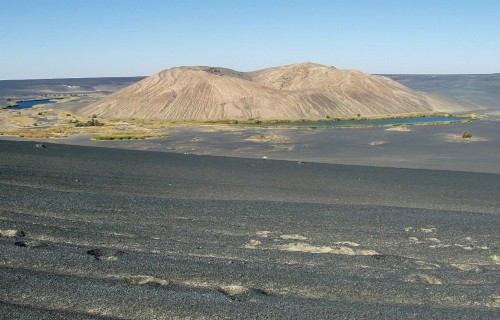
Public Domain Image
Waw an Namus Physical Description
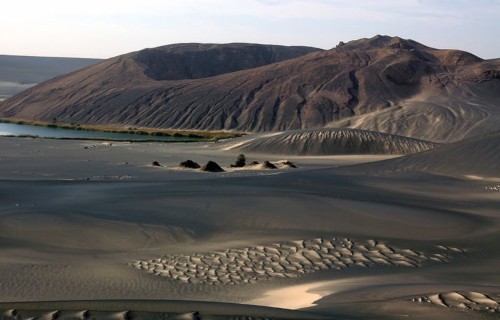
Despite not being its most notable feature, the sheer size of Waw an Namus quickly grabs the attention of visitors. That’s because the caldera itself measures a staggering 2.5 mi (4 km) in diameter. This same feature also boasts a depth measuring roughly 330 ft (100 m).
Nestled within the confines of the already remarkable caldera itself, though, lies an equally impressive scoria cone. This natural formation itself measures about 0.81 mi (1.3 km) wide at its base. This section of the volcano also has a height of approximately 460 ft (140 m).
Yet, amazingly, this feature holds still another crater! This particular one, though, happens to measure roughly 260 ft (80 m) deep, and 490 ft (150 m) wide. The remains of yet another one is situated on the western section of the summit of the crater of Waw an Namus.
Its wonders do not end there, however. A darker colored layer of volcanic fragments extends outward around the central site. This layer, called tephra, extends a mind-boggling distance of 12.4 mi (20 km) in some directions. Its depth ranges from 0.8 – 59 in (2 – 150 cm).
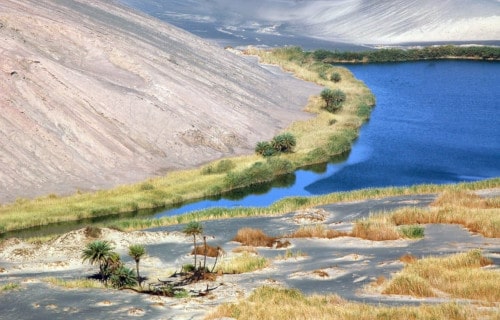
CCL: https://bit.ly/2MM3wQH
Waw an Namus Location, History, and Ecosystem
The mesmerizing site known as Waw an Namus formed in a part of the world that may shock some individuals. That’s because it lies within the confines of the Sahara Desert! More specifically, it’s found in the Fezzan region of the country of Libya, in Africa.
To this day, the exact age of the structure remains a source of debate among researchers. Studies place its formation at somewhere around 200,000 years ago, give or take about 9,000 years. The scoria cone in the center, though, may be only a few thousand years old.
Incredibly, three small lakes actually lie within the caldera of Waw an Namus. Given that evaporation rates in the region exceed precipitation rates, that’s believed to be fed by groundwater. These have a total surface area of around 0.12 sq mi (0.3 sq km).
These lakes remain relatively shallow, however. In fact, the maximum depth of the deepest only reaches 49 – 52 ft (15 – 16 m). Seasonal variations affect the altitude of these bodies of water, as well. Nonetheless, this averages roughly 1,424 ft (434 m) above sea level.
Various other small bodies of water also appear within Waw an Namus. These, however, tend to come and go. All of them sometimes display various shades of red. Unsurprisingly, the colors derive from varying chemical compounds in the surrounding rock strata.
Nyiragongo Volcano
Nyiragongo Volcano
- The third entry into this gathering of these 5 Astounding African Mountains is the extraordinary feature known as Nyiragongo Volcano.
- This creation of geological processes bears the somewhat hard to pronounce name within its region of the world. It’s perhaps best known, at least to researchers, for its unique combination of factors. Vulcanologists continue to study it even today.
- In fact, those ongoing investigations keep geologists, vulcanologists, and those specializing in related fields busy. That’s mainly due to the extreme variability of conditions in and around its confines. While fascinating, this also remains dangerous.
- The site also stands out from similar formations around the world. It further does so for a variety of reasons. Perhaps chief among these is its sheer volume. While this varies, the average amount of lava contained within it staggers the imagination.
- More precisely, the average amount of lava it contains makes it the largest regularly maintained lava lake in the world. The lava produced by this volcano additionally garners much interest, and thus study, due to its intriguing and unusual nature.
- That’s true since the lava produced by the Nyiragongo Volcano has an extremely fluid consistency. This occurs due to its containing an unusually high concentration of alkali-rich volcanic rock. That nature creates a remarkable effect on its eruptions.
- Coincidentally, this impressive volcano also possesses a relatively steep slope. Its flows often literally do flow, almost like water. Combined with the fluid consistency of that lava and its proximity to populated areas, it’s viewed as a highly dangerous volcano.
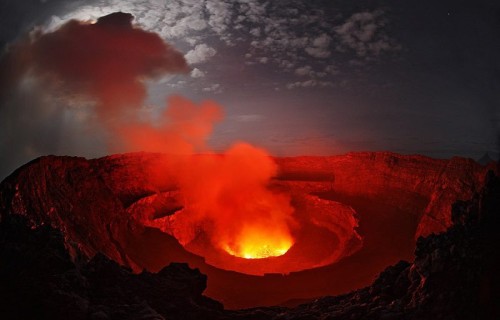
Nyiragongo Volcano Physical Description
The fabulous Nyiragongo Volcano represents an excellent example of the specific variety that experts classify as a stratovolcano. That’s one displaying a roughly conical shape, that’s also formed of multiple layers of hardened lava and debris, known as tephra.
This wonder of vulcanism also remains highly active, and indeed, is almost constantly so. This makes it one of the few of its type in the world for which this holds true. Its precise shape and dimensions are therefore constantly changing, at least to small degrees.
This turbulent marvel of its region additionally boasts other impressive physical statistics. It stands quite tall, with a height equaling roughly 11,380 ft (3,470 m). The primary crater itself also stands out for its sheer size, measuring almost 1.25 mi (2 km) in width.
The ever-present lava lake of the Nyiragongo Volcano adds yet another distinctive characteristic to the site. That’s because it has an average depth of nearly 2,000 ft ( 600 m). Yet the nature of the lava itself remains the most distinctive feature of this prodigious peak.
This has an extremely high alkali ratio, which allows for its flowing rapidly down its steep slopes. As a result, flow speeds sometimes reach 60 mph (96 kph). Due to its combination of slope and lava fluidity, its flow speeds represent the fastest currently known to man.
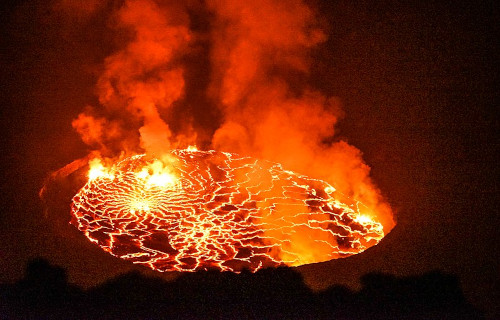
CCL: https://bit.ly/3jv8FL5
Nyiragongo Volcano Location and History
For the moment, vulcanologists still know little of its ancient eruptive history. During its activity in modern times, though, events remains well documented. The volcano has erupted at least 34 times since 1882. Incredibly, some of these eruptions lasted for years at a time.
This amazing volcano also has an amazing history all its own. It actually overlaps with several older volcanoes and sits amid hundreds of small cinder cones. Because of its unique dangers, the Nyiragongo Volcano was named as a Decade Volcano in 1991.
In March of 2016, the Goma Volcano Observatory discovered that a new vent had opened on the northeast edge of the crater. Since that time, various rumblings and small quakes have continued to occur within its confines. It’s by no means finished amazing us.
Piton de la Fournaise
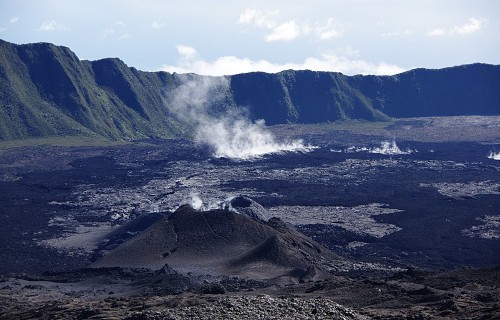
CCL: https://bit.ly/1xMszCg
Piton de la Fournaise Facts
- Now appearing in this compendium of these 5 Astounding African Mountains comes the remarkable location named Piton de la Fournaise.
- This magnificent creation of geological forces is best known throughout the world by the French language name given it long ago. Local residents sometimes also refer to this natural marvel simply by the short but descriptive term of le Volcan.
- Regardless of the moniker one applies to it, though, it stands out from others of its type due to its present nature. That holds true due to the fact that it’s highly active. In fact, it currently ranks as one of the most active volcanoes on the planet.
- This ranking actually places it with the likes of Mount Erebus, Stromboli, Mt. Etna, and Kilauea. Thus, while magnificent, it nevertheless remains an extremely hazardous location. Despite this, though, it’s become an extremely popular tourist destination.
- Local officials take every precaution possible with the safety of local population and tourists alike. To than end, the volcano continues to be closely monitored at all times by numerous instruments. This provides for some warning of impending eruptions.
- The most recent eruption of Piton de la Fournaise occurred on December 7, 2020. The aforementioned monitoring of the site, however, provided warning to local officials. That prompted the closing of the site to visitors prior to that eruption.
- In an ironic twist, this marvelous yet dangerous site sits within a National Park. Itself a World Heritage Site, it bears the name of the Réunion National Park.This serves as the main reason for the extreme diligence of the authorities in observing its activities.
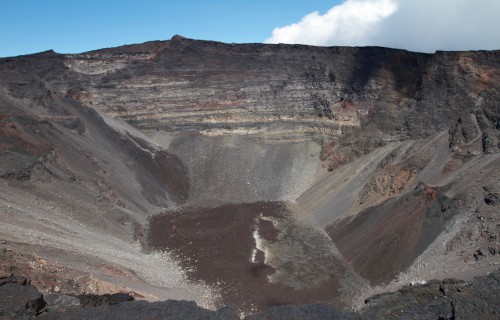
Piton de la Fournaise Physical Description
It bears noting that the breathtaking Piton de la Fournaise, cannot be compared with your typical volcano. That’s because its gigantic caldera boasts some truly impressive dimensions. More precisely, it has an astonishing diameter measuring roughly 5 mi (8 km).
In case this does not impress the reader, however, Nature did not simply stop there. That’s true since it also boasts other incredible dimensions. That’s because it stands an imposing 8,635 ft (2,632 m) tall. That alone elevates it to extreme status, no pun intended.
Yet the marvels of this geological wonder do not end there. Within its already incredible confines lies a lava shield that posseses a diameter of approximately 1,300 ft (396m). Few volcanoes on the planet have features rivaling those of this spectacular site.
Astonishingly, the list of features to be found in Piton de la Fournaise just keeps rolling. Indeed, numerous other geological formations line the inside of the enormous crater. These primarily consist of much smaller craters and volcanic features known as spatter cones.
Over time, and simply adding to its impressiveness, another visually stunning feature came into existence. That’s due to the fact that, on the southeast side of the caldera, the sea breached its walls. This only augments the incredible array of sights to behold here.
CCL: https://bit.ly/1xMszCg
Piton de la Fournaise Location and Activity
The air of magic pervading the marvelous yet dangerous Piton de la Fournaise also owes part of its presence to its location. That’s because the intriguing volcano additionally formed in an extremely remote part of the world. That region’s already known for its marvels.
More precisely, though, it sits on the eastern side of what now holds the name of Reunion Island. That site itself formed in the Indian Ocean, near the continent of Africa. This places the tantalizing creation of ongoing natural processes east of the island of Madagascar.
According to scientific research, this stunning volcano formed roughly 530,000 years ago. In relative geological terms, it is thus comparatively young. It further represents only a portion of what experts call the Reunion hotspot, active for nearly 66 million years.
Though extremely active, the phenomenal Piton de la Fournaise typically produces comparatively slow-moving flows, as opposed to violent eruptions. The majority of its activity therefore falls into the category of basaltic flows. Over 150 have been recorded.
While most of these remain inside the caldera, a few do leave its boundaries, however. The most recent of these occurred in February of 2019. But, in all of this, only 6 have reached beyond the caldera. That could change at some point though, due to its active nature.
Ol Doinyo Lengai
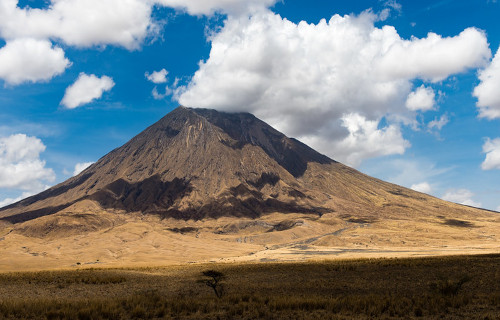
CCL: https://bit.ly/3dxridz
Ol Doinyo Lengai Facts
- Closing out this article about 5 Astounding African Mountains is the gorgeous site best known by the term Ol Doinyo Lengai.
- The unusual sounding term serves as the most commonly used name for this true masterpiece of geological processes. But that term represents the english language translation of its name in the native tongue of the original inhabitants of its region.
- Two local groups of Indigenous Peoples share that common language. In the ancient tongue of the Maasai and the Sonjo, the term translates as The Mountain of God. They also use other terms, though, such as Basanjo, Donjo Ngai, and Mongogogura.
- Regardless of which moniker one uses, it’s an impressive natural feature. It also merits appreciation for its uniqueness. That’s due to the special attributes of the lava it produces. These easily rank it as one of the most unusual volcanoes on the planet.
- Due to its unique nature, the lava spewed forth by Ol Doinyo Lengai displays astonishing patterns. It’s initially black or brown in color. Within days, or sometimes only hours, however, it changes color. After that time, it changes to a snow-like white!
- Yet another quality of its flows distinguishes it from other volcanoes. Its flows are also highly liquid compared to others. In fact, these remain the most liquid-like of any known such flows. These also emerge at significantly lower temperatures than others.
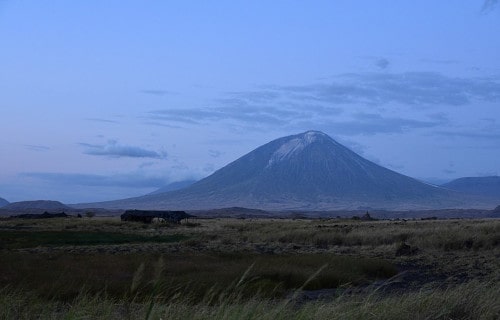
CCL: http://bit.ly/2xQPH8p
Ol Doinyo Lengai Physical Description
The fabulous Ol Doinyo Lengai easily merits attention and appreciation by the viewer. It further does so for a variety of reasons. The site’s not the largest of its kind around the world, of course. Yet, its physical dimensions certainly qualify it as an impressive volcano.
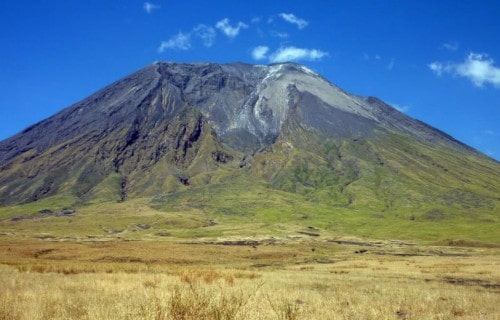
The site boasts a remarkably rounded and even cone shape structure. The intriguing mountain also rises to a respectable height above the surrounding terrain. This aspect of the site makes it clearly visible over great distances. It stands an impressive 5,900 ft (1,800 m).
Each side of the summit of the mountain additionally features a large crater. These remain separated by a ridge measuring approximately 360 ft (110 m) in length. Despite such close proximity to each other, the two craters displays striking different appearances.
The one on the southern flank appears to be completely inactive. This sometimes fills with water. The other crater, however, presents a vastly different view. It’s routinely covered in fresh lava flows. It also regularly forms small, temporary cones that produce lava.
Ol Doinyo Lengai further manifests several parasitic vents. These smaller formations appear on its flanks. Presently, four of these exist on its slopes. The western flank also displays large, deep fractures. Large debris fields dot its sides as well, from earlier events.
It’s the lava itself that ranks as its most unique structure, however. This stratovolcano produces eruptions with an incredibly low silica content. Its composition consists of more than 50% carbonate, even though this compound rarely appears on the earth’s surface.
Public Domain Image
Ol Doinyo Lengai Location, Formation, and Importance
The location of Ol Doinyo Lengai probably won’t surprise many of you. That’s because this wonder of geological processes formed in a region of the world well known for its natural marvels. That’s due to the fact that it formed on what’s now the continent of Africa.
There, it lies in the rough southeastern section of the continent. That location places the amazing formation with the boundaries of the country of Tanzania. Within that area, the volcano lies in the more northerly portion of the country, above the Serengeti.
The mountain itself forms an integral part of the East African Rift Valley. Geological research indicates that this continental rift began forming around 1.2 million years ago. Over time, the resulting thinned crust allowed for the formation of the site as it’s seen today.
Though far too infinitesimally slow for human observation, this expansion continues today. Such ongoing movement generates the heat that still maintains the activity of the mountain. This continued movement by the rift proceeds at a leisurely 0.12 in (3mm) per year.
The mighty Ol Doinyo Lengai has much to offer. It plays a vital role in the overall health of the surrounding ecosystem. Its unique lava actually breaks down quickly when it rains. The resulting runoff has helped lead to the remarkable verdure of the entire region.
It’s importance doesn’t end there, though. That’s true since it’s also quite important to research. Carbonatite, which it produces, remains invaluable to the study of rare earth elements. This site represents the only actively producing source of these elements.
5 Astounding African Mountains
We truly hope that each of you greatly enjoyed reading, and hopefully learning from, this article we’ve presented to you about these 5 Astounding African Mountains. It’s also our hope that doing so has left you with either a new or renewed appreciation for such wonders of Nature.
Unfortunately, many other such features located around the world now find themselves facing threats to their continued existence in an undamaged state. Many of those dangers, in fact, stem from the actions of mankind. We must do all we can to protect and preserve them all.
Check out our other articles on 5 Stunning Islands of Europe, The Mighty Tornado, 3 Breathtaking Central American Birds, Spectacular Dolphins Throughout Our World










Leave a Reply