Glymur Waterfall Facts
- The deceptively short term of Glymur Waterfall serves as one of the most frequently used common names for this marvel of natural processes. However, it also has other general titles by which its’s known. These include Glymur Foss, The Echoing Waterfall, and simply Glymur.
- This marvel of geology holds a place of distinction in scientific circles. It currently ranks as the second-tallest waterfall in the country in which it formed. Experts previously considered it to be the tallest. That recently changed when new measurements of another changed that status.
- Local inhabitants of its region long knew of its existence, of course. The exact date on which local populations first noted its presence remains clouded in history. However, it’s known that this event occurred at least over 1,000 years ago, since it’s situated near an ancient settlement.
- Written records of it, though, only appeared around 200 – 300 years ago. The first documented mention of it by outsiders appeared in travel journals and geographic descriptions from the 18th and 19th centuries, when naturalists and explorers began recording local landscapes.
- Thankfully, today the beauty and majesty of Glymur Waterfall earns it a measure of protection from the depredations of mankind. Currently, both the cascade itself and the surrounding valley lie within a protected nature area under the locally present Nature conservation laws.
- Nonetheless, it’s still at risk of degradation of its pristine state due to a number of external factors. Like similar features around the world, most of these stem from the actions of humans. These threats mainly stem from increased tourism, climate change, and ecological disruption.
Related Articles
Glymur Waterfall Physical Description
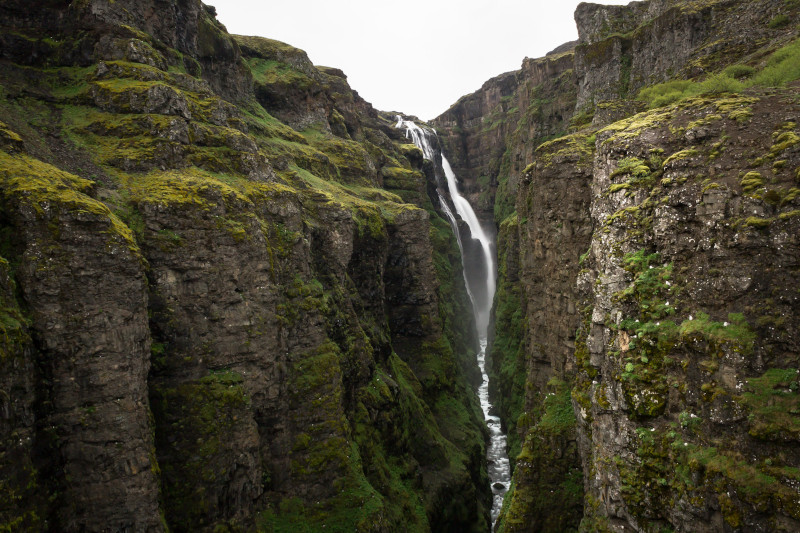
The breathtaking Glymur Waterfall never fails to capture the awe and amazement of those individuals fortunate to visit this natural wonder. It does so, though, due to a startling combination of natural characteristics. These include its own natural beauty, height, and natural suroundings.
This particularly stunning cascade’s actually comprised of a single, strongly vertical drop. The flow cascades in a thin ribbon form most of the year. This does, however, widen significantly seasonally. This expansion occurs due to the inflow of massive amounts of new water from nearby snowmelt.
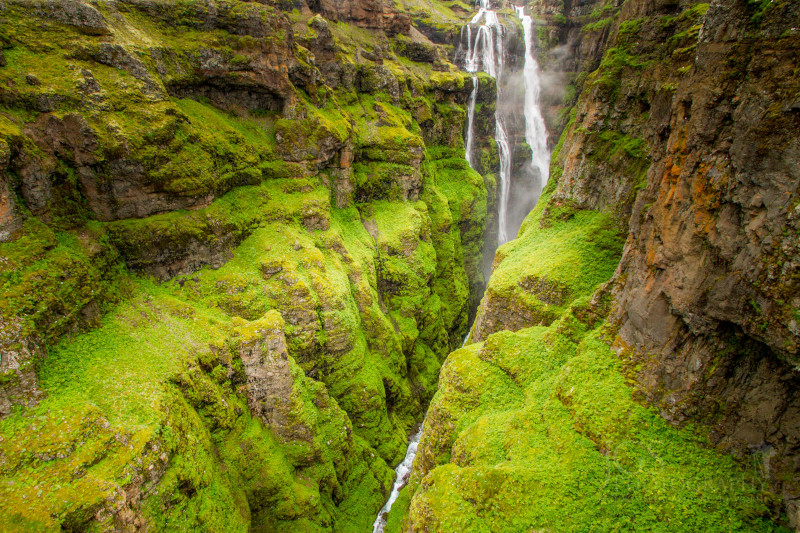
In total, its water plunges approximately 650 ft (198 m) as it drops to the floor of the canyon below, named Botnsdalur canyon. The base over which it flows is composed of basaltic volcanic rock, which is the most common rock type in its region, due to the surrounding country’s volcanic origin.
This host canyon itself boasts impressive traits, further augmenting the splendor of this cascade. Its walls remain quite steep and its confines narrow. That structure’s additionally flanked by rugged volcanic cliffs with dramatic rock formations, often covered in moss and lichen, and even lava fields.
The water itself of Glymur Waterfall also boasts its own remarkable qualities. That’s typically clear and transparent, with a slight bluish tint from the glacial and mountain origins. Due to the regional volcanic landscape, the water is generally low in sediments and has a neutral to slightly acidic pH.
It also routinely maintains a relatively low level of pollution, since the area’s remote and protected. Even the temperture stands out. Water temperature usually remains quite cold year-round, often measuring just above the freezing point during winter and only being slightly warmer in the summer.
Glymur Waterfall Location, Formation, and Ecology
The mesmeric Glymur Waterfall formed in a part of the world that’s long been known for its extraordinary abundance of geological marvels. The location of that setting likely won’t surprise many people who learn on it. That’s because this cascade formed as part of the nation of Iceland.
Though technically an island, the landmass remains both culturally and politically linked with Europe. The precise coordinates of the island places it on the Mid-Atlantic Ridge. That puts the country it lies in straddling the boundary between the North American and Eurasian tectonic plates.
Within the greater landmass of the nation, itself full of boundless wonders, though, the waterfall formed in the approximate western portion of the impressive setting. That placement puts this amazing formation roughly 45 – 60 minutes by car from the closest major city, that being Reykjavík.
The cliffs and canyon walls around this natural beauty are principally composed of basalt, formed by lava flows from volcanic eruptions that occurred thousands to millions of years ago. These lava layers inexorably built up over time, creating the high plateau from which the waterfall descends.
During the Ice Age, massive glaciers covered Iceland and carved out deep U-shaped valleys and fjords. As the glaciers retreated, they left behind steep-walled valleys like its home of Botnsdalur. The steep cliffs of the canyon further deepened due to glacial meltwater rushing through the valley.
After the glaciers melted, the Botnsá River, fed by Hvalvatn Lake, began flowing through the valley. Over thousands of years, the river cut into the rock, forming the narrow canyon and plunge that became the falls. The vertical plunge developed as the river eroded a fault or weakness in the stone.
This stunning cascade’s location in a remote, ecologically rich valley, at the end of a fjord in western Iceland, shapes its ecology. The area represents a vast mosaic of volcanic cliffs, riverine habitats, alpine vegetation, and birdlife, each shaped by Iceland’s cold climate and volcanic geology.
Despite the rugged terrain, the area encompassing Glymur Waterfall supports diverse plant life, especially in sheltered spots along the river and lower canyon. These include a variety of low shrubs, mosses and lichens, grasses, sedges, numerous wildflowers, and abundance of other alpine plants.
Multiple avian species also flourish here. Those include various cliff nesters, wading birds, songbirds, and several migratory species. Smaller mammals also abound here, though larger one’s remain conspicuously absent. Those include field mice, in addition to a number of Arctic foxes.
The water itself supports a relatively large variety of cold-water invertebrates and possibly small fish. Those likely include Brown trout and Arctic char, due to its connection to Hvalvatn Lake. The water supplied by it’s quite clean, cold, and oxygen-rich, supporting a healthy aquatic ecosystem.
Features Sharing Its Region
Check out our other articles on 5 Magnificent Mountains of Europe, Humpback Whale, Nile River, Achiote Tree, Emperor Penguin, Bat Star, Purple Frog, Epirus Dancing Grasshopper, Eyelash Viper

Leave a Reply