Bahaman Swallowtail Facts
- The partially informative term of Bahaman Swallowtail serves as the most frequently used common name for this beautiful Lepidoptera. Yet, it does have a few other general titles by which it’s known. Those include the similar Bahama Swallowtail and Andraemon swallowtail.
- Inside of the scientific community, however, it’s possibly better known by its entirely technical designation. Thankfully, that’s a comparatively simple one for the layperson to pronounce. That’s because this wonder of Nature and evolution bears the tag Papilio andraemon.
- The invertebrate received that epithet due to the efforts of Jacob Hübner. That highly respected German entomologist accomplished the first official recognition of the creature as a separate and distinct species. He achieved that scientifically noteworthy deed in the year 1823.
- This wonder of the insect world holds a certain measure of distinction within the entomological world. That’s due to the fact that, despite its relatively small range, there appear to be several distinct subspecies of the butterfly. To date, researchers recognize a total of three.
- Fortunately, the lovely Bahaman Swallowtail seems to be maintaining a population base that’s both stable and sufficient. This pleasant state also appears to hold true throughout the entirety of its range. The IUCN thus presently shows it as Least Concern on its published Red List.
- It should nevertheless still be considered as facing multiple potential threats to its continued existence as a species. Like most forms of life on earth today, most of these numerous dangers stem from the actions of mankind. They include both habitat loss and climate change.
Related Articles
Bahaman Swallowtail Physical Description
Not surprisingly, the remarkable Bahaman Swallowtail typically captures the immediate atttention and appreciation of those individuals fortunate enough to encounter it. Unlike some butterflies, though, it does not rely solely on that visual appeal to merit the recognition of observers.
In regards to appearance, it also follows a pattern of development common among its kindred around the world. That manifests in the fact that it displays a certain degree of the physiological trait of sexual dimorphism. In its case, however, the gender-based differences remain quite small.
This majestic Arthropod beauty evolved as a medium-large variety of Lepidoptera. Mature individuals attain an average wingspan measuring between 3.5 – 4.3 in (9 – 11 cm). Females tend to have a slightly greater wingspan than males, though only by around roughly 0.2 – 0.4 in (0.5 – 1 cm).
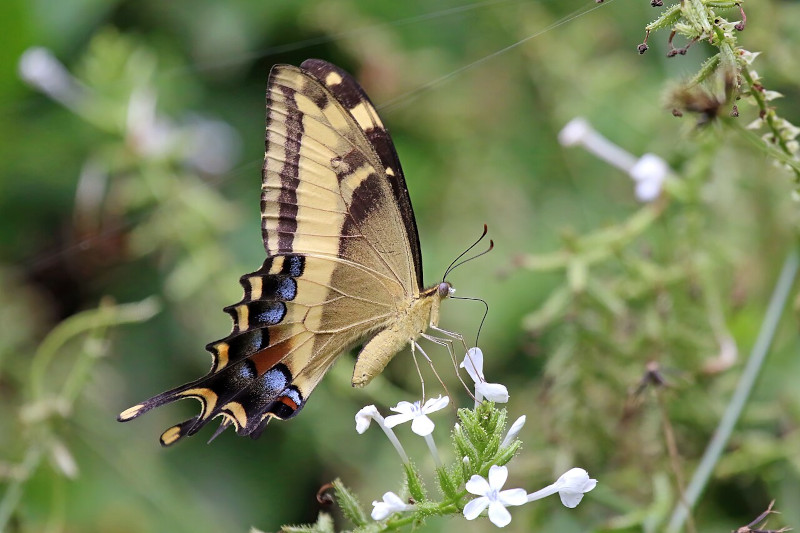
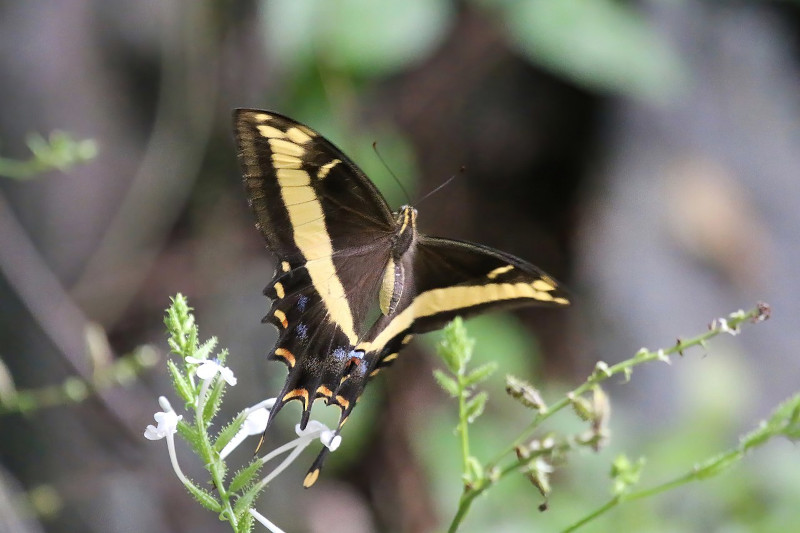
The head and body of this marvel also earn note, presenting as a dark black in color, with yellow side stripes along the thorax and abdomen. Its eyes, meanwhile, develop as large and dark, also. Typical of butterflies, its two antennae evolved as deep black in coloring, and with clubbed ends.
Without doubt, though, it’s the wings of the breathtaking Bahaman Swallowtail that most frequently garner the most attention from those who observe the creature. The upperside of these features shows a rich black background with broad yellow bands across both forewings and hindwings.
On the forewings, however, another feature also appears. That’s the yellow band present which usually runs diagonally from the leading edge toward the inner margin. The hindwings, on the other hand, feature a yellow submarginal band and a single red-orange eyespot near the tail area.
The underside, though, shows a very different pattern. These remain paler, with light brown to yellowish tones and the same yellow band pattern more faintly visible. A row of blue and red spots also often presents itself along the hindwing margin among the majority of individual examples.
Yet one more aspect of these wings also draws the eye. Each hindwing ends in a long, slender swallowtail projection, edged in black and yellow. The tails themselves develop as markedly less pointed than in many of its many relations around the world, giving the butterfly a softer silhouette.
- Kingdom: Animalia
- Phylum: Arthropoda
- Class: Insecta
- Order: Lepidoptera
- Family: Papilionidae
- Genus: Papilio
- Species: P. andraemon
Bahaman Swallowtail Distribution, Habitat, and Ecology
The gorgeous Bahaman Swallowtail evolved as indigenous to only a comparatively small swathe of the surface of our world. Precisely where that native zone of habitation lies, though, likely won’t be difficult for anyone to guess. That’s due to the fact that the very name provides a strong clue.
This wonder primarily inhabits the Caribbean region of the earth. Within this area, it principally appears in the Bahamas, Cuba, and the Cayman Islands. In the Bahamas, it’s especially common on the larger islands. It and subspecies also appear in Cuba and the Cayman Islands in small numbers.
Northward, however, its range even extends into a small portion of North America. There, the butterfly appears in parts of southern Florida and the Florida Keys, part of the United States. These individuals, though, usually represents only occasional stray individuals or temporary populations.
It displays clear preferences regarding its choice of habitat. It’s a tropical and subtropical butterfly that thrives in open, sunny environments, especially those where its host plants grow naturally or in cultivation. It’s well adapted to island ecosystems with dry to moderately moist climates.
It often lives in regions of coastal scrublands. Given that, it’s abundant in dry coastal areas with scattered shrubs and low vegetation. It’s also common in open pine forests, mostly in the Bahamas and Cuba. It prefers sunlit clearings, edges, and disturbed patches rather than dense forest interiors.
The species also frequents artificial areas, including gardens, orchards, and citrus groves, where it finds larval host plants. Incredibly, despite its seeming fragility, this remarkably intrepid Lepidoptera also adapts well to human-modified landscapes as long as the nectar and host plants are available.
The stunning Bahaman Swallowtail plays an important role as both a pollinator and a herbivore in tropical island ecosystems. Adults contribute to pollination while feeding on flower nectar. Larvae feed on certain Rutaceae plants, influencing vegetation dynamics, sometimes acting as minor pests.
Females lay eggs singly on the leaves of host plants, mainly wild lime, satinwood, and citrus. These carefully select plants that offer both shelter and optimal food quality for larvae. The pupa attaches to stems or branches, usually of the same host plants, using silk, blending in with plant material.
Mature adults remain primarily diurnal in nature, being most active during the sunny, warm hours of the day. Basking also remains an extremely common activity, with adults often resting with wings spread in full sun. In the Caribbean, the species is multi-brooded, with several generations per year.
Adults feed on nectar from a variety of flowering plants, mainly including lantana, bougainvillea, hibiscus, and others, and thus also serving as pollinators. In turn, however, they face a number of natural predators. These include birds, lizards, spiders, and a variety of predatory insect species.
Species Sharing Its Range


Check out our other articles on 5 Magnificent Mammals of Oregon, Ethiopian Wolf, Amazon River, American Tiger Lily, California Two-Spot Octopus, Goldentail moray, Eyelash Viper










Leave a Reply