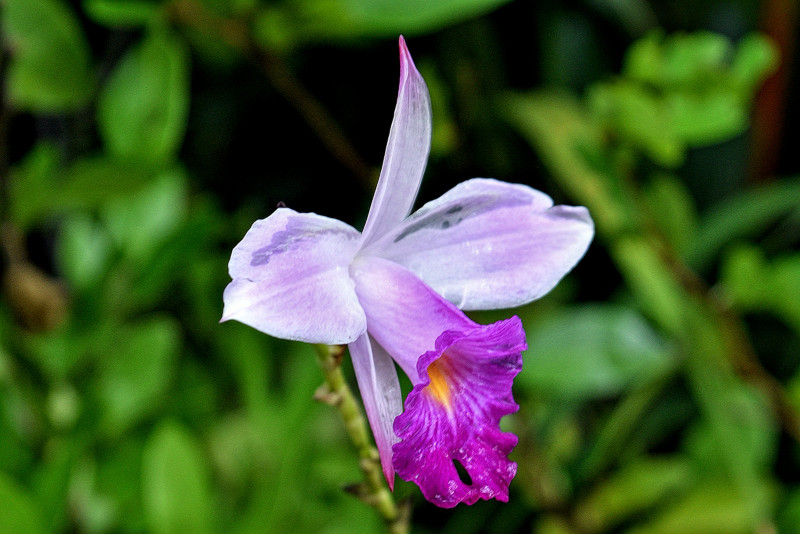
Bamboo Orchid Facts
- This stunning product of Nature and botanical evolution most typically goes by the simple title of Bamboo Orchid in its native range. Yet, the gorgeous Angiosperm also holds multiple other general names. These include Grass-Leaved Orchid, Reed Orchid, and Arundina Orchid.
- Inside of the scientific community, though, it’s perhaps better known by its technical moniker. Like many such designations, however, that’s difficult for the layperson to pronounce. That’s because the herbaceous plant holds the formal appellation of Arundina graminifolia.
- That wasn’t its original name, though. The esteemed British botanist, John Lindley, holds the distinction of being the first individual to formally recognize it as a separate and distinct species. He assigned the wondrous species the very similar tag Bletia graminifolia, in 1833.
- A few years later, in 1838, however, the species received reclassification, as often happens in the field of botany. Intriguingly, the highly accomplished and respected John Lindley himself, after further research into the mesmerizing flora, managed the change of designation himself.
- Thankfully, the captivating Bamboo Orchid appears to be maintaining a population base that’s both stable and sufficient. This pleasant state further seems to hold true throughout the entirety of its range. The IUCN therefore does not presently name it on its published Red List.
- The beautiful plant nevertheless faces the same potention threats to its continued existence as all forms of life on earth today. Most of these stem, either directly or indirectly, from the actions of mankind. They include the related perils of habitat loss and climate change.
Related Articles

Bamboo Orchid Physical Description
The magnificent Bamboo Orchid understandably engages most of those who encounter it, especially in its native environment. Yet, while it’s great beauty clearly ranks as the primary reason for this, it certainly isn’t the only one. The charming flora also possesses other distinctive attributes.
Impressively, and quite uncommonly as well, the highly versatile plant demonstrates the ability to grow in two different variety of ways. Though it most often does so with a fibrous root system, that’s not always the case. Under certain conditions, it occasionally grows and spreads as an epiphyte.
This terrestrial, evergreen orchid typically grows in a clumping, reed-like fashion. As its common name implies, its stems bear a striking resemblance to bamboo, due to its tall, slender, segmented stems. Reaching heights of up to 6.5 ft (2 m), these generally present as dark green and smooth.
Its foliage also merits notice. This usually develops as long, narrow, and lance-shaped in form. Each also grows alternately along the stem. Leaves also appear as bright green in color and with a parallel-veined structure. Typically, they average 8-12 in (20 – 30 cm) long, and 0.4 – 08. in (1 – 2 cm) wide.
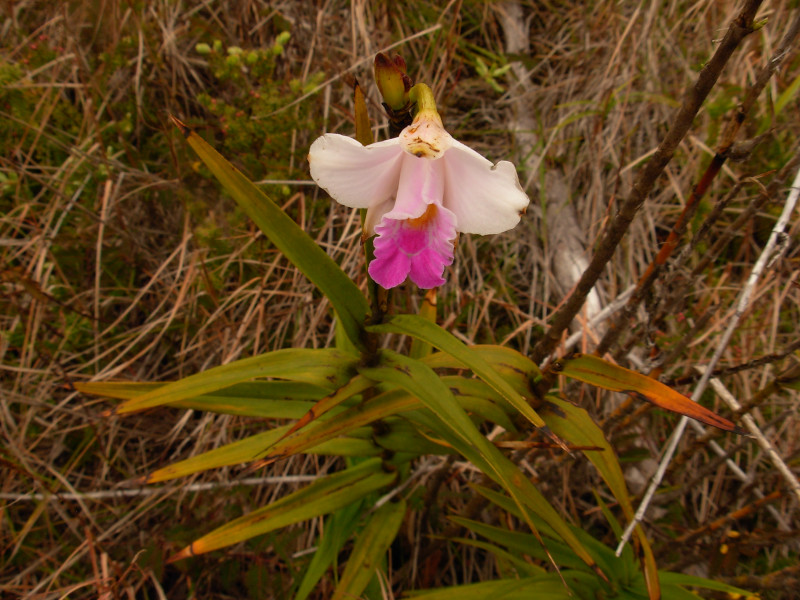
Nevertheless, it’s the showy flowers of the Bamboo Orchid that garner the most attention. In shape and general structure, these closely resemble Cattleya Orchids. The blooms typically appear at the tips of short stems, usually doing so in small clusters. In warm climates, these develop year-round.
Each fabulous flower attains an average diameter measuring approximately 2 – 3 in (5 – 8 cm). The soft, lacy petals vary in color, ranging through shades of pink to purple. Complimenting this, however, the lip and labellum in the center generally display combinations of yellow and white.
The fruit of the flora, meanwhile, evolved as an elongated, cylindrical seed pod. This average roughly 1.2 – 2.4 in (3 – 6 cm) in length. It presents as green when first forming, but changes to brown, with a ribbed texture, as it matures. Within it, the flower develops thousands of tiny, dust-like seeds.
- Kingdom: Plantae
- Phylum: Angiosperm
- Class: Monocots
- Order: Asparagales
- Family: Orchidaceae
- Genus: Arundina
- Species: A. graminifolia
Bamboo Orchid Distribution, Habitat, and Ecology
The breathtaking Bamboo Orchid evolved as indigenous to a moderately broad swathe of the surface of the earth. Given its exotic nature, though, the setting of that natural territory won’t surprise many people. That’s true since this marvel of natural evolution developed in Asia.
Within that greater zone of habitation, however, it lives in several sections. This includes South and Southeast Asia. There, it lives within the borders of India, Sri Lanka, Nepal, Bhutan, Bangladesh, Myanmar, Thailand, Laos, Cambodia, Vietnam, Malaysia, Indonesia, and the Philippines.
The plant also makes its home in the eastern portion of the region. There, it lives in Taiwan, southern China, including Hong Kong, and the Ryukyu Islands of Japan. Not stopping there, though, the flora’s also known to exist in the Pacific Isalnds, specifically the magical island of New Guinea.
Fortunately for it, the species displays a moderate degree of flexibility regarding its choice of habitat. It’s therefore found in several different types of ecosystems. The plant’s often found in sunny, well-drained areas with little tree cover. These mainly consist of open grasslands and meadows.
It also commonly lives on gentle hillsides and slopes with adequate drainage, from lowland to montane regions. The flora additionally displays a fondness for the transitional zones between open spaces, such as the above-mentioned meadows and grasslands, and densely forested regions.
Though it prefers the types of soil found in these areas, it’s nonetheless fully capable of growing in areas with greater amount of moisture. This include riverbanks and wetlands. Impressively, it also shows the ability to thrive in human-altered landscapes, such as along roads and cleared land.
Though it manages in temperate climates in those regions where it’s been naturalized, it prefers tropical and subtropical conditions. It’s even adaptable to a moderate range of altitudes, too. It’s known to live in populations at heights ranging from roughly sea level up to 6,562 ft (2,000 m).
The delightful Bamboo Orchid principally achieves its pollination via the actions of both bees and butterflies drawn to its flowers. Some small populations of the highly evolved plant, though, occasionally exhibit self-pollination, ensuring reproduction even in the absence of pollinators.
It also plays a surprisingly pivotal role in its local ecosystem wherever it lives. The blooms provide nectar for pollinators, supporting local insect populations. It helps stabilize soil in disturbed habitats, too, preventing erosion. It does, however, compete with grasses and shrubs in open areas.
Species Sharing Its Range
Check out our other articles on 5 Geological Wonders of Wyoming, Striped Possum, Great Dismal Swamp, Kamehameha Butterfly, Spotted Seahorse, Little Auk, Rose’s Ghost Frog, Black Caiman










Leave a Reply