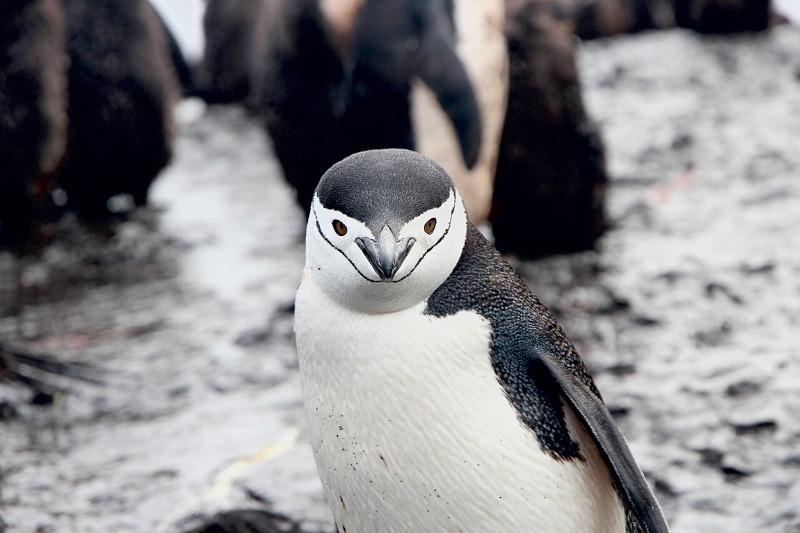
Chinstrap Penguin Facts
- This highly distinctive species of flightless wonder most frequently goes by the intriguing common name of Chinstrap Penguin. It does have a few other titles by which it’s known, though. Those include the terms ringed penguin, bearded penguin, and stonecracker penguin.
- Within the scientific community, however, it’s perhaps much better known by its purely technical designation. Sadly though, as so often remains the case, that’s a moniker that’s quite difficult for the layperson to pronounce. That’s because it holds the tag Pygoscelis antarcticus.
- The animal received that epithet due to the efforts of Johann Reinhold Forster. That highly respected German naturalist accomplished the first formal recognition of the creature as a separate and distinct species. He achieved that scientifically noteworthy deed in the year 1781.
- It stands out from its brethren in the annals of science for several reasons. The bird’s considered one of the most aggressive penguin species, frequently defending nests or pebbles. It also now ranks as one of the most numerous types of penguin known to modern science.
- Thankfully, the beautiful Chinstrap Penguin also seems to be maintaining that stable and sufficient population base. That pleasant state further appears to hold true throughout the entirety of its known range. The IUCN thus presently shows it as Least Concern on its Red List.
- Nevertheless, the creation of Nature and evolution still faces multiple potential threats to its continued existence as a species. Most of these numerous perils stem from the actions of mankind. They include the closely related dangers of habitat loss and ongoing climate change.
Related Articles
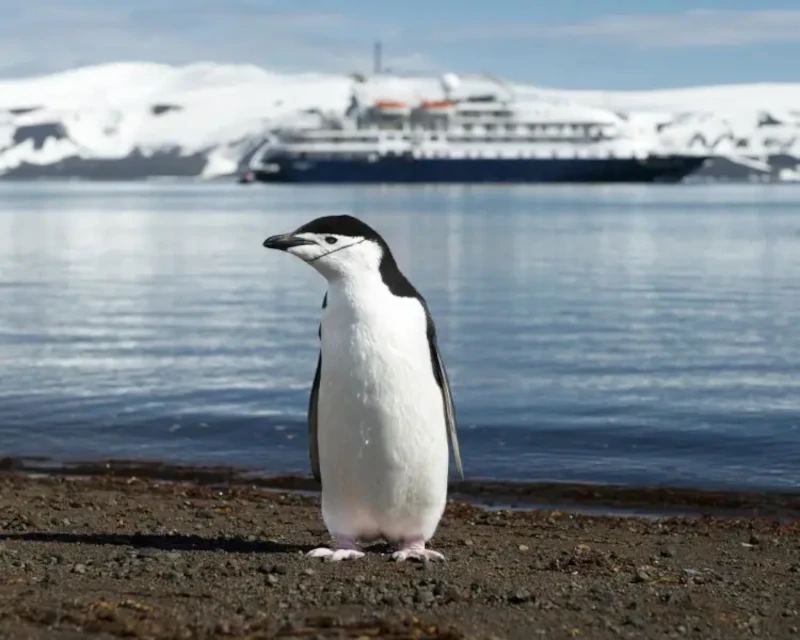
Chinstrap Penguin Physical Description
The gorgeous Chinstrap Penguin instantly captivates and impresses most individuals fortunate enough to encounter it. The remarkable bird does not typicall do so, though, due to any extremes of physical dimensions. In that respect, it ranks as an approximately medium-sized penguin species.
It also follows a pattern of natural development that’s extremely common among animals. That’s the fact that the avian displays a certain degree of the physiological characteristic of sexual dimorphism. In its case, though, this evolutionary trait manifests itself solely in terms of simple size.
Males of this marvel of Nature attain a slightly greater average size than that of their female counterparts. That tendency includes both in terms of mean height and weight. This sex also displays a somewhat different structure of the bill than that of the females of the intriguing species.
The males of this wonder reach an average height measuring roughly 28 – 30 in (71 – 76 cm). Being heavier and stockier than the females, a typical body mass ranges from 9.9 – 12.1 lb (4.5 – 5.5 kg). Although exceptional examples do sometimes occur, few rarely exceed this by very much.
The females, meanwhile, possess a notably slimmer body structure. For them, an average height varies from between 26.8 – 28.3 in (68 – 72 cm). While developing as only minimally shorter than the males, their weights are actually much lighter. They average roughly 7.7 – 9.9 lb (3.5 – 4.5 kg).
The overall body shape evolved as relatively streamlined and bulet-shaped, though this holds true more of females than males. Outside of this fact, the amazing product of eons of natural evolution possesses numerous physical attributes to thoroughly mesmerize the occasional fortunate observer.
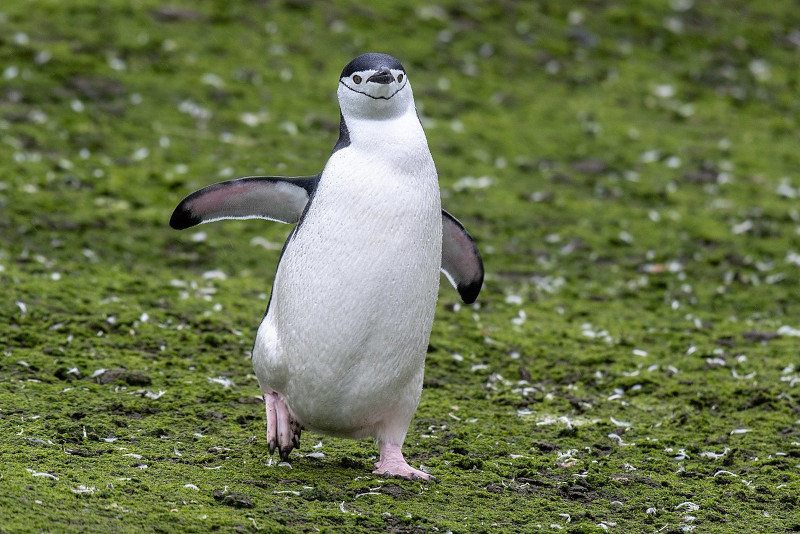
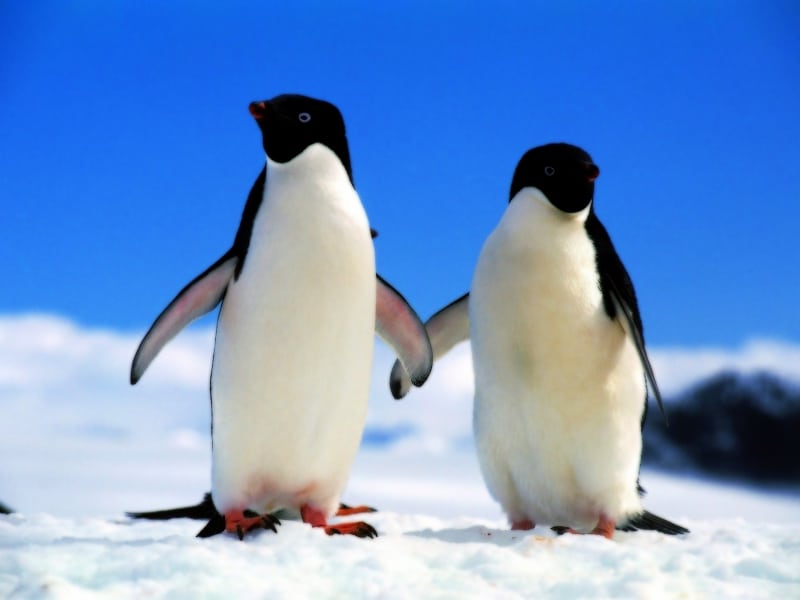
The most distinctive feature of the aptly-named Chinstrap Penguin, however, clearly consists of the narrow black band that runs from ear to ear under the chin. The rest of the face, though, as well as the underside, presents as completely bright white, creating a sharp contrast with the remainder.
Both the back and dorsal sides of the lovely work of natural art manifest either black or dark bluish-black feathers that cover the head, back, and tail. The bill evolved to be comparatively short, yet strong, and black in color. Among males, this also develops as longer and thicker than with females.
Other parts of the anatomy of the penguin also serve to catch the eye of those viewing them. The eyes present as a reddish-brown or dark red with a thin black orbital ring. Its feet stand out as well, being webbed, and either pinkish or pale-flesh colored, yet having dark black soles and claws.
- Kingdom: Animalia
- Phylum: Chordata
- Class: Aves
- Order: Sphenisciformes
- Family: Sphenicidae
- Genus: Pygoscelis
- Species: P. antarcticus
Chinstrap Penguin Distribution, Habitat, and Ecology
The fascinating Chinstrap Penguin holds more reasons to respect it than simply its intriguing appearance. That’s because it also inhabits one of the broadest ranges of the surface of the earth of any penguin in its region. Where that zone of habitation lies, however, probably won’t surprise you.
Its distribution remains primarily associated Antarctica and the sub-Antarctic regions. This holds especially true for areas around islands and coasts with access to open water. Yet, it also possesses two separate ranges of habitation, one being for breeding and the other for non-breeding activities.
Its breeding range principally consists of the Antarctic Peninsula and nearby islands. Major breeding areas include several island groups, such as the South Sandwich Islands, South Orkney Islands, and the South Shetland Islands, including Deception Island. It also breeds on several individual isles.
During winter, though, its population disperses northward into the non-breeding territory, in the Southern Ocean. They often appear as far north as sub-Antarctic waters, like the Falkland Islands and in the Drake Passage. Occasionally a few show up near the southern tip of South America.
This amazing product of evolution displays decidedly clear and strong preferences regarding its choice of habitat. In this respect, it follows the same pattern as most of its kin around the world. Its habitat choices are very strongly influenced by sea ice, ocean productivity, and coastal geography.
For its breeding habitat, it favors ice-free coastal areas, rocky slopes, cliffs, and small islands around the Antarctic Peninsula and surrounding archipelagos. It establishes its colonies on bare rock, pebble beaches, or slopes free of snow and ice. For its marine habitat it prefers open areas of water.
Despite its relatively small size, the impressive Chinstrap Penguin plays a surprisingly important role in the region of the globe it inhabits. Its ecology reflects tight connections among numerous factors, including sea-ice conditions, prey availability, predator interactions, and breeding habitat.
It feeds as a carnivore, primarily foraging in shallower areas. The avian also does so during the day, and often in small groups. It mainly consumes Antarctic krill, though it occasionally supplements this with small fish and squid. In fact, it serves as one of the major predators of krill in its region.
In turn, it faces its own share of threats, both natural and otherwise. Natural predators include such species as leopard seals, skuas, and sheathbills. Yet, it also faces threats from human-related actions. These dangers include commercial krill fisheries, and various forms of habitat disturbances.
Breeding chiefly takes place during the period of November to March. It constructs its nest out of pebbles to keep eggs above meltwater. Females typically lay two eggs, with a different number being extremely rare. Both parents aid in the incubation, which generally lasts for approximately 37 days.
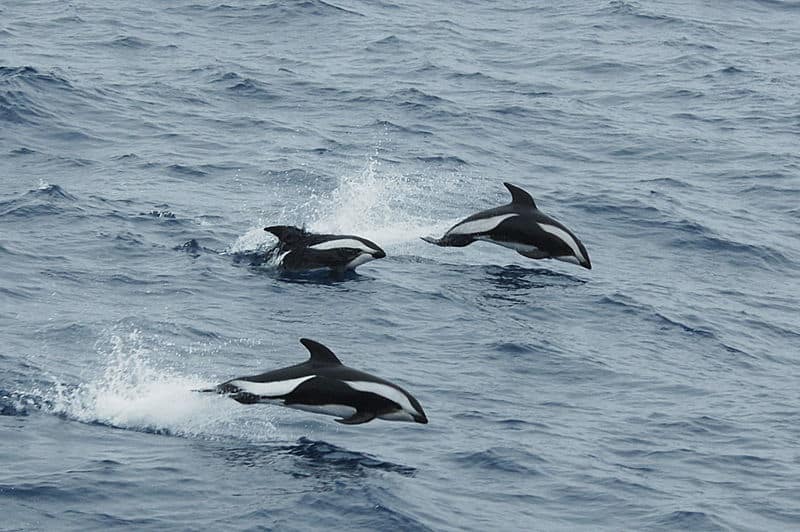
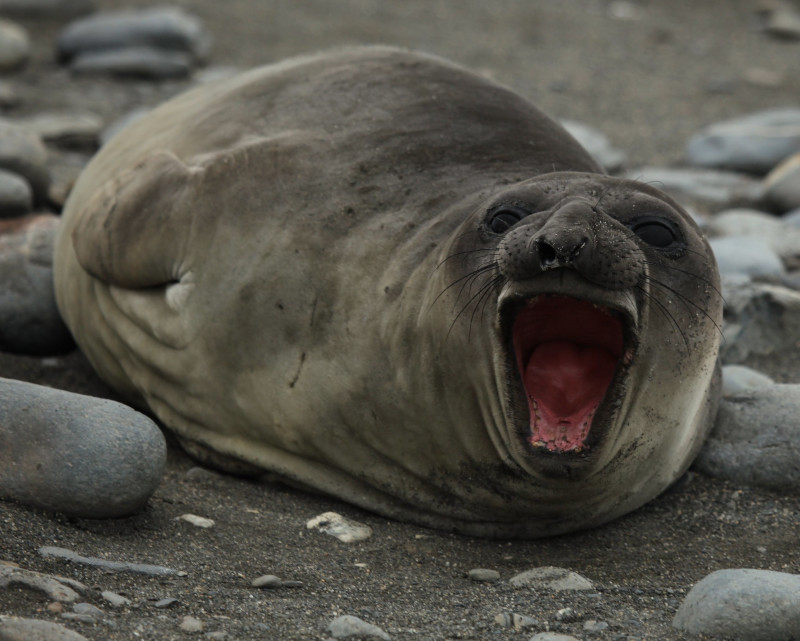
Species Sharing Its Range
Check out our other articles on 5 Astounding African Mountains, Red-legged Pademelon, Rio Grande River, Kazahk Apple Tree, Aphrodite Fritillary, Great Barracuda, Texas Alligator Lizard










Leave a Reply