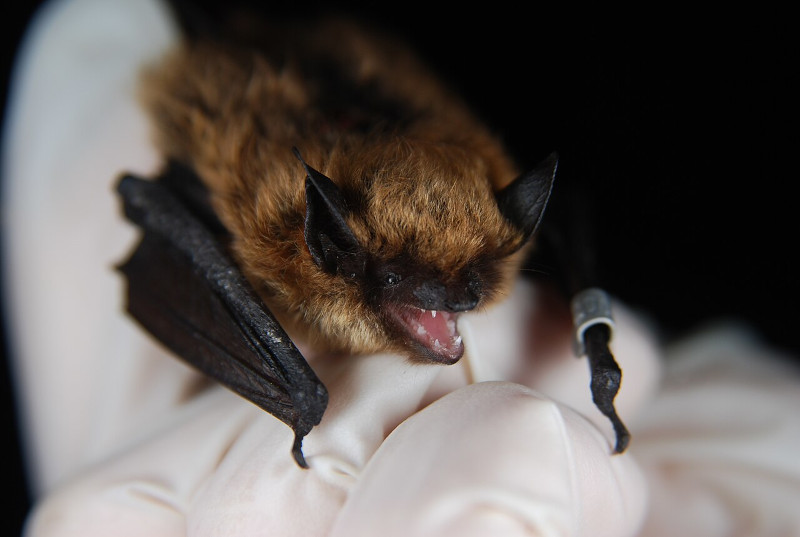
Eastern Small-Footed Bat Facts
- This intriguing creature most frequently goes by the highly descriptive common name of the Eastern Small-Footed Bat throughout its native range. Yet, it does have other titles. These include the similar terms Leib’s Bat, Eastern Small-Footed Myotis, and Small-Footed Bat.
- Inside of the scientific community, however, it’s possibly better known by its technical moniker. That’s the pleasantly short and simple designation, from the perspective of the layman, at least, of Myotis leibii. In most instances, the formal epithet’s harder to pronounce.
- The small mammal received that tag due to the combined efforts of a truly esteemed duo. This naming resulted from the work of John James Audubon himself, and his colleague and co-author, John Bachman. The pair accomplished this noteworthy deed in the year 1842.
- The species holds several distinctions in the scientific world. It represents one of the smallest of all known types of bat inside its native range. Experts had considered all small-footed Myotis in this region one species. Recent work, though, divided these into two separate species.
- Fortunately, the impressive Easterm Small-Footed Bat appears to be maintaining a population base that’s still stable and sufficient. It’s declined very little in recent decades. The IUCN nevertheless lists it as Endangered, due to a combination of range and specific habitat needs.
- The remarkable winged mammal also faces the same potential threats to its continued existence as a species as all forms of life on earth today. Most of these dangers stem from the actions of mankind. They include the related perils of habitat loss and ongoing climate change.
Related Articles

Eastern Small-Footed Bat Physical Description
The eye-catching Eastern Small-Footed Bat typically captures the notice and fascination of those fortunate enough to encounter it in the wild. It generally does so, however, due more to its distinctive appearance, rather than size. That’s because it’s a fairly small member of its Family.
Following the well-established pattern among mammals, this marvel Nature and evolution displays a certain degree of the physiological characteristic of sexual dimorphism. In its specific case, though, this natural trait mainfests itself in terms of size and mass, but only to a very minor degree.
Overall, the biological wonder attains an average head and body length measuring between 2.75 – 3.5 in (7 – 9 cm). Its wingspan, meanwhile, typically reaches 8.25 – 9.75 in (21 – 25 cm). Weights usually range from 0.1 – 0.2 oz (3 – 6 gms). In all dimensions, the female’s typically on the higher end.
A key distinguishing feature of the animal, as part of the name implies, is the size of the feet. These appendages evolved as proportionately small compared to the rest of the body. It also displays ears that develop as short and mainly rounded, but additionally rise to slight points at their tips.
Yet, it’s the attention-grabing coloring of the Eastern Small-Footed Bat that generally garners the most attention, along with its size. The short fur on the back typically presents as a golden-brown to yellowish-brown, with a noticeably darker shade present at the base of this aspect of the body.
The underside of the mammal, however, shows the viewer a very different pattern. Here, the fur appears lighter, often being grayish or buff-colored. Its face, ears, and flight membranes, though, manifest a black or dark brown, thus creating a striking contrast with the rest of the body colors.
The wings themselves also deserve note for their appearance. These typically develop as dark, like the fur on the back. Each also remains relatively thin, and delicate, with a slightly rounded shape when extended. Its tail’s enclosed within a membrane, situated between the legs of the animal.
- Kingdom: Amimalia
- Phylum: Chordata
- Class: Mammalia
- Order: Chiroptera
- Family: Vespertilionidae
- Genus: Myotis
- Species: M. leibii

Eastern Small-Footed Bat Distribution, Habitat, and Ecology
Regrettably, the amazing Eastern Small-Footed Bat apparently developed as indigenous to a minor expanse of the earth’s surface. That zone of habitation further seems to be both comparatively patchy in nature and limited. It evolved as native to only a small portion of North America.
The entirety of its known territory lies within the borders of Canada and the United States. In Canada, the smaller part of that range, it lives only in the southern sections. Even there, however, the mammal’s only found in the areas of Ontario and Quebec, but populations remain quite sparse.
Within the United States, the animal lives mainly in the Appalachian Mountains, the Ozarks, and parts of the Northeast. Inside the latter region, observers note its presence in the states of New York, Pennsylvania, New Jersey, Vermont, New Hampshire, Maine, Massachusetts, and Connecticut.
In the Mid-Atlantic, it’s in Maryland, Virginia, and West Virginia. It’s also in the Southeast, known in Kentucky, Tennessee, and North Carolina. In the Midwest, it lives in Ohio, Indiana, Illinois, and Missouri. The mammal’s also spotted in Northern Georgia and Northern Alabama, to the south.
Unfortunately, it possesses extremely specialized habitat preferences, greatly limiting its chances of spreading. It prefers various forms of rocky landscape. It’s often found in rock outcrops, talus slopes, cliffs, and boulder fields. It also uses crevices, cracks, and loose rocks for summer roosting.
Other regions do sometimes serve, though. It also inhabits deciduous and mixed forests in mountainous or hilly regions. The creature’s occasionally found at higher elevations, often near rock formations. It additionally makes advantageous use of cool, humid caves and even mines in winter.
Despite its small stature, the Eastern Small-Footed Bat plays a pivotal role in the various ecosystems it inhabits. It’s principally insectivorous in nature, feeding on moths, beetles, flies, ants, and other small flying insects. These activities begin after sunset, and continue throughout the night.
The mammal most commonly hunts in forest edges, near rocky outcrops, and over streams, using echolocation to detect prey. This efficient hunter also feeds voraciously for its size, often consuming an impressive number of insects, thereby acting as a natural control mechanism for these.
Mating occurs in Fall, usually shortly before entering its period of hibernation. Sperm’s stored in the female’s reproductive tract until spring, though, when ovulation occurs. Gestation generally lasts about 50–60 days, with females giving birth to a single pup in late spring or early summer.
Species Sharing Its Range

Check out our other articles on 3 Memorable Malaysian Herbaceous Plants, Maned Wolf, Amazon River, Mountain Ebony, Kamehameha Butterfly, Spotted Seahorse, Little Auk, Black Caiman










Leave a Reply