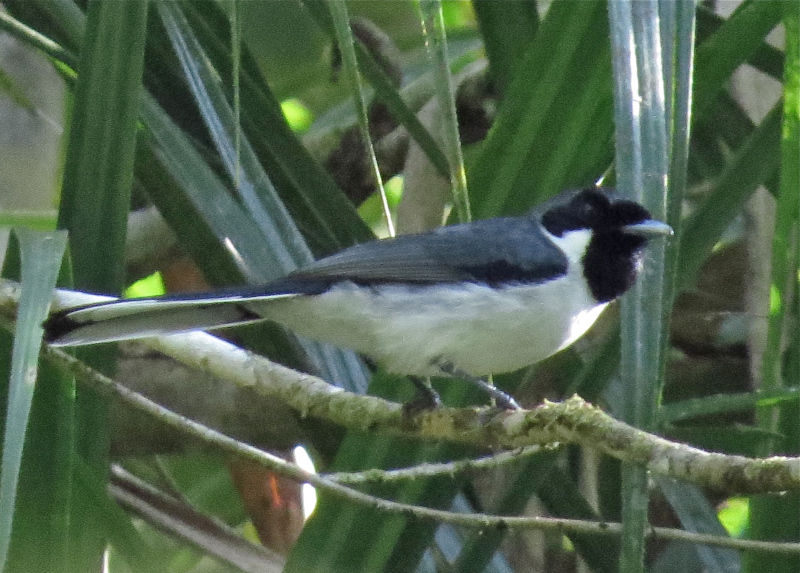
Flores Monarch Facts
- The short, simple, yet fully informative term of Flores Monarch represents the most frequently used common name for this rarely photographed bird. Yet, the animal does have a few other general titles. These include Flores Island monarch, Sacred monarch, and Flores flycatcher.
- Inside the annals of science, however, it’s possibly better known by its technical designation. Sadly, though, that one’s extremely difficult for the layperson to pronounce. That’s because this product of avian evolution bears the tongue-twisting tag Symposiachrus sacerdotum.
- The bird received that convoluted moniker due to the efforts of Gerlof Fokko Mees. The highly respected Dutch ornithologist accomplished the first formal acknowledgement of it as a separate and distinct species. He achieved that scientifically noteworthy deed in the year 1973.
- This remarkable creation of Nature continues to be only rarely seen or studied, thus leading to the existence of very few quality photos of the creature. That also creates a great dearth of knowledge among researchers about many aspects of its behavior, breeding, and feeding habits.
- Lamentably, among the little information available to scientists concerning the Flores Monarch is the fact that its population appears to be diminishing. The rate of this, however, remains unclear. At the present moment, the IUCN shows it as Critically Endangered on its Red List.
- This amazing avian faces numerous threats to its continued existence as a species. Like all forms of life on earth today, the majority of these stem from the actions of mankind. Chief among these many dangers stands the closely related perils of habitat loss and climate change.
Related Articles
Flores Monarch Physical Description
The amazing Flores Monarch rarely fails to impress those few individuals fortunate enough to encounter one of these marvels of Nature. The lovely avian does not typically do so due to any factor of size, however. That’s due to the fact that, like its many relatives, it’s a small variety of bird.
Although, as mentioned previously, little’s known about many aspects of its nature, it appears that it distinguishes itself from many other birds in one manner. That’s true since the animal seems to display virtually no noticeable degree of the physiological characteristic of sexual dimorphism.
Therefore, to the best of the knowledge of ornithologists, both genders of the avian present the same basic appearance. That’s believed to hold true in regards to both size and plumage. Scant research indicates that mature adults attain a total length averaging between 6 – 6.3 in (15 – 16 cm).
The overall body shape of observed examples remains consistent with its kindred around the world. That consists of a comparatively compact body, relatively long tail, and a short but strong beak. This trait additionally appears to hold equally true for the young and adult of the species alike.
The aforementioned tail of this product of Nature and evolution evolved as relatively lengthy in relation to the body itself. This visually distinctive appendage sometimes presents a pattern of subtle white edging or tips. Its wings, meanwhile, develop as broad and somewhat rounded in form.
It’s doubtless the plumage of the uncommonly elusive Flores Monarch that most typically captivates those lucky few who do manage to view this wonderful bird. The general background of the head, back, and wings of known specimens most frequently consists of a slaty-gray to blackish.
Other sections of the body, though, show very different patterns of coloring. The chest and belly primarily display shades that run from pale gray to white, creating a strong contrast with the much darker top. Some individuals occasionally manifest subtle buff or rufous tones on the flanks or sides.
This winged wonder also possesses facial features fully worthy of note. Many of those who study it describe its face as having a clean look, absent any heavy streaking or mask. Its eyes develop as quite dark, creating a stark contrast. Some monitored individuals also show a pale blue or grayish bill.
- Kingdon: Animalia
- Phylum: Chordata
- Class: Aves
- Order: Passeriformes
- Family: Monarchidae
- Genus: Symposiachrus
- Species: S. sacerdotum
Flores Monarch Distribution, Habitat, and Ecology
Lamentably, the reclusive Flores Monarch evolved as indigenous to an extraordinarily restricted portion of the surface of the globe. Exactly where that zone of habitation lies won’t come as a surprise to anyone, however. That’s true given the fact that the name of the bird makes it evident.
This intriguing creature developed as native only a single island in the world, understandable named Flores Island. That formation itself forms part of the Lesser Sunda Islands in eastern Indonesia. Its precise placement puts it between the islands of Sumbawa to the west and Lembata to the east.
One of the countless reasons why the species continues to be considered as so vulnerable is its habitat preferences. It displays decidedly specific requirements, the nature of which restricts its potential for expansion. That dependence on specific conditions also makes its situation fragile.
It requires the presence of extremely dense, tropical, and humid forests. The species further needs a very precise, and somewhat surprising, range of elevations. It’s found almost exclusively at altitudes measuring between 3,281 – 4,593 ft (1,000 – 1,400 m). It studiously avoids areas of lowland forests.
Due to these very specific prerequisites, it only resides in a few areas of this already greatly restricted range. That includes only two locations in western and central Flores. Those are the Ruteng Nature Reserve and forests near Gunung Ranaka, both part of the central mountain spine of the island.
The complete and precise ecology of the magnificent yet evasive Flores Monarch still isn’t fully understood by researchers due to both its rarity and elusive nature. Ornithologists do know some facts, though, and make numerous assumptions of other aspects based on related species.
Assuming it follows the pattern of those kindred, it feeds as an insectivore. It most likely consumes various insects and other small invertebrates. Experts also believe its foraging activities mostly occur in the understory and mid-canopy layers. It likely catches prey from both the air, and the canopy.
For the moment, researchers known virtually nothing about its breeding patterns. No confirmed nests or breeding behaviors have been documented in the wild. It’s presumed to be territorial, especially when breeding. The avian also likely forages alone or in pairs, similar to related species.
Species Sharing Its Range
Check out our other articles on 5 Sensational Salamanders, Humpback Whale, Amazon River, American Tiger Lily, Koa Butterfly, Indian Vulture, Spotted Seahorse, Indian Bullfrog, Mugger Crocodile










Leave a Reply