
King Penguin Facts
- The distinguished title of King Penguin serves as the most frequently used common name for this remarkable flightless avian. The lovely animal also has a few other, less often employed terms by which it’s known. Those include the tags of Patagonian penguin and Great penguin.
- Within the hallowed halls of science, however, it’s perhaps more typically referred to by its technical designation. Sadly, though, like many such monikers, that’s somewhat difficult for the layperson to pronounce. That’s because it holds the official tag Aptenodytes patagonicus.
- This remarkable creature received that particular epithet due to the efforts of John Frederick Miller. That individual was a highly respected English illustrator, mainly of botanical subjects. Though not an ornithologist, he accomplished this scientifically noteworthy deed in 1778.
- This amazing wonder of Nature and evolution holds a respectable place in the annals of science. It currently ranks as the second-largest of all known varieties of penguin. Only the Emperor Penguin, which happens to bear a striking resemblance to it, exceeds it in this regard.
- Fortunately, the beautiful King Penguin appears to be maintaining a population base that’s both sufficient and stable. This pleasant state also seems to hold true throughout the entirety of its range. The IUCN thus presently lists it as Least Concern on its Red List of Threatened Species.
- This captivating marvel nonetheless still faces numerous potential threats to its continued existence as a species. As holds true for most species on the earth today, most of these stem from the actions of mankind. They chiefly include the perils of habitat loss and climate change.
Related Articles


King Penguin Physical Description
The stunning King Penguin virtually always captivates and amazes those individuals fortunate enough to encounter one. Unlike some of its numerous relatives, however, it does so for several reasons. That’s because it’s not only a beautiful animal, but also boasts respectable measurements.
The wonder of Nature also follows a pattern of development shared by most its kindred. That’s the fact that it displays a very minor degree of the physiological characteristic of sexual dimorphism. Males of the species achieve a slightly greater size than that of their female counterparts.
On average, members of this species attain a height ranging from 28 – 39 in (70 – 100 cm). As a general principle, the males tend to be on the higher end of this range than the females. Exceptional examples do occur, of course, independent of gender. But few exceed this size by any great degree.
Body masses also typically vary fairly significantly. This usually ranges from between 20 – 35 lbs (9 – 16 kg). The body shape develops as vertically elongated, with a streamlined, torpedo-shaped design. Males tend to have both a broader chest and a slightly thicker neck and head than the females.
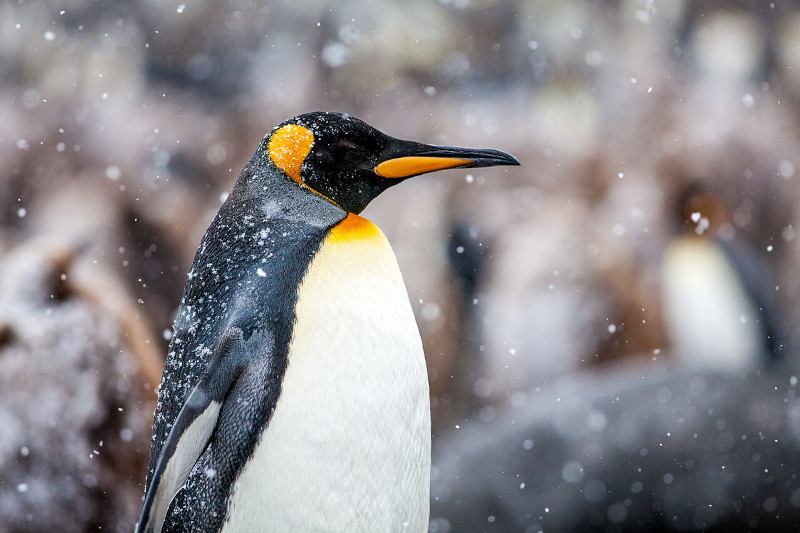
But it’s the outward appearance of the beautiful King Penguin that generally garners the greatest amount of appreciation from observers. In this respect, however, both genders of the creature present the same patterns of coloring and shading. This makes distinguishing the sexes difficult.
The bird’s renowned for its bold, high-contrast coloring with vivid accents. The back and wings present as either dark gray or black. In stark contrast, the chest and stomach display a bright white shade. Bright orange or golden-yellow patches also appear on the sides of the enck and upper chest.
Its head, though, manifests as entirely black, creating a strong contrast with the brighter colors. The beak evolved as relatively long, slender, and also nearly completely black. Evolution highlighted this structure with the presence of a thin stripe of orange or pinkish color along the lower mandible
- Kingdom: Animalia
- Phylum: Chordata
- Class: Aves
- Order: Spheniciformes
- Family: Sphenicidae
- Genus: Aptenodytes
- Species: A. patagonicus
King Penguin Distribution, Habitat, and Ecology
The fabulous King Penguin evolved as indigenous to a uniquely divided portion of the surface of the earth. One apsect of its life remains spent largely in a moderately restricted section of the globe. Another part of the life cycle, however, takes place over a much larger section of the world.
This intriguing creature breeds and lives on remote islands located just north of the continent of Antarctica. In parts of the South Atlantic Ocean, that includes the Falkland Islands, and South Georgia. The latter holds the largest known single population of this wonder of Nature.
Populations also live on the Crozet Islands, the Kerguelen Islands, and the Prince Edward Islands. All of these settings lie in the Indian Ocean. Yet other, albeit smaller groupings, also make their home in the Antarctic region. There, the large avians live on Heard Island and Macquarie Island.
These concentrations, though, represent massive breeding colonies. In actuality, these remarkable birds spend the vast majority of their lives at sea. Average journeys measure between roughly 125 mi (200 km ) and 500 mi (800 km). Some, however, stretch as far as an astounding 932 mi (1,500 km)!
On land, the animals prefer stretches ofice-free ground. Those usually include flat beaches or gentle slopes. While at sea, the creature favors cold, nutrient-rich waters. Though they spend most of their time closer to the surface, they frequently dive to great depths, in their pursuit of their prey.
Like its relatives, the gorgeous King Penguin developed as a predator. Its diet primarily consists of lanternfish, squid, and small crustaceans. In turn, they themselves face their own share of predators. At sea, adults often fall victim to leopard seals. On land, seabirds prey on the eggs and chicks.
Breeding activities for this species occur year-round, but typically peaks between the months of November to March. Preganancy generally lasts between 14 – 16 months, with a single egg produced being the norm. Both parents usually participate in incubation and feeding of the young.
Species Sharing Its Range


Check out our other articles on 3 Magnificent Marvels of Maine, Washington Ground Squirrel, Nile River, Long-nosed horned frog, Polyphemus Moth, Canadian Columbine, Hermann’s Tortoise










Leave a Reply