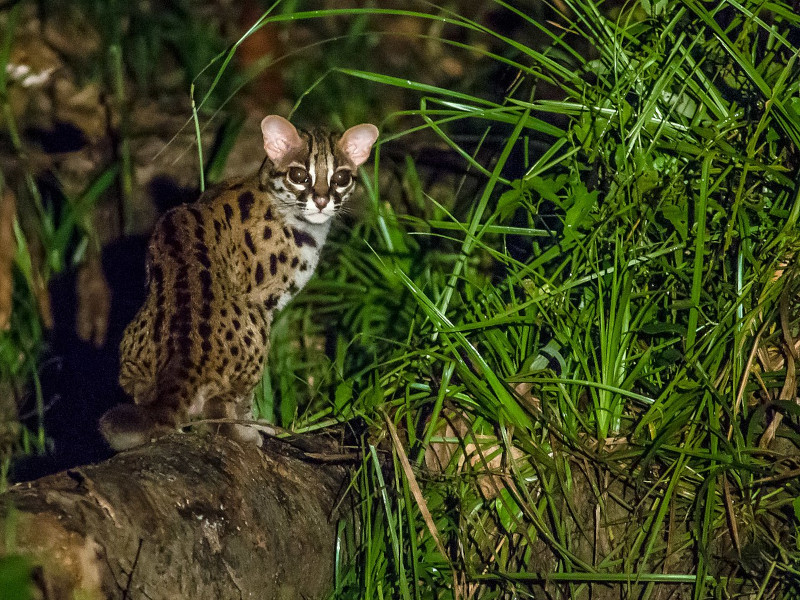
Leopard Cat Facts
- This tantalizing creation of Nature and evolution most frequently goes by the misleading common name of Leopard Cat across its native range. It does hold other titles, though. These include Bengal Cat, Asian leopard cat, Mainland leopard cat, and Jungle cat, among others.
- Within the hallowed halls of science, however, it’s perhaps much better known by its purely technical designation. Unfortunately, that one’s quite difficult for the layperson to pronounce. That’s because this marvelous mammal bears the formal moniker of Prionailurus bengalensis.
- The stunning feline received that eptithet due to the efforts of Robert Kerr. The esteemed Scottish surgeon and scientific writer recorded the first formal recognition of the animal as a separate and distinct species. He achieved that scientifically noteworthy deed in the year 1792.
- The amazing creature earns its fair share of interest among researchers. Previously, researchers considered there to be a startling total of 12 separate subspecies of this gorgeous wild cat. More recently, though, morphological research changed most of these to distinct species.
- Thankfully, the remarkable Leopard Cat appears to currently be maintaining a population base that’s both sufficient and stable. That pleasant state also seems to hold true throughout the entirety of its known range. The IUCN therefore presently lists the mammal as Least Concern.
- It nevertheless still faces the same potential threats to its continued existence as a species as all forms of life on earth today. Like them, the majority of the dangers it faces stem from the actions of manking. Chief among these perils stands habitat loss and ongoing climate change.
Related Articles
Leopard Cat Physical Description
The captivating Leopard Cat generally has exactly that effect on those individuals fortunate enought to encounter one of these wonders. It typically does so, however, due more to its visual appeal than any statistic of size. That’s because the animal ranks as a surprisingly small variety of wild cat.
It also follows an evolutionary pattern common among mammals, including its many kindred around the world. That’s the fact that it displays a certain degree of the physiological characteristic of sexual dimorphism. In its case, this trait manifests itself purely in terms of measurements.
Males usually attain a greater size in all respects than their female counterparts. These most commonly range in weight from 8.8 – 15.4 lb (4 – 7 kg). The females of the species generally remain much lighter. For that gender, a mean weight ranges from approximately 5.5 – 9.9 lb (2.5 – 4.5 kg).
Body length also differs between the two sexes of the feline. Among males, this typically ranges from roughly 19.7 – 25.6 in (50 -65 cm). Females reach a slightly shorter size than this. Among this gender, an average length of body measures within a range between 17.7 – 21.7 in (45 – 55 cm).
The tail, at least, reaches the same mean length for males and females alike. This appendage usually grows to somewhere between 9.8 – 13.8 in (25 – 35 cm). Shoulder height also measures about the same for all individuals. This physical aspect typically ranges between 10 – 14 in (25 – 35 cm).
Other forms of gender-based differentiation also appear within the intriguing species. These, though, tend to remain relatively minor. Males tend to have slightly larger skulls than the females. The former also most frequently develop more robust musculature in both the neck and shoulders.
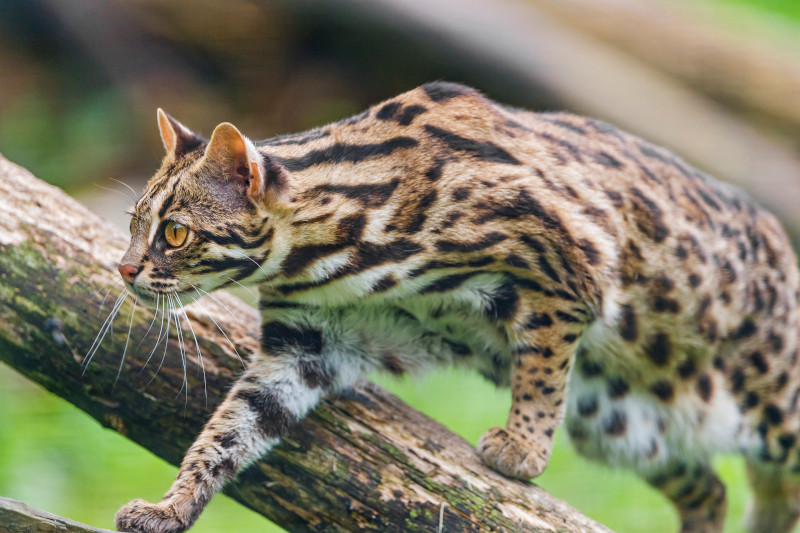
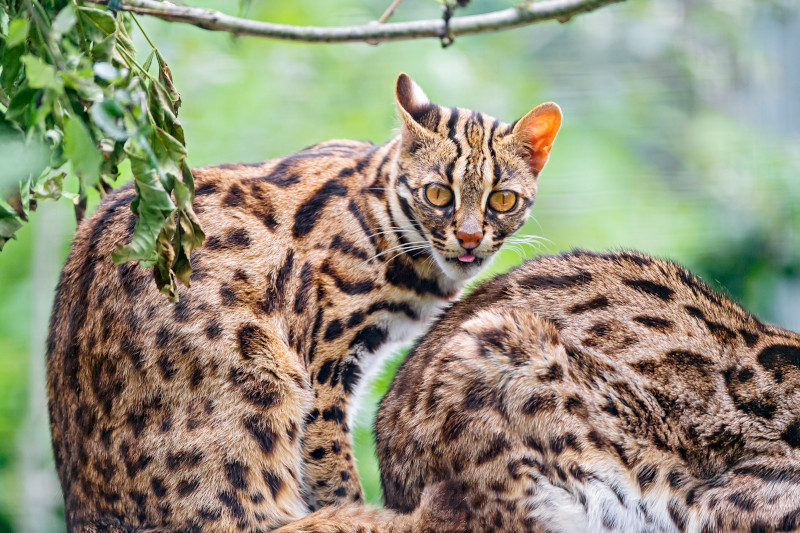
This is where the differences between the sexes of the beautiful Leopard Cat stop. Otherwise, both present the same outward appearance to the viewer. The color pattern of the mamal merits note, as well. The overall background pattern consists of an eye-catching yellowish-grey to reddish coat.
Beyond this, other, smaller details serve to augment its visual distinctiveness and appeal. Dark rosettes or spots appear at random locations, varying among specimens. The belly of the cat usually manifests an off-white shade. Two prominent black stripes also extend from the eyes to the ears.
- Kingdom: Animalia
- Phylum: Chordata
- Class: Mammalia
- Order: Carnivora
- Family: Felidae
- Genus: Prionailurus
- Species: P. bengalensis
Leopard Cat Distribution, Habitat, and Ecology
Truly impressively, the fabulous Leopard Cat evolved as indigenous to an extraordinarily broad expanse of the surface of the earth. In fact, this mesmerizing feline developed as native to a zone of habitation that ranks as one of the widest of any variety of wild cat in its entire region of the world.
The areas included in that range likely won’t surprise anyone, however, given its exotic nature. It includes most of north, south, east, and southeast Asia. In the northeastern part of this range, the animal’s known to currently live in the Russian far east, the Korean Peninsula, China, and Taiwan.
Meanwhile, in south Asia, it appears in India, especially in the Himalayan foothills, northeast states, and parts of the central and southern sections. It’s also in the nations of Nepal, Bhutan, Bangladesh, and Pakistan. Though historically present in Sri Lanka as well, its current status there’s uncertain.
Yet, Nature provided the marvel with an even greater range. That’s because its known territory extends further into other portions of the region. In the southeast, it’s known to still be extant within the borders of the countries of Myanmar, Thailand, Laos, Cambodia, Vietnam, and Malaysia.
Evolution also blessed this creature with an extremely high degree of adaptability regarding its choice of habitat. In fact, it remains one of the most habitat-flexible wild cats in Asia, thriving in a wide range of natural and human-influenced environments. This provides it with a great advantage.
It primarily inhabits regions of forest. That includes tropical and subtropical moist forests, as well as temperate broadleaf and mixed forests. Numereous regions comprised of both montane forests and dry deciduous forests additionally serve to complement this array of its preferred habitat.
Yet, it resides in many other ecosystems, too. These include logged forests, plantations, agroforestry systems, village edges, and even rural farmland. Grasslands, scrublands, wetlands, and riparian zones also serve well. It even ranges at heights extending from sea level to 9,800 ft (3,000 m).
The wonder plays an important role in the ecosystems it inhabits as a mesopredator by helping regulate populations of species such as rodents, birds, and reptiles. Its great adaptability, solitary nature, and nocturnal behavior shape its ecological interactions across a wide geographic range.
Like other felines, it evolved as carnivorous in nature. Its practices control populations of small vertebrates, particularly rodents, making it beneficial in agricultural landscapes. A typical diet consists of small mammals, mainly rodents, birds, reptiles, amphibians, fish, insects, and carrion.
The amazing Leopard Cat lives as principally nocturnal in nature, though some regions and habitats it’s sometimes crepuscular or occasionally even diurnal in its patterns. Most individuals live an extremely solitary life, with the exception being during mating or when females are raising kittens.
Breeding season varies by region, with some populations breeding throughout the year. Litter sizes average 2- 4 kittens, although sometimes more occur. Gestation takes roughly 60 -70 days, while weaning typically takes place at around three months of age, and sexual maturity at one year.
Species Sharing Its Range
Check out our other articles on 4 Fabulous North American Caves, Elk, Mahé, Achiote Tree, Spotted Eagle Ray, Texas Blind Salamander, Koa Butterfly, Emperor Penguin, Blue-lipped sea krait










Leave a Reply