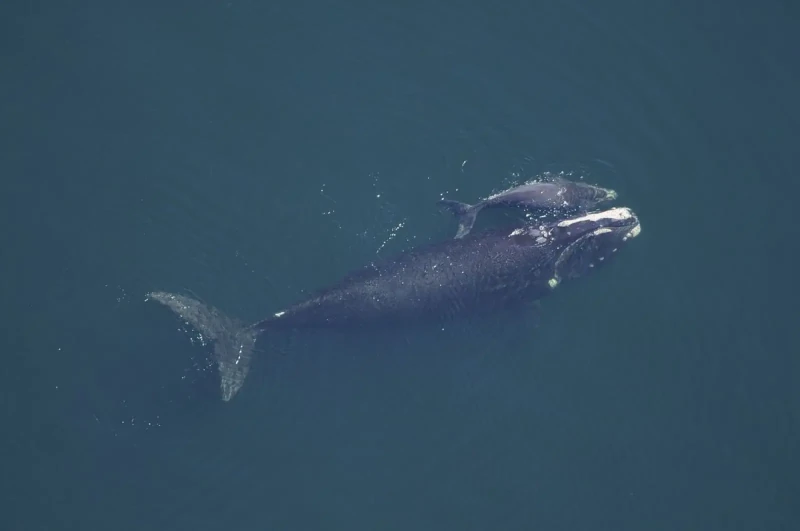
North Pacific Right Whale Facts
- The somewhat lengthy title of North Pacific Right Whale serves as the most frequently used common name for this true marine marvel. Yet, it does have a few other general titles by which it’s known. These include the terms Japanese right whale and Pacific right whale, among others.
- Within the scientific community, however, it’s possibly much better known by its purely technical designation. Fortunately, that’s a comparatively simple one for the layperson to pronounce. That’s because this wonder of Nature holds the formal tag Eubalaena japonica.
- The remarkable cetacean received that epithet due to the efforts of Bernard Germain de Lacépède. That rrespected French naturalist accomplished the first official recognition of it as a separate and distinct species. He achieved that scientifically noteworthy deed in the year 1818.
- Interestingly, the amazing product of Nature and evolution possesses two distinctly separate population groups. Evidence indicates that the smallest of these consists of fewer than 50 individuals. While somewhat larger, the second group nonetheless remains quite small.
- Taken together, the stunning North Pacific Right Whale finds facing an extremely dire situation. Its total numbers, already minimal, continue to decline. This lamentable state appears to hold true in both groupings. Accordingly, the IUCN now lists it as Endangered on its Red List.
- Although this fabulous mammal enjoys protected status, it nevertheless still faces multiple threats to its continued existence as a species. Like all forms of life on earth, the majority of these perils stem from the actions of man. They include habitat loss and climate change.
Related Articles

North Pacific Right Whale Physical Description
The aptly-named North Pacific Right Whale never fails to enthrall and fascinate those individuals fortunate enough to encounter one. Unlike some creatures, though, it does so for several reasons. It’s both a truly majestic species of fauna, and one possessed of impressive dimensions.
It also follows an evolutionary pattern common among mammals across the world. That’s the fact that it displays a certain amount of the physiological characteristic of sexual dimorphism. In its specific case, this natural trait manifests itself in terms of size, though the difference is minimal.
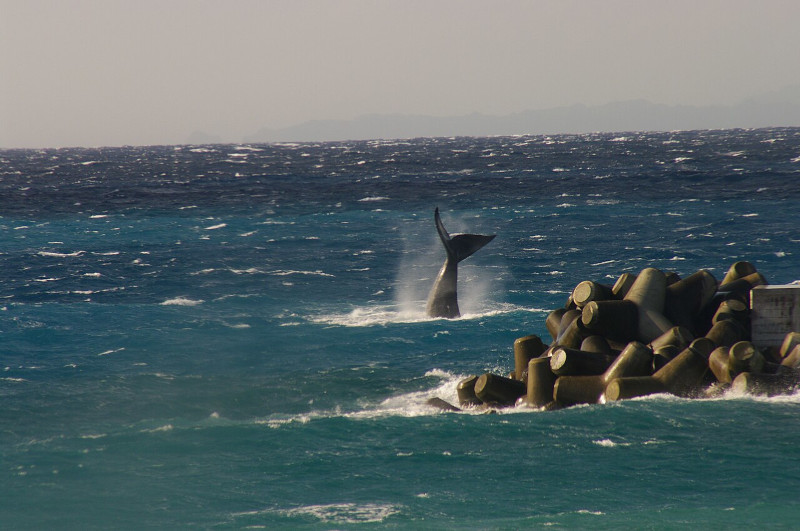
Overall, individuals of both genders develop a body shape best described as rotund and thicker than most whales. It has no dorsal fin or grooves under the throat, unlike rorquals like blue or humpback whales. The mammal also has broad, paddle-shaped flippers and a wide, notched tail fluke.
The powerful cetacean further evolved a covering of numerous baleen plates on each side of its body. Measuring up to 9 ft (2.8 m) in length each, every animal develops between 200 – 300 of these per side. In its coloring, this feature typically presents various dark shades unique to each specimen.
The rest of the body of the North Pacific Right Whale displays as mostly a dark gray to black in coloring. Some individuals have white patches on the belly or chin, but these are rare. The skin of this whale often appears rough or mottled due to the presence of callosities, scars, and parasites.
Yet, several features undoubtedly draw the most attention. One consists of an enormous, arched head, making up about one-third of the whale’s body length. The upper jaw, technically known as the rostrum, evolved as sharply arched, and holds many hundreds of its own long baleen plates.
Meanwhile, the previously mentioned callosites represent another distinctive feature that separates this creatue from its many relatives. These represent extremely roughened patches of skin, unique to each whale. They’re also often colonized by whale lice, which gives them a whitish appearance.
- Kingdom: Animalia
- Phylum: Chordata
- Class: Mammalia
- Order: Artiodactyla
- Family: Balaenidae
- Genus: Eubalaena
- Species: E. japonica
North Pacific Right Whale Distribution, Habitat, and Ecology
Historically, the North Pacific Right Whale held a territorial range that included a significant portion of the marine regions of the globe. The impressive cetacean once appeared throughout nearly the entire North Pacific Ocean, from the Sea of Japan, Okhotsk Sea, and Bering Sea in the west.
From there, though, that previous zone of habitation extended across to the Gulf of Alaska, Aleutian Islands, and down to Baja California in the east. It also frequently migrated between high-latitude feeding areas and lower-latitude breeding grounds within each of these separate regions.
Due to the near extinction of this wonder from 19th and 20th century whaling, its range has contracted greatly. The Western North Pacific population holds three confirmed areas of habitation. These zones consist of the Sea of Okhotsk, Eastern Russian waters, and offshore of Japan.
The smaller Eastern North pacific grouping, meanwhile, lives in just a few known small marine sections of the world. It’s present in the Bering Sea, particularly near Bristol Bay, the Gulf of Alaska, including Kodiak Island and south of the Aleutians, and along the west coast of the United States.
This breathtaking creation of eons of evolution displays a very specific set of preference regarding its choide of habitat types. That’s true since the whale inhabits marine environments that vary seasonally, reflecting its migratory behavior between feeding and potential breeding grounds.
During the summer and autumn, it primarily resides in its feeding habitat, mainly in high-latitude, cold, nutrient-rich waters with highly abundant zooplankton. Features common to this area typically include continental shelf and slope regions, cold water currents, and oceanographic fronts.
Inside of this section of the globe, certain geographical locations appear to be more favored than others, some mentioned earlier. These include the Bering Sea, especially the southeastern shelf, and Sea of Okhotsk. It’s also around the Aleutian Islands and the Northwestern Pacific, near Hokkaido.
Yet, in the winter, it migrates to its breeding habitat. That’s poorly known, but presumed to be in lower-latitude, warmer offshore waters. It’s known to favor shallow to mid-depth waters, reaching down no further than 4,921 ft (1,500 m). It also often appears over sandy or muddy bottoms.
The ecology of the fantastic North Pacific Right Whale centers on its specifc role within its region. There, it represents a large, slow moving baleen whale that feeds on zooplankton in cold, productive waters. It additionally serves as a key indicator species for ecosystem health in the North Pacific.
Though carnivorous in nature, it feeds entirely as what science calls a secondary consumer. Its prey principlly consists of extremely small copepods and krill. The massive mammal consumes these in vast quantities, utilizing skim feeding, filtering zooplankton through its many baleen plates.
It’s most commonly found either singly, or in small groups numbering no more than 3 individuals. Females generally give birth in warmer waters, and usually to a single calf. An estimated lifespan equals approximately 70 years, with sexual maturity occurring at roughly 10 years of age.
Species Sharing Its Range
Check out our other articles on 4 Fabulous New Zealand Flora, Mountain Hare, Amazon River, Douglas Iris, Weedy Seadragon, Indian Vulture, Fulvous Skimmer, Rose’s Ghost Frog, Black Caiman










Leave a Reply