Pawpaw Tree Facts
- This distinctive flora, little known outside its native range, most frequently goes by the somewhat strange sounding common name of the Pawpaw Tree. Yet, it does have a few other general titles. These options include the similar paw paw, paw-paw, and American pawpaw.
- Within the scientific community, however, it’s perhaps much better known by its purely technical designation. Thankfully, though, that’s an extremely simple one for the layperson to pronounce. That’s because the unusual Angiosperm holds the formal moniker Asimina triloba.
- The esteemed Swedish botanist, Carl Linnaeus himself made the first official recognition of it as a separate and distinct species. He achieved that scientifically noteworthy deed in the year 1753. However, at that time, he assigned the the plant the appellation Annona triloba.
- A French botanist, Michel Adanson, later reclassified this work of Nature and evolution into the genus Asimina, recognizing it as distinct from the tropical Annona species. At that time, he assigned it the epithet it holds today. He accomplished that renaming in the late 18th century.
- Fortunately, the intriguing Pawpaw Tree seems to be maintaining a population base that’s both stable and sufficient. That pleasant state also appears to hold true throughout its native range. The IUCN therefore currently list this appealing tree as Least Concern on its Red List.
- This remarkable flora nonetheless should be considered as facing several potential threats to its continued existence as a species. Like all forms of life on earth today, most of these stem from the actions of man. They include the related perils of habitat loss and climate change.
Related Articles
Pawpaw Tree Physical Description
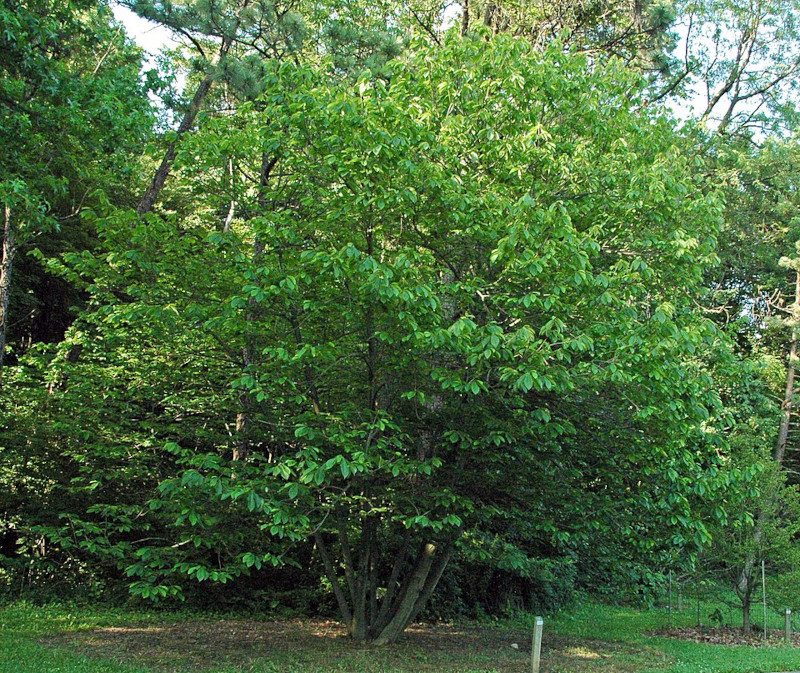
The fascinating Pawpaw Tree generally captures the attention of those individuals fortunate enough to encounter one of them. It doesn’t typically do so, however, due to any impressive physical statistics. That’s due to the fact that it often develops as either a large shrub or small deciduous tree.
Separate specimens vary significantly in terms of both their height and spread of their canopy. Vertically, most mature examples reach upward anywhere from 10 – 40 ft (3.1 – 12.2 m). Though its outward extension doesn’t vary quite so greatly, it still ranges from between 10 – 20 ft (3.1 – 6.1 m).
In either form, though, the bark it possesses presents some distinctive characteristics. In general texture, it develops as relatively smooth. Its coloring generally manifests as a grayish-brown shade. However, this same feature also usually shows a covering of numerous porous cells, called lenticels.
Its foliage also merits its own share of attention from viewers. The leaves evolved as simple, alternating structures. In shape, these generally develop as oblong, and range in length from 6 – 12 in (15 – 30 cm). These further present a bright green color in spring, that changes to yellow in Autumn.
The flowers of the lovely Pawpaw Tree also catch the eye. These cup-shaped wonders average between 1 – 2 in (2.5 – 5 cm) across, and have three outer petals and three inner one’s. In color, though, these wondrous blooms typically present charming shades of maroon to reddish-brown.
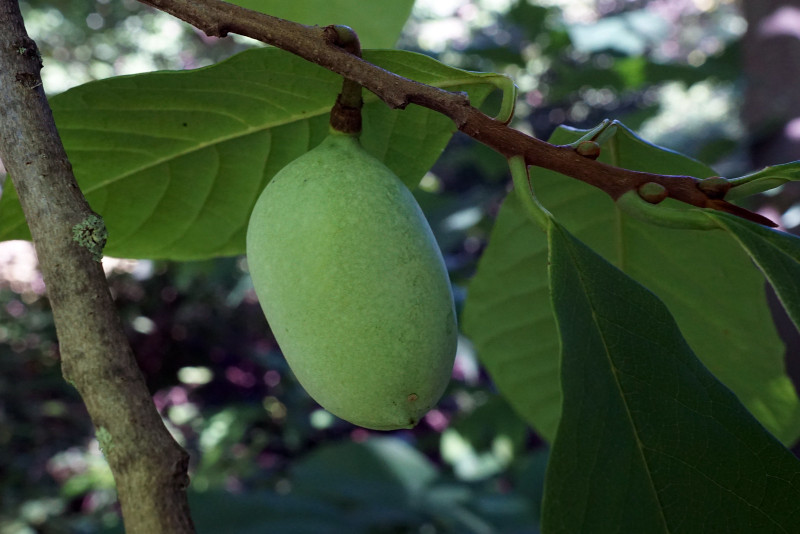
Nevertheless, it’s the fruit of this unique tree that garners the most interest. Technically, this actually represents a type of fleshy berry. This evolved to present a shape that ranges from oblong to kidney-shaped. Each individual fruit also averages between about 3 – 6 in (7 – 15 cm) in total length.
In color, each of these presents a light greenish shade while still unripe. Yet, as the fruit matures, this slowly changes to a yellowish or even brownish hue. Meanwhile, the sweet flesh varies in color from yellow to orange. Every individual also produces several large, brown, bean-shaped seeds.
- Kingdom: Plantae
- Phylum: Tracheophyta
- Class: Magnoliopsida
- Order: Magnoliales
- Family: Annonaceae
- Genus: Asimina
- Species: A. triloba

Pawpaw Tree Distribution, Habitat, and Ecology
The appealing Pawpaw Tree evolved as indigenous to a moderately broad expanse of the surface of the earth. That same area also remains well known for its abundance of natural wonders. The precise location of that native zone of habitation therefore likely won’t be a surprise to many people.
It developed as endemic to a specific portion of the continent of North America. In that greater landmass, it only appears naturally in the approximate eastern section of the landmass. That habitat range extends from Texas, in the United States, to as far north as Ontario, in the nation of Canada.
In the United States, its territory also extends somewhat westward, to a point. From the east coast, it ranges west into eastern Nebraska, Kansas, and eastern Oklahoma. Certain states contain the largest groupings, though. These areas consist of Ohio, Kentucky, Indiana, West Virginia, and Missouri.
Like many species, this amazing flora displays decidedly clear and strong prefrences regarding its choice of habitat. It appears almost exclusively within the confines of deciduous hardwood forests. There, this botanical marvel usually forms part of the understory layer beneath taller canopy trees.
Although as both a seedling and sapling, it’s fairly shade tolerant, it generally thrives at forest edges, openings, or cleared areas, since it needs more light to produce fruit properly. The remarkable plant also shows a clear favoristism for regions containing primarily moist, deep, well-drained soils.
Given this combination of factors, certain areas in forested regions predominate in its habitation. These include near streambanks and riverbanks. Others include moist hillsides and ravines, rich floodplains, and shady woodlots or thickets, often growing in colonies formed by suckers.
The eye-catching Pawpaw Tree plays a unique ecological role in the ecosystems of eastern North America that it appears in. Though it strongly resembles tropical plants in some ways, it’s native to temperate forests, and maintains several highly specialized interactions with its environment.
Unlike many flowering trees, it does not accomplish its pollination via the actions of bees. Instead, this flora achieves this through the visitation of various beetles and flies, especially carrion flies. Both of these are attracted by the dark maroon flowers and musky odor produced by its blooms.
Young trees have the ability to persist in shade for years, but require more sunlight to produce fruit. Since its natural pollination often remains insufficient, it also reproduces clonally through root suckers. When and where this occurs, it generally appears in relatively dense thickets or colonies.
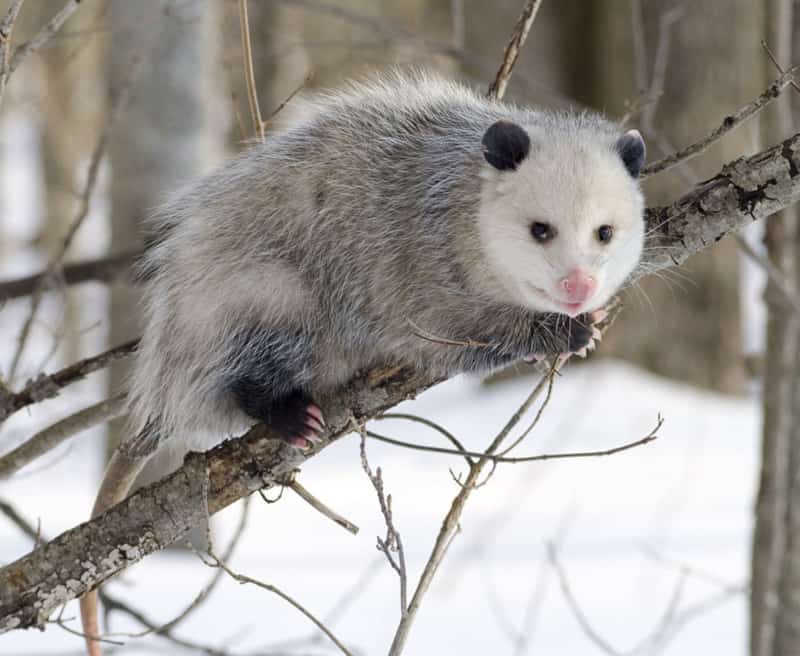
The fruit of this flora also plays a vital role in its local ecosystems. This portion of the tree is not only edible for humans and other animals alike, but high in energy and highly nutritious, as well. In Nature, mammals such as raccoons, foxes, and opossums often consume it and spread the seeds.
Its leaves do contain chemicals toxic to most insects, though. However, one species of butterfly evolved a special dependency with this plant. Its larvae feed exclusively on various Asimina species, including this one. These compounds protect the caterpillars and adult butterflies from predation.
Species Sharing Its Range
Check out our other articles on 5 Magnificent Mountains of Europe, Mountain Hare, Nile River, Lobster Claw Heliconia, Emperor Penguin, Goldentail moray, Emerald Ash Borer, Inland Taipan










Leave a Reply