
Rajah Pitcher Plant Facts
- This otherwordly variety of carnivorous flora most frequently goes by the informative common name of Rajah Pitcher Plant. Yet, it does have a few other general titles by which it’s known. These include King of Pitcher Plants, Borneo Pitcher Plant, and Sumatran Pitcher Plant.
- Inside of the scientific community, though, it’s perhaps much better known by its purely technical designation. Fortunately, that’s a comparatively simple one for the layperson to pronounce. That’s because the biological wonder holds the formal moniker Nepenthes rajah.
- The marvel of Nature received that specific epithet due to the efforts of Joseph Dalton Hooker. The highly respected British botanist recorded the first official recognition of it as a separate and distinct species. He accomplished that scientifically noteworthy deed in the year 1859.
- Regrettably, the amazing Rajah Pitcher Plant presently finds itself in moderately dire straits. It possesses both a small population in the wild, and an extremely limited natural habitat range. The flora does, however, also now exist in other parts of the world, due to cultivation.
- Accordingly, the IUCN now lists this remarkable plant as Endangered on its Red List. It faces numerous threats to its continued existence as a species. Most of these stem from the actions of man, and include the closely related perils of habitat loss and ongoing climate change.
Related Articles

Rajah Pitcher Plant Physical Description
The mesmerizing Rajah Pitcher Plant constitutes one of the most iconic and striking tropical pitcher plants. It’s renowned for both its massive size and unusual adaptations. This marvel therefore rarely if ever fails to capture the attention of those individuals fortunate enough to encounter one of them.
In terms of its general appearance, it evolved the ability to present itself in any of several forms. These varieties consist of either a terrestrial, climbing or scrambling plant, often growing low to the ground in the wild. It adapts itself in this regard to the surroundings within its local environment.
This wonder of Nature and botanical evolution also modifies itself as it progresses through different stages of its lifecycle. Young plants generally form a tight rosette of leaves, situated close to the ground. Meanwhile, more mature plants frequently send out climbing stems up to 10 ft (3.1 m) long.
The plant’s also well known for its distinctive leaves. This foliage develops as long, sword-shaped, and possessing a central midrib. In size, these typically attain a maximun length of 31 in (80 cm). Their coloring also stands out, being bright green with a red or maroon midrib in some individuals.
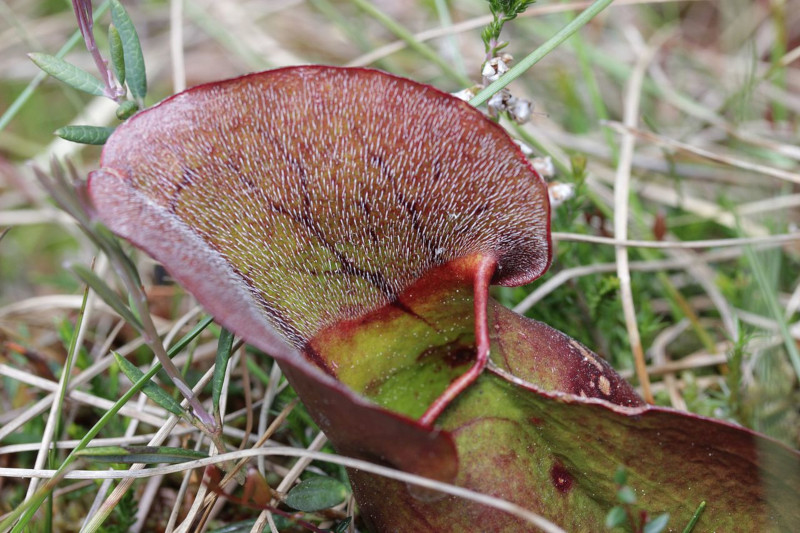
Yet, it’s doubtless the pitchers of the aptly-named Rajah Pitcher Plant that usually garner the most attention and respect from its admirers. This amazing feature develops the largest such structure of any of its relatives. This reaches up to 16 in (41 cm) in height, and holds up to 0.9 gal (3.5 L).
In shape, it evolved to display an oval to cylindrical form, with a wide mouth and flared lip known as a peristome. Its coloring often varies quite significantly, ranging from green to reddish or purplish, often mottled. In some individual specimens, the inside occasionally appears as slightly speckled.
Its lip also serves to distinguish it from many of its recognized kindred around the world. This part of the plant develops as notably broad and heavy, covering the opening and preventing rain from diluting digestive fluids. Fringed wings-like structures often run down the front of lower pitchers.
- Kingdom: Plantae
- Phylum: Tracheophyta
- Class: Magnoliopsida
- Order: Caryophyllales
- Family: Nepenthaceae
- Genus: Nepenthes
- Species: N. rajah

Rajah Pitcher Plant Physical Description
Lamentably, the extraordinary Rajah Pitcher Plant evoloved as indigenous to an extremely restricted and isolated portion of the surface of the earth. Given its exotic nature, the location of that zone of habitation likely won’t surprise anyone. That’s true since it’s native to one specific section of Asia.
There, this marvel of botanical evolutionary processes developed as natural to only the remarkable island of Borneo. Yet, even within this already severely limited habitat range, the stunning flora lives in just two know settings. Those consist of the amazing Mount Kinabalu and Mount Tambuyukon.
This captivating species has one of the most unique and specialized habitats among carnivorous plants in the entire world. It lives only in montane and subalpine regions of the mountains. In both locations, it appears solely at heights that range from 4,900 – 8,700 ft (1,500 – 2,650 m).
The plant displays astonishing preferences regarding its choice of habitat. It grows only in what experts call ultramafic soils, being rich in heavy metals like nickel, chromium, and magnesium, but poor in nutrients. These remain toxic to most plants, giving it a competitive advantage.
It also requires comparatively cool temperatures, ranging from 50F – 73F (10C – 23C). The wonder thrives in extremely high humidity, due to frequent cloud cover, rain, and mist. Yet, it also needs open, sunny environments such as steep slopes, ridges, and landslides, where cover’s minimal.
The ecology of the rajah Pitcher Plant qualifies as both remarkable and intricately adapted to its extreme, nutrient-poor habitat. Like others of its kind, it evolved carnivorous aspects to compensate for the extremely nutrient-poor nature of the soil of the surroundings in which it makes its home.
Its highly modified leaves form large, ground-level pitfall traps for its prey. This typically includes such fare as insects, spiders, small frogs. However, due to its great size, it occasionally consumes small mammals like rodents. It digests these using special enzymes and mutualistic microbes.
The marvel also forms a unique mutualistic relationship with tree shrews. While feeding, these defecate into the pitcher, and it digests the feces as a rich nitrogen source. This forms a nutritional symbiosis. It offers food in the form of nectar, and the animal returns nutrients via droppings.
This Angiosperm evolved as dioecious in nature, with male and female flowers growing on separate plants. Although researchers known little about its specific pollinators, it’s likely these include flies and beetles. The seeds eventually produced become dispersed short distances via the wind.
Species Sharing Its Range
Check out our other articles on 5 Fantastic Fauna of Tunisia, Humpback Whale, Salton Sea, Lobster Claw Heliconia, Emperor Penguin, Epirus Dancing Grasshopper, Spotted Seahorse, Gila Monster










Leave a Reply