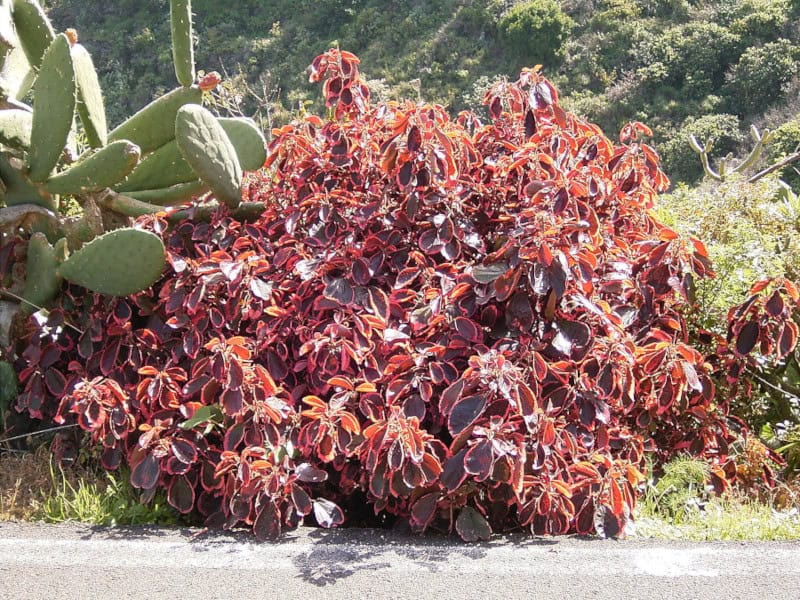
Copperleaf Facts
- The intriguing short term of Copperleaf represents the most frequently used common name this remarkable woody shrub. Yet, the wonder also possesses several alternate titles by which it’s known. These options include Jacob’s coat, Fire dragon plant, and Match-me-if-you-can.
- Within the scientific community, though, it’s perhaps markedly better known by its purely technical designation. Unfortunately, like many such tags, that’s one that’s difficult for the layperson to pronounce. That’s because it holds the formal moniker of Acalypha wilkesiana.
- The amazing flora received that hard to pronounce epithet due to the efforts of Johannes Müller Argoviensis. That respected Swiss botanist recorded the first official recognition of it as a separate and distinct species. He achieved that scientifically noteworthy deed in 1866.
- Modern history credits Captain Charles Wilkes of the United States Exploring Expedition, from 1838 – 1842, as the first outsider to view this marvel of Nature and evolution. However, the Indigenous Peoples of the region knew of its existence for untold centuries prior to that date.
- Thankfully, the fascinating Copperleaf seems to still be maintaining a population base that’s both stable and sufficient. That fortunate state also appears to hold true throughout the entirety of its range. Accordingly, the IUCN presently shows it as Least Concern of its Red List.
- The stunning creation of evolution nevertheless should still be considered as facing multiple potential threats to its continued existence as a species. Like all forms of life on earth today, most of these stem from the actions of man. They include habitat loss and climate change.
Related Articles
Copperleaf Physical Description
The fabulous Copperleaf typically grabs the attention and interest of those individuals who encounter one of these wonders. Unlike some related species around the world, though, it does not do so solely due to its distinctive appearance. That’s true since it also achieves a respectable size.
In all instances, this flora develops as a variety of evergreen shrub. Its form manifests as primarily erect, bushy in nature, and extremely densely branched. Average examples attain heights ranging from between 6.5 – 9.8 ft (2 -3 m). Exceptional specimens, however, sometimes reach 16.4 ft (5 m).
The stem and bark of this plant represent the first things that gain notice among viewers. The former begins as woody at the base, becoming softer and more flexible toward new growth. Meanwhile, the latter appears light brown to gray, smooth when young, slightly rough as it matures.
When they develop, the blossom of this species do so as unisexual, meaning separate flowers are either male or female. In appearance, each bloom remains quite small, inconspicuous, and lacks petals. Male blossoms appear in slender catkin-like spikes, usually up to 7.9 in (20 cm) in length.
Their female counterparts, though, evolved to present the same appearance, but to manifest in notably shorter spikes. Both genders of the flowers present the same basic color patterns to the observer. While these remain unobtrusive, their colors range from greenish to reddish hues.
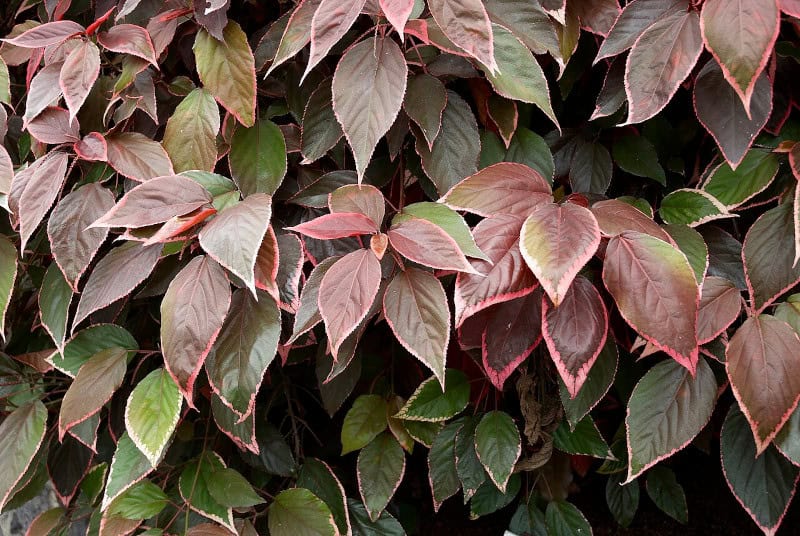
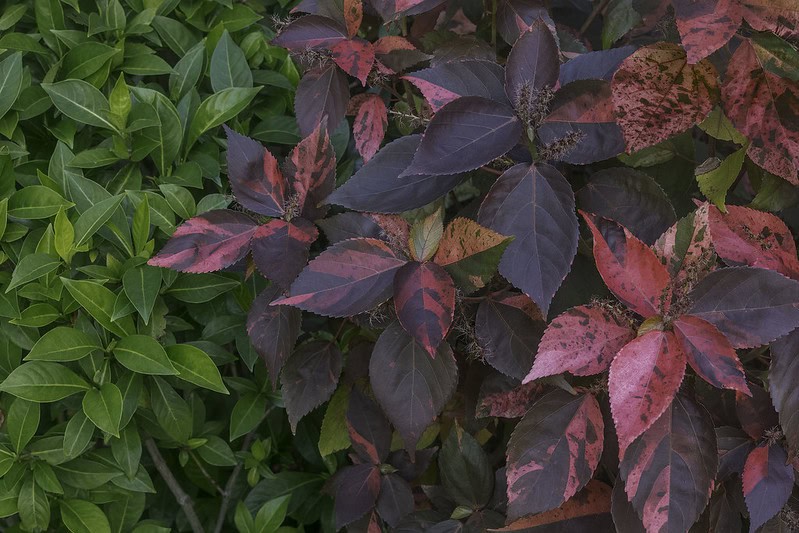
Uncommonly, it’s the leaves of the captivating Copperleaf that generally garner the most attention, being its most distinctive feature. These develop as relatively large, usually ranging from 3.9 – 7.9 in (10 – 20 cm) in length. Each leaf appears as mottled, blotched, or edged with contrasting colors.
This same foliage also has a broadly egg-shaped form, with the presence of serrated margins. Arranged in an alternating pattern along the stems, these have a leathery texture that’s rough to the touch. Their color’s also highly varied, including copper, bronze, red, pink, purple, green, or a mix.
- Kingdom: Plantae
- Phylum: Tracheophytes
- Class: Magnoliopsida
- Order: Malpighiales
- Family: Euphorbiaceae
- Genus: Acalypha
- Species: A. wilkesiana
Copperleaf Distribution, Habitat, and Ecology
The visually appealing Copperleaf evolved as indigenous to a comparatively small portion of the surface of the earth. In fact, the exact location of that native zone of habitation will probably surprise many of you. That’s true because it developed as native to only a small group of islands.
That same collection of locations themselves consist of just four groups of islands within one region of the South Pacific. Collectively, though, these do consist of dozens of separate islands. Those settings consist of New Guinea, Vanuatu, the Bismarck Archipelago and the Solomon Islands.
This marvel of Nature and botanical evolution displays decidedly clear and strong preferences regarding its choice of habitat. Given its territorial range, however, the nature of these isn’t surprising. The plant shows a powerful favoring of regions formed of warm, humid tropical settings.
Elevation also play an important factor in this manner. Examples principally appear at heights ranging from approximately sea level up to roughly 2,624 ft (800 m). Within this range and areas of these conditions, it mainly lives in either of three separate but related types of location.
The edges of tropical forests and mixed in with scrubby vegetation constitutes one of the primary regions where one finds this marvel. Another consists of sections of disturbed ground where sunlight’s abundant. It’s also often observed in areas of coastal lowlands and even village clearings.
Despite the comparatively small size of its flowers, the remarkable Copperleaf still draws a variety of pollinators to aid in its reproductive processes. It achieves this function mainly via the actions of insects, including local species of bees, butterflies, and flies. Hummingbirds also aid in this function.
While its leaves contain certain chemical compounds that deter many herbivores, it nonetheless plays an important ecological role in the ecosystems in which it appears. Among these stands the fact that its dense nature serves to provide both habitat and cover for small insects and birds.
The gorgeous Angiosperm also merits appreciation for yet another role that it plays. It represents an important member of the secondary forest vegetation in its environment. In each setting in which it makes its home, it’s also a major contributor to soil stabilization and microhabitat structure.
Species Sharing Its Range
Check out our other articles on 5 Lively North American Lizards, New Zealand Sea Lion, Cepkeiai Marsh, Cucumber Tree, Spiny Butterfly Ray, Bird Dung Spider, Little Auk, Keeled slug-eating Snake










Leave a Reply