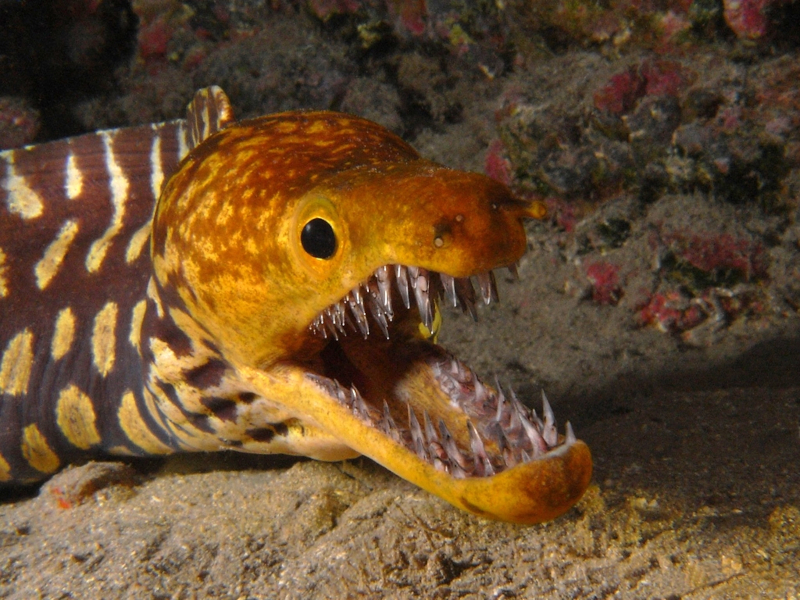
Fangtooth moray eel Facts
- This attention-grabbing creature most frequently goes by the descriptive common name of the Fangtooth moray eel. It does, however, also possess a few other general titles by which it’s sometimes known. These alternate terms include tiger moray and bird-eye conger.
- Inside of scientific circles, though, it’s perhaps much more often referred to by its purely technical designation. Unfortunately, like many such monikers, that’s one that’s difficult for the layperson to pronounce. That’s because it holds the cumbersome tag Enchelycore anatina.
- The marine marvel received that epithet due to the efforts of Richard Thomas Lowe. That highly respected English ichthyologist accomplished the first official recognition of it as a separate and distinct species. He achieved that scientifically noteworthy deed in the year 1838.
- Given its appearance, many individuals consider this wonder of Nature and evolution to be among the most striking of morays. Despite the scary face, though, it’s not usually aggressive toward divers unless provoked. The open-mouth posture for which it’s known isn’t a threat.
- Thankfully, the Fangtooth moray eel appears to be continuing to maintain a population base that’s both stable and sufficient. That pleasant state also seems to hold true across its entire range. The IUCN thus shows it as Least Concern on its Red List of Threatened Species.
- Nevertheless, the remarkable creature still faces multiple potential threats to its continued existence as a species. Like all forms of life on earth today, most of these dangers stem from the actions of man. They include the related perils of habitat loss and ongoing climate change.
Related Articles
Fangtooth moray eel Physical Description
Understandably, the incredible Fangtooth moray eel rarely if ever fails to immediately grab the attention and interest of those individuals who encounter one. Unlike some of its relatives around the world, however, it doesn’t do so only due to its appearance. It’s also a comparatively large eel.
In terms of any physical description, this marvel of eons of evolution also follows a pattern of natural development common among its kindred. That’s the fact that, unlike many species on earth, this marine-dwelling animal displays no evidence of the physiological trait of sexual dimorphism.
Both genders of this fascinating species therefore achieve the same general body shape, having the long, slender, and flexible body typical of eels, shaped like a ribbon or snake. Though most examples remain slightly shorter, some individuals reach total lengths equaling approximately 4 ft (1.2 m).
Its body also tapers gradually toward the tail, which lacks scales and possesses a relatively smooth, slimy skin that helps it glide through rocky crevices. Despite its rather impressive length, though, it remains surprisingly light. Typical specimens only weigh somewhere between 4.4 – 6.6 lbs (2 – 3 kg).
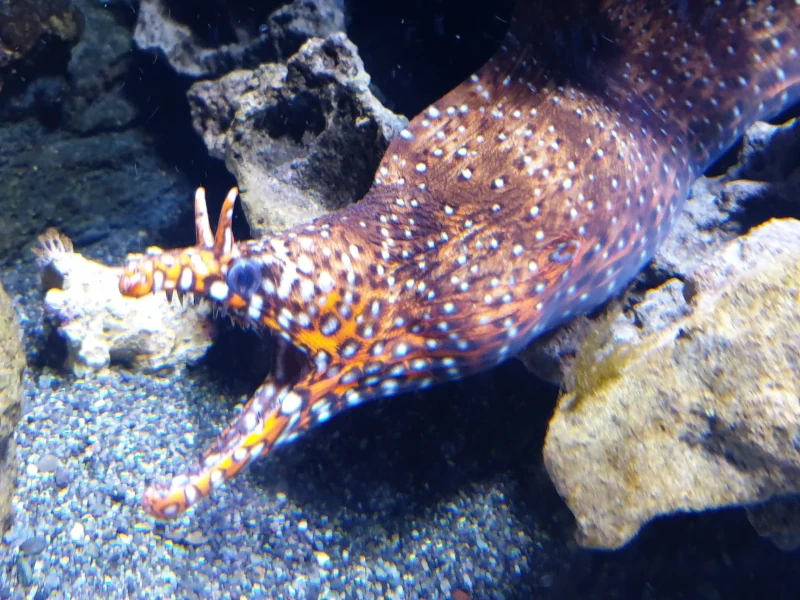
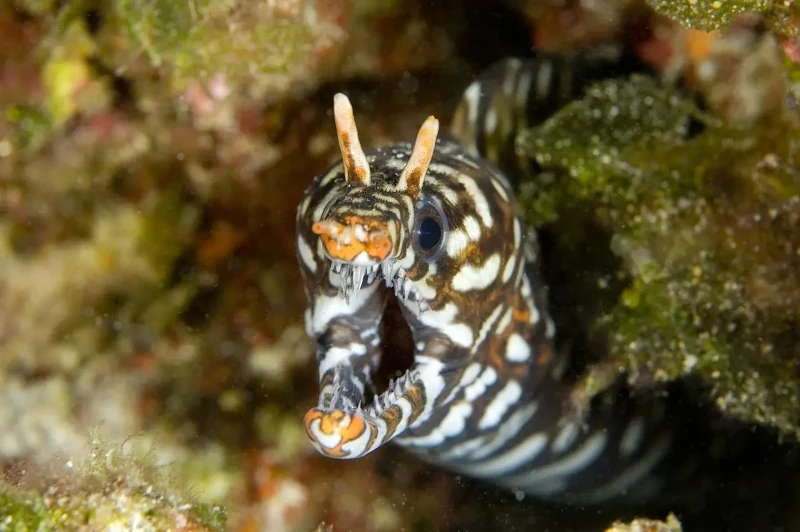
The head evolved as elongated and narrow, with a distinctly arched jawline, ans small dark eyes. Its large, curved, glasslike teeth remain its most famous feature, though. These develop as slender, sharply pointed, and so long that it can’t close its mouth. Incredibly, they’re also fully transparent!
Yet, the coloring of the body of the Fangtooth moray eel also merits note. The body varies from reddish-brown to orange or yellowish-brown, depending on habitat and lighting. It’s also covered with irregular yellow or white spots and lines, which sometimes form faint reticulated patterns.
The head itself frequently appears bright yellow or golden, contrasting with darker areas located near the gill openings and along the back. The inside of the mouth, meanwhile, shows as relatively pale in comparison to the rest of the body, making the fangs even more visible when open.
Like all morays, it lacks pectoral and pelvic fins. The dorsal fin runs continuously from just behind the head, merging with the caudal and anal fins into one long ribbon-like fringe along the body. The dorsal fin occasionally has a slightly darker or lighter edge, adding to the eel’s pattern contrast.
- Kingdom: Animalia
- Phylum: Chordata
- Class: Actinopterygii
- Order: Anguilliformes
- Family: Muraenidae
- Genus: Enchelycore
- Species: E. anatina
Fangtooth moray eel Distribution, Habitat, and Ecology
The intriguing Fangtooth moray eel evolved as indigenous to a moderately broad swathe of the marine regions of the world. Precisely where that native zone of habitation lies, however, most likely won’t surprise many people. The marvel’s endemic to approximately half of the Atlantic Ocean.
Within the general confines of the Eastern Atlantic, the amazing fish primarily appears along the coasts of Portugal, the Azores, Madeira, the Canary Islands, and the Cape Verde Islands. Albeit in smaller numbers, though, the intrepid creature also lives along parts of the coast of western Africa.
It also lives in the Western Atlantic, and in roughly the same concentrations as in the eastern part of that body. There, it lives from Bermuda and south Florida, in the United States, through the Caribbean Sea, including the Bahamas, and along the north coast of South America to at least Brazil.
This fascinating creation of Nature and evolution displays decidedly strong and clear preferences regarding its choice of habitat. Although it chooses to live in a number of slightly different settings, each of them obviously shares a number of basic qualities that serve to meet its precise needs.
It’s most commonly found around rocky substrates, coral reefs, and underwater caves. The fish also demonstrates a clear favoritism for such locations as crevices, overhangs, and holes in various rocks or corals. It typically dwells at shallow depths ranging from between 10 – 260 ft (3 – 80 m).
The highly evolved Fangtooth moray eel plays an important ecological role in the reef ecosystems and many similar areas in which it appears. As a chief predator within these differing ecosystems, the powerful animal helps maintain balance in the local fish and crustacean populations.
Due to its size, the carnivore qualifies as a secondary predator. Its diet mainly includes small fish, crustaceans, and occasionally cephalopods. Being principally nocturnal in nature, it usually hunts its food at night, and does so as an ambush predator, hiding in crevices and lunging at passing prey.
In turn, the species also faces its own share of natural predators, especially given its relative size. These hunters include larger fish, such as groupers and barracudas. Sharks, like the Tiger Shark and Caribbean reef shark also prey on it. Larger moray species occasionally attack smaller individuals.
Its reproductive processes aren’t well documented, but it’s assumed they’re similar to other morays. If so, males and females release sperm and eggs simultaneously into open water. Fertilization thus occurs externally, during spawning seasons, influenced by temperature, lunar cycles, or tides.
Species Sharing Its Range

Check out our other articles on 3 Remarkable North American Rodents, Eastern Small-Footed Bat, Dead Sea, Scarlet Elf Cup, Teddy Bear Bee, Chinese Giant Salamander, Keeled slug-eating Snake










Leave a Reply