
Morskie Oko Facts
- This stunning creation of natural proceses and the passage of time most frequently goes by the simple name of Morskie Oko. Yet, it’s also had other titles throughout history by which it was known. Those older options included Meerauge, Sea Eye, and Morskie Oko w Tatrach.
- This marvel of Natue and geology wasn’t discovered in the classical sense of the term. Local inhabitants of the surrounding region knew of its presence for countless centuries. However, no single individual or group holds historical credit for being the first to sight the wonder.
- The first known recorded mentioning of it, though, occurred in the year 1565. At that time, the remarkable feature appeared in an official document describing property boundaries between the two countries along whose mutual borders the beautiful lake approximately lies.
- This product of natural processes did become rediscovered, in a sense, albeit for tourism, much later, though. That happened due to the efforts of Dr. Tytus Chałubiński, a Polish naturalist. For that purpose, it saw the first shelter constructed along its boundaries in 1836.
- Fortunately, Morskie Oko now enjoys a certain amount of protection from the depredations of man. It now sits within the confines of the Tatra National Park. Founded in 1954, the laws governing its creation provide for the protection of all nature found inside its borders.
- Later, UNESCO also named the park a Biosphere Reserve. Nonetheless, the majestic feature still faces potential threats to its pristine state. Most of these derive from the actions of man. Even given the protections, massive tourism endangers its state, along with climate change.
Related Articles

CCL: https://tinyurl.com/44ka7ja6
Morskie Oko Physical Description
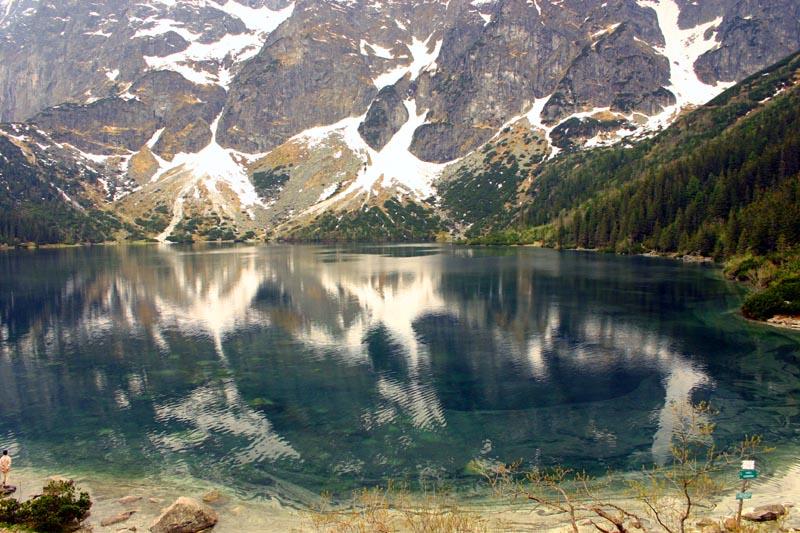
The breathtaking Morskie Oko never fails to immediately capture the full attention from those individuals fortunate enough to view it. Yet, it typically does so more for its incredible beauty than because of imposing size. That’s because, despite its appeal, it’s a physically small body of water.
Naturally, it has an irregular shape and outline, as most such bodies of water. Its maximum measured length equals roughly 0.54 mi (0.86 km). The greatest recorded width, though, equals around 0.35 mi (0.57 km). These provide the lake a surface area of about 0.135 sq mi (0.35 sq km).
This spectacular setting also demonstrates a comparatively shallow depth. Again, like most such similar constructs of earth’s Nature, this aspect of it naturally varies, at times significantly. To date, however, the deepest known spot in the entire tarn only plunges down to roughly 167 ft (50.8 m).
Regardless of all these important statistics, however, the gorgeous Morskie Oko holds numerous other characteristics which serve to set it apart. The lake’s bowl-shaped depression formed surrounded by steep rocky walls, a classic situation for mountain lake formations across the globe.
Many of these, in fact, tower over the body of water. Rysy, standing 8,212 ft (2,503 m) tall, ranks as the tallest in the country in which it sits. Nearby, Mięguszowiecki Szczyt Wielki also rises over it, jutting up 7,999 ft (2,438 m). Likewise, nearby Mnich stands 6,785 ft (2,068 m) over the marvel.

Morskie Oko Location, Formation, and Ecology
The mesmerizing Morskie Oko formed in a region of the earth’s surface already strongly associated with numerous other natural works of art. Precisely where Nature created it therefore likely won’t surprise anyone. It sits within a specific portion of the always beautiful continent of Europe.
In general, its location places the lake inside the confines of the stunning Tatra Mountains. Its exact geographical placement puts it within the national borders of the country of Poland. The wonder lies in the Rybi Potok Valley, a branch of the Białka Valley, on the Polish side of the High Tatras.
That placing also puts it at the foot of the Mięguszowiecki Summits, in addition to being directly below the aforementioned Rysy. The surface of the tarn itself also sits high in the mountains. That altitude equals approximately 4,577 ft (1,395 m) above sea level on average, though it varies.
This majestic glacial lake formed thousands of years ago during the last Ice Age. As glaciers moved through the Rybi Potok Valley, they carved out a deep, bowl-shaped depression. When the climate warmed and the glaciers retreated, meltwater filled this, creating the lake as we see it today.
Thick mountain glaciers inexorably flowed down from the surrounding Tatra peaks. The huge ice sheets carried rocks and debris, which scraped and deepened the valley floor. The glacier carved out a U-shaped valley and a hollow basin at its head, a structure known to science as a glacial cirque.
As the massive glacier slowly melted, it also left behind enormous quantities of rock and sediment. These acted as natural dams, trapping meltwater in the basin. That meltwater, rainfall, and mountain runoff slowly filled the basin, forming the cold, clear, high-altitude lake as it exists today.
The cold, clear, oxygen-rich water of Morskie Oko itself supports only a few hardy species adapted to high-altitude conditions. Nevertheless, a few fish varieties live in it. These largely consist of brown trout and brook trout. Occasionally sticklebacks and other mountain stream fish also appear.
The territory surrounding its waters, however, teems with life, both flora and fauna. On the lower slopes, forests of Norway spruce thrive. The higher slopes support Dwarf mountain pine and alpine shrubs. Meanwhile, the rocky upper slopes abound with mosses, lichens, and hardy alpine plants.
The surrounding forests and cliffs host multiple rare and protected mountain species. Mammals include Red deer, foxes, marmots, pine martens, Brown bear, and the Eurasian lynx. Multiple species of amphibians and reptiles also live here, including the Common frog and the Viviparous lizard.
Not surprisingly, the region immediately surrounding the lake also supports a vast variety of avians. These local inhabitants include the Golden eagle, Common raven, and the Ring ouzel. Impressively, the area also serves as home to a population of Wallcreeper, a beautiful but rare alpine bird.
Features Sharing Its Region
Check out our other articles on 5 Wonderful Canadian Woody Shrubs, Striped Possum, South Georgia Island, Sandbox Tree, Epirus Dancing Grasshopper, Oceanic whitetip shark, Inland Taipan










Leave a Reply