

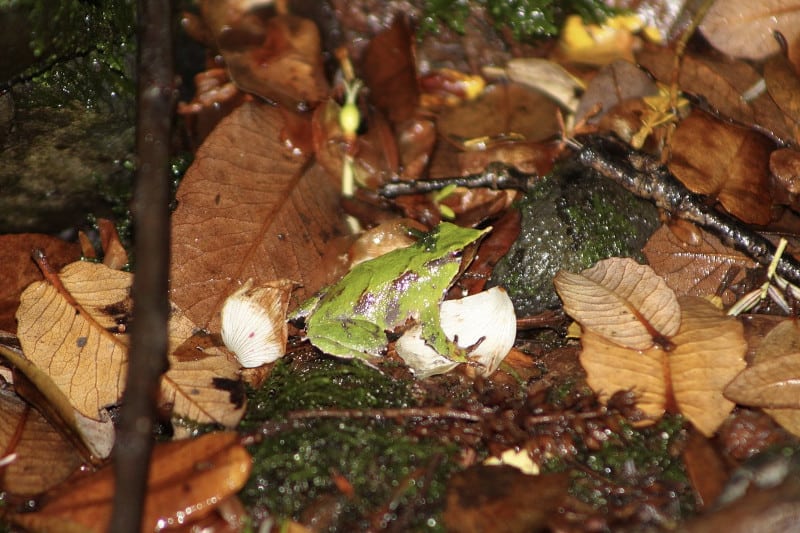
Southern Darwin’s Frog Facts
- This remarkable wonder of Nature and evolution most frequently goes by the intriguing common name of the Southern Darwin’s Frog. It also holds that particular moniker for interesting reasons. For the moment, though, the wonder has no other widely accepted name.
- Among scientists, however, it’s possibly much better known by another title. That’s the purely formal, technical name for the amazing species. Like many creatures known to science, though, that’s somewhat hard to pronounce. It holds the formal name of Rhinoderma darwinii.
- It received that tongue-twisting name due to a combination of efforts. The highly esteemed English naturalist, Charles Darwin, discovered the creature in 1841. French zoologist, André Marie Constant Duméril and his assistant, Gabriel Bibron later named the animal, though.
- Regardless of which term one chooses to use, it remains an intriguing animal. It evolved a trait that possibly makes it completely unique. A genetic cousin shared the trait, but’s believed extinct. Males of the species carry the tadpoles within the vocal sac, under their throat!
- Sadly, though, the population base of the remarkable Southern Darwin’s Frog is now declining rapidly. This unfortunate situation also seems to hold true throughout the entirety of its known range. The IUCN, therefore, now lists the animal as Endangered on its published Red List.
- The distinctive fauna now faces numerous threats to its continued existence as a species. Many of these dangers stem directly from the actions of man. Habitat loss and degradation due to human expansion currently endanger it. It also faces the danger of ongoing climate change.
Related Articles
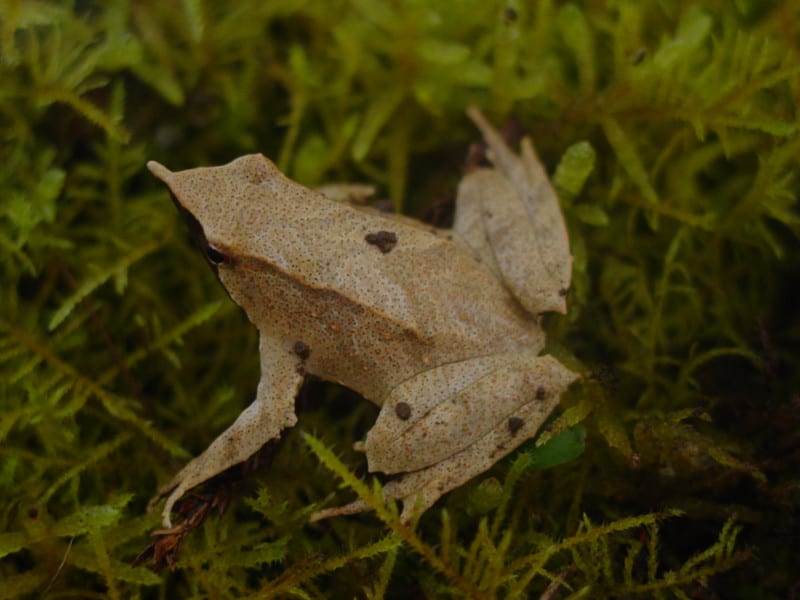
Southern Darwin’s Frog Physical Description
The stunning Southern Darwin’s Frog fascinates those individuals who actually encounter it. The amazing animal does so, however, for reasons beyond its unique pattern of brooding behavior. That’s true since this marvel of Nature intrigues one due to its sheer physical appearance, as well.
Like many of its relatives around the world, it also displays a moderate degree of sexual dimorphism. In its specific case, this physiological trait manifests itself in terms of appearance, rather than simple size. Individuals of both genders attain roughly the same physical measurements.
Despite its mulitple other unique attributes, this marvel remains a very small variety of frog. Specimens of both sexes reach an average body length ranging from only 0.9 – 1.2 in (2.2 – 3.1 cm). This includes the snout, which also has an unusual feature. It’s elongated into a fleshy proboscis.
Amazingly, compared to similar creatures, its legs actually evolved as comparatively slender and long in nature. Among the studied examples, its front feet display no sign of webbing. Yet, most individuals of the species possess this structure on a few of the toes on both their small hind feet.
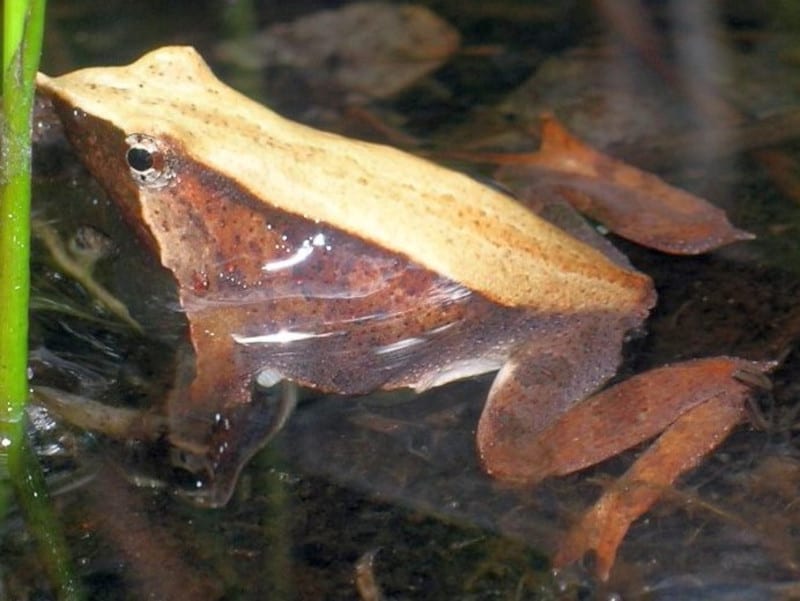
The genders of the Southern Darwin’s Frog distinguish themselves in coloring, however. Females of the spcies typically present either a brown or green underside. Some of those examples showing the brown shade also present other patterns. These include faint V-shaped marks on the back.
Males, meanwhile, vary far more in their coloration. These individuals often present mostly or entirely as green on the upperside. The throat, in contrast, commonly shows a brownish hue. Much of the underside further manifests as black, with large white spots in completely random patterns.
- Kingdom: Animalia
- Phylum: Chordata
- Class: Amphibia
- Order: Anura
- Family: Rhinodermatidae
- Genus: Rhinoderma
- Species: R. darwinii
Southern Darwin’s Frog Distribution, Habitat, and Ecology
The fabulous Southern Darwin’s Frog evolved as endemic to a relatively small portion of the world. That region’s also already renowned for its abundance of natural wonders. That’s because this marvel of evolution developed in the area that’s now the continent of South America.
Even there, though, the awesome amphibian only appears in a very small swathe of the continent. All known sightings of this rare amphibian occurred in the countries of Argentina and Chile. For the moment, no evidence of the unique creature ever appearing outside of that small range exists.
It also displays clear and strong preferences regarding its choice of habitat. The vast majority of known individuals live within the boundaries of the Valdivian Temperate Rain Forest. It most often inhabits forested areas and glades. It lives at altitudes up to 3,600 ft (1,100 m) above sea level.
Most frequently it makes its home in a variety of ecosystems. These regions usually include areas of coarse woody debris, mossy areas, and grasslands. The presence of bushes and small trees appears to augment its survivability. Slow moving streams and bogs also seem to be a clear favorite.
Intriguingly, the Southern Darwin’s Frog developed a widely varied diet. Due to this adaptation, it feeds on a broad range of small local invertebrate species. Its native habitat seerves to provide it with an abundance of prey. Like many related animals, it primarily feeds as an ambush predator.
Subsequent to mating, the females typically lay anywhere from 4 – 10 eggs. Exceptional broods, though, occasionally total as many as 40 of these. Males usually only have the ability to brood 5 – 8 tadpoles at a time, however. An average lifespan for this impressive species seems to be 10 – 15 years.
Species Sharing Its Range
Check out our other articles on 4 Charming Christmas Season Species, Blue Footed Booby, Macquarie Island, Golden Shower Tree, Rough-nosed Horned-lizard, Giant Swallowtail