
Coralberry Facts
- The short yet colorful term of Coralberry serves as the most frequently used common name for this amazing variety of flora. It does, however, have several other titles by which it’s known. These options include Indian currant, Buckbrush, and Devil’s shoestring, among others.
- Within the scientific community, though, it’s perhaps better known by its entirely technical designation. Unfortunately, that’s one that remains extremely difficult for the layperson to pronounce. That’s because the plant holds the formal tag Symphoricarpos orbiculatus.
- It received that tongue-twisting epithet due to the efforts of Conrad Moench. That respected German botanist accomplished the first official recognition of the Angiosperm as a separate and distinct species. He achieved that scientifically noteworthy deed in the year 1794.
- In addition to its visual appeal, this wonder of Nature and evolution also once played a role of moderate distinction in the lives of local populations of Indigenous Peoples. Some groups once used parts of the plant medicinally, though the berries aren’t considered safe for ingestion.
- Thankfully, the Coralberry appears to be continuing to maintain both a stable and sufficient population base. That pleasant state also seems to hold true across the entirety of its native range. The IUCN thus currently has no listing of it on their Red List of Threatened Species.
- Nonetheless, the remarkable plant still faces numerous potential threats to its continued existence as a species. Like all forms of life on earth today, most of these dangers stem from the actions of mankind. They include the related perils of habitat loss and climate change.
Related Articles


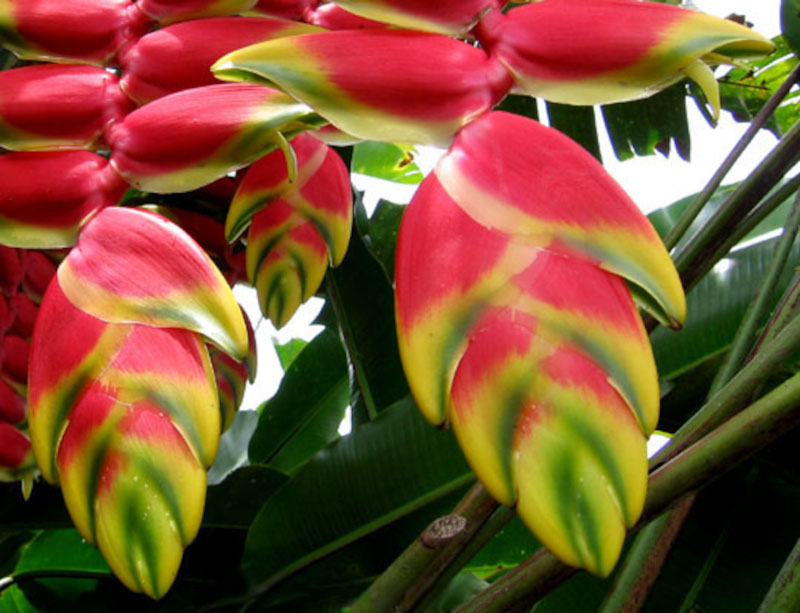

CCL: https://tinyurl.com/mrx5uknb
Coralberry Physical Description
The beautiful Coralberry generally appeals to those individuals fortunate enough to encounter it in its natural setting. It does so, however, due to a combination of several reasons. Obviously, its appearance plays a role in this, but it also impresses viewers with some respectable dimensions.
This botanical beauty develops as a variety of deciduous woody shrub. Typical specimens attain a height ranging from between 2 – 5 ft (0.6 – 1.5 m). Most reach a greater width than height. A typical spread measures approximately 6 – 8 ft (1.8 – 2.4 m), thus forming a comparatively dense mound.
Given that construction, the plant produces a prodigious number of slender, flexible, opposite-branching stems. When young, the bark on these appears greenish-brown to reddish, with a smooth texture. As these age, though, they become gray-brown, and slightly shredded or scaly with maturity.
The leaves also merit note. This foliage evolved in a pattern of pairs of the opposite sides of the stem, and possessed of an oval to nearly rounded shape. Each averages roughly 1 – 2 in (2.5 – 5cm) long. The upper surface shows a medium to dark green, while the underside is paler, with fine hairs.
Doubtless, however, it’s the gorgeous flowers of the Coralberry that garner the most attention. These develop in small clusters located near the tips of the stems. Each remains small, and with a tubular or bell-shaped form. The stunning colors range from a pale pink to a greenish-white shade.
Its fruits, meanwhile, evolved as clustered, berry-like drupes, not technically being true berries. Each of these shows a bright coral-pink to purplish-red color. These small parts of the flora only reach a mean diameter equaling about 0.25 in (6 mm). They’re also mildly toxic in nature to humans.
- Kingdom: Plantae
- Phylum: Tracheophyta
- Class: Magnoliopsida
- Order: Dipsacales
- Family: Caprifoliaceae
- Genus: Symphoricarpos
- Species: S. orbiculatus

Coralberry Distribution, Habitat, and Ecology
The eye-catching Coralberry evolved as indigenous to a comparatively broad swathe of the surface of the earth. Precisely where that native zone of habitation lies, though, likely won’t surprise anyone. That’s because Nature created it as endemic to a large portion of the continent of North America.
The vast majority of its population appears within the confines of the United States. It’s extremely common in both the central and eastern portions of the nation. There, it’s found from Texas and Florida north to South Dakota, Minnesota, and New York. It’s also frequent in the Great Plains area.
The plant also appears abundantly in Midwest and Ozarks, especially in Missouri, Arkansas, Kansas, and Oklahoma. It’s less common, though present, in the southeast. In the northeastern regions, however, the botanical marvel only makes occasional appearances in scattered individual locations.
Yet, it also resides in other countries, too. To the north, the woody shrub stretches its territory into southern Ontario, in Canada. To the south, meanwhile, the species appears in scattered concentrations in northern Mexico, primarily in the northern Coahuila and Tamaulipas areas.
Like many of its kindred around the world, this incredibly evolved flora displays an impressive degree of versatility regarding its choice of habitat in which to live. Due to this great flexibility, it’s frequently observed inhabiting a remarkable variety of different locally present ecosystems.
This versatile, hardy shrub thrives equally well in a variety of both upland and lowland habitats. It’s common along the edges of deciduous forests and savannas, where light is filtered but not dense. It also grows in sunny, well-drained grasslands or transitional zones between prairie and woodland.
The plant tolerates the shallow, rocky soils and dry upland conditions prevalent on rocky hillsides and slopes. On occasion, it inhabits the moist soil of stream banks and ravines, though it favors drier settings. It even quite readily colonizes such locations as roadsides and abandoned fields.
The beautiful Coralberry represents a native deciduous shrub that plays an important role in woodland, prairie-edge, and thicket ecosystems throughout both central and eastern North America. It also serves as a stabilizing, sheltering, and transitional species, thriving in many environments.
It forms dense colonies and thickets through root suckering and layering stems. These provide ground cover that helps prevent soil erosion, particularly on slopes and stream banks. It acts as an understory shrub in savannas and open woodlands, helping to structure the vertical habitat layer.
Like the great majority of all flowering plants, it accomplishes its pollination via the actions of numerous locally common insects. The small, tubular pink flowers attract a range of native bees, butterflies, and sometimes hummingbirds in summer. Many animals spread the seeds via droppings.
In the areas in inhabits, it plays a vital role in the local ecosystem. The berries persist into winter, being eaten by some birds, like the Northern bobwhite, American robin, and Brown thrasher when other food’s scarce. Dense thickets also provide excellent nesting and shelter for small songbirds.
Rabbits and small mammals use coralberry thickets for protection from predators, as well, further enhancing its usefulness. Deer occasionally browse young stems and leaves, though the plant remains moderately resistant to heavy browsing. It also hosts the larvae of certain moth species.
Species Sharing Its Range
Check out our other articles on 3 Remarkable North American Rodents, Eastern Small-Footed Bat, Melnik Earth Pyramids, Cucumber Tree, Teddy Bear Bee, Wolf Eel, Earless Monitor Lizard










Leave a Reply