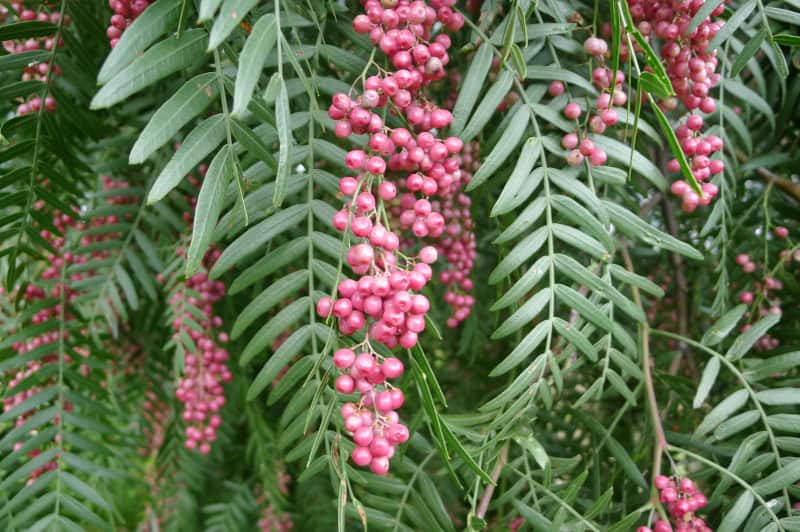
Peruvian peppertree Facts
- This colorful creation of Nature and evolution most often goes by the informative common name of the Peruvian peppertree. It does have numerous other titles by which it’s known, though. Those include false pepper, peppercorn tree, Peruvian mastic, and pepperini.
- Inside the hallowed halls of science, however, it’s possibly better known by its purely technical designation. Fortunately, that’s a comparatively easy one for the layperson to pronounce. That’s because this botanical wonder presently bears the formal moniker of Schinus molle.
- The Angiosperm received that particular epithet due to the efforts of Carl Linnaeus himself. That eminently respected Swedish researcher recorded the first official recognition of it as a separate and distinct species. He accomplished that scientifically noteworthy deed in 1753.
- This marvel of botanical development stands out in the annals of science due to a special distinction. Though it does produce spicy, pepper-like fruits, it’s not actually a member of that group. As an excellent example of convergent evolution, it uses a different chemical pathway.
- Thankfully, the amazing Peruvian peppertree seems to be continuing to maintain a population base that’s both sufficient and stable. This pleasant state also appears to exist throughout the entirety of its known native range. As a result, the IUCN now shows the flora as Least Concern.
- Nonetheless, it should still be considered as facing multiple potential threats to its continued existence as a species. Like all forms of life on earth today, most of these stem from the actions of mankind. These dangers include habitat degradation or loss, and ongoing climate change.
Related Articles

Red Maple
Peruvian peppertree Physical Description
The remarkable Peruvian peppertree typically captures the attention of those individuals fortunate enough to encounter one. Unlike some its many relatives around the world, though, it does not do so due to its beauty alone. The marvel also boasts some highly respectable physical dimensions.
Individual specimens of the species often vary greatly in height, largely due to local environmental factors. The majority of specimens reach upward around 19.7 ft (6 m) at full growth. Exceptional examples of this botanical wonder, however, occasionally stretch that to as much as 50 ft (15 m).
Among the physically distinctive characteristics of this flora, the nature of its outer bark frequently receives a high degree of notice. This usually develops as rough, fissured, and grayish to brown, becoming more textured with age. Younger branches tend to be smoother and more flexible.
The upper branches of this tree have a tendency to droop, due to the large number of leaves it produces. This foliage develops on opposing sides of a long thin stem. Each stem ranges in length from 3.15 – 9.8 in (8 – 25 cm), and the 9 – 41 clustered leaves average 1.6 – 3.5 in (4 – 9 cm) wide.
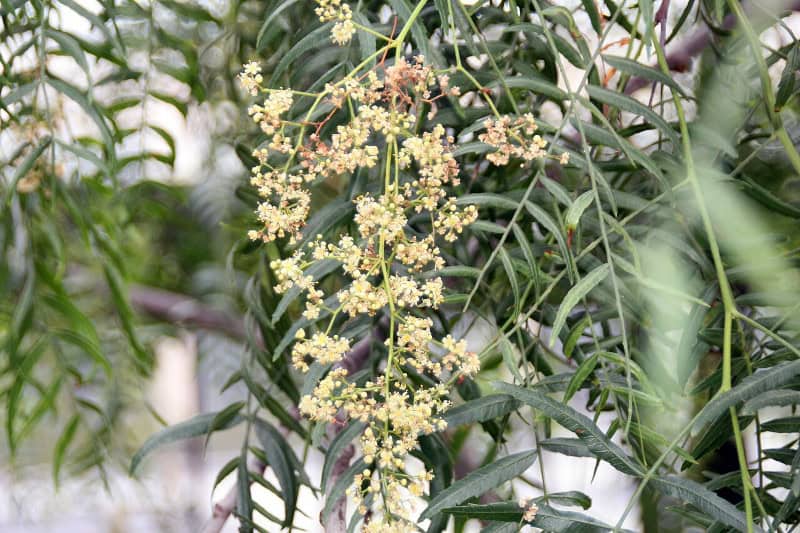
The blooms of the lovely Peruvian peppertree appear as either male or female, depending on the individual tree. These evolved as small, white, and borne profusely in panicles at the ends of the drooping branches. Occasionally, though, these bloom as pale yellow or even slightly greenish.
It’s most generally the fruit that garners the most interest, however. This feature matures as a small, rounded berry. Individually, they average only 0.2 – 0.28 in (5 – 7 mm) in diameter. In terms of their coloring, these usually vary between shades, ranging from light pink to a deep reddish hue.
- Kingdom: Plantae
- Phylum: Tracheophyta
- Class: Angiosperms
- Order: Sapindales
- Family: Anacardiaceae
- Genus: Schinus
- Species: S. molle

Peruvian peppertree Distribution, Habitat, and Ecology
The captivating Peruvian peppertree evolved as endemic to a comparatively small portion of the surface of the earth. That same region of the globe already remains known for its abundance of other natural marvels. The general area in which it appears, though, likely won’t come as a surprise.
That’s because its general name provides a clear clue to that portion of world. It developed as indigenous to limited section of South America. Within that greater zone of habitation, however, the amazing plant only appears natively in the parts of the western and central areas of the landmass.
To the knowledge of researchers, that section consists solely of specific parts of the nations of Peru, Chile, Argentina, and Bolivia. The botanical wonder has, however, been introduced into numerous areas of the world with the proper climate. That includes the United States, Mexico, and Australia.
Following an established pattern common to many varieties of flora, it displays markedly strong and clear preferences regarding its choice of habitat. It’s naturally adapted to various types of dry, open, and often extremely rugged environments. That’s especially true of South America’s Andean region.
It commonly thrives in warm to hot climates, with seasonal drought conditions, such as dry, Andean valleys. The intrepid species also favors areas with low to moderate rainfall; often semi-arid scrublands. Rocky slopes and hillsides exposed to high levels of sunlight also form a preference.
Each of these separate ecosystems provide it with its most basic environmental requirements. It prefers well-drained, even poor or rocky soils. The plant also tolerates both drought and high salinity well. Given these traits, the Eudicot often thrives in regions where most other trees struggle.
The ecology of the Peruvian peppertree evolved to be strongly shaped by its adaptation to extremely dry, disturbance-prone environments. Within these habitats, it plays a number of vital ecological roles within them. Its extensive root system helps reduce erosion in dry, fragile landscapes.
The remarkable plant provides shade and shelter for a wide variety of creatures in otherwise open, sun-exposed environments. Its dense, drooping foliage offers nesting and roosting sites for birds in arid zones. These eat the bright red “peppercorn” fruits and spread the seeds over long distances.
The distinctive foliage, being evergreen in nature, allows for year-round photosynthesis in stable warm climates. It achieves its pollination via the activities of many locally prevalent insect species. These principally consists of different species of bees and flies, with no degree of specialization.
Species Sharing Its Range


Check out our other articles on 5 Particularly Pleasing Pines, Ethiopian Highland Hare, Hukou Waterfall, Hellbender Salamander, Rabbitfish, Basket Stinkhorn, Golden Eagle, Chinese Alligator










Leave a Reply