
Candy-Striped Leafhopper Facts
- This dazzling creation of Nature and evolution most often goes by the descriptive common name of the Candy-Striped Leafhopper. Yet, it also has other titles by which it’s known. These include red-banded leafhopper, scarlet-and-green leafhopper, and red-and-blue leafhopper.
- Within the scientific community, however, it’s perhaps much better recognized by its technical designation. Unfortunately, that term’s one that remains extremely difficult for the layperson to pronounce. That’s because it holds the formal moniker of Graphocephala coccinea.
- It received that somewhat tongue-twisting epithet due to the efforts of Johann Reinhold Forster. That respected German naturalist accomplished the first official acknowledgement of it as a separate and distinct species. He achieved that scientifically noteworthy deed in 1771.
- This amazing inverebrate stands out in the halls of science for at least two reasons. Presently, entomologists recognize a total of three distinct subspecies of the insect. Sadly, though, it’s also known to be one of the carriers of a bacteria that’s especially harmful to some plants.
- Thankfully, the remarkable Candy-Striped Leafhopper appears to be maintaining both a stable and sufficient population base. This pleasant state also seems to hold true across the entirety of its territory. Accordingly, the IUCN does not currently place it on the published Red List.
- Nevertheless, the wonder should still be considered as facing multiple potential threats to its continued existence as a species. Like all forms of life on earth today, most of these dangers stem from the actions of man. They include both habitat loss and ongoing climate change.
Related Articles

Candy-Striped Leafhopper Physical Description
The brilliantly-hued Candy-Striped Leafhopper generally captures the attention and interest of those fortunate individuals who spot one. It does so, however, due more to its appearance than any impressive statistics. That’s true since this remarkable insect remains quite small in terms of its size.
Regarding any physical description, the creature follows a pattern of natural development typical among its kindred. That’s the fact that it displays almost no noticeable amount of the physicological characteristic of sexual dimorphism. Distinguishing the genders visually thus becomes difficult.
Individuals of both sexes of this invertebrate manifest the same general pattern of coloring. Females potentially measure slightly larger on average, but the difference remains small and inconsistent. These also have a broader abdomen than males, along with and a visible ovipositor at the end.
Otherwise, the two genders usually present the same appearance to the observer. On average, examples attain a total body length equaling approximately 0.25 in (6 – 7 mm). Each also evolved to have a notaby slim, elongated wedge-shaped body, typical of leafhoppers found around the world.
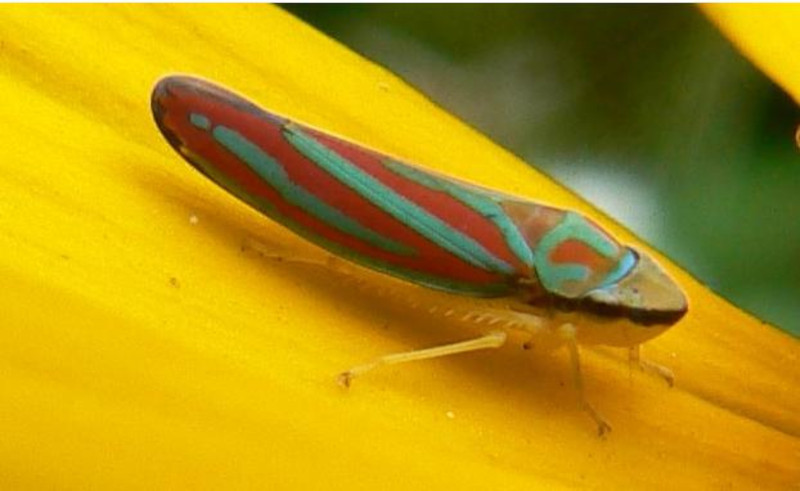
Doubtless, though, it’s the coloring of the lovely Candy-Striped Laefhopper that usually garners to most appreciation. It typically represents one of the most colorful of its relatives found in its region of the world. That primarily consists of a bright turquoise or blue-green base color on the wings.
Not to be outdone, however, two bold, diagonal red or orange stripes running across each forewing, giving it the candy-striped name. Meanwhile, the head often appears either yellowish or greenish. Sharply contrasting this, the underside of the insect usually presents a comparatively pale shade.
Its body structure also merits note. The wings fold tent-like over the body when at rest. Its legs developed as adapted for jumping, and its hind legs remain strong and spined. Typical of its kind, the antennae appear short and slender. Its eyes also evolved as very dark and relatively small in size.
- Kingdom: Animalia
- Phylum: Arthropoda
- Class: Insecta
- Order: Hemiptera
- Family: Cicadellidae
- Genus: Graphocephala
- Species: G. coccinea

Candy-Striped Leafhopper Distribution, Habitat, and Ecology
The enchanting Candy-Striped Leafhopper evolved as indigenous to a comparatively wide range of the surface of the earth. Precisely where that native zone of habitation lies, therefore, probably won’t surprise anyoone. It developed as native to a wide portion of the continent of North America.
The majority of its population, though, appears within the borders of the continental United States. It’s very common from the Northeast through the Mid-Atlantic, Southeast, and Midwest. Yet, it also lives in in parts of both the Southwest and West Coast, though less abundant than in the east.
Further north, the wonder of Nature and evolution lives in parts of southern Canada. There, it mainly resides in Ontario and Quebec, with scattered sightings placing it farther west in warmer regions. To the south, the creature also lives in the northern sections of the country of Mexico.
Fortunately, this intriguing product of eons of natural development manifests a high degree of flexibility regarding its choice of habitat. It thus appears in a wide range of local ecosystems. Each of these does, of course, maintain a similarity when it comes to certain environmental conditions.
It occupies a broad range of sunny, vegetated habitats. These include gardens and landscaped areas, where it’s common on ornamentals such as roses. It additionally strongly favors areas of meadows and grasslands, especially where various wildflowers and herbaceous plants remain plentiful.
Still other areas include forest edges and clearings. There, it prefers open, sunlit areas rather than dense forest. Shrublands and hedgerows also frequently attract the insect. Even agricultural settings often attract it. It enjoys vineyards and orchards, as well as fields with flowering plants or weeds.
The fascinating Candy-Striped Leafhopper serves a surprisingly vital purpose in Nature. The wonder actually plays several ecological roles within the ecosystems that it chooses to inhabit. Its ecology centers on sap-feeding, plant interactions, predator–prey dynamics, and disease transmission.
It feeds on what’s called the xylem sap of a wide variety of plants. Like other leafhoppers, it uses piercing–sucking mouthparts to tap into plant tissue. Because xylem sap remains low in nutrients, it consumes large amounts, producing abundant watery excrement, often known as leafhopper rain.
Given its diminutive size, the colorful creature serves as prey for a large number of predators. These mostly include spiders, assassin bugs, and damsel bugs. Lady beetles, green lacwing larvae, and many small birds feed on them. Jumping spiders are often particularly adept at ambushing them.
Females of the species lay eggs inside plant tissue using the ovipositor. The nymphs develop as completely flightless, feeding openly on leaves and stems. Under warm conditions, it has the ability to produce multiple generations per year, making them common throughout the growing season.
Species Sharing Its Range
Check out our other articles on 5 Captivating North American Wildcats, Eastern Small-Footed Bat, Amazon River, Bamboo Orchid, Teddy Bear Bee, California Two-Spot Octopus, Black Caiman










Leave a Reply